
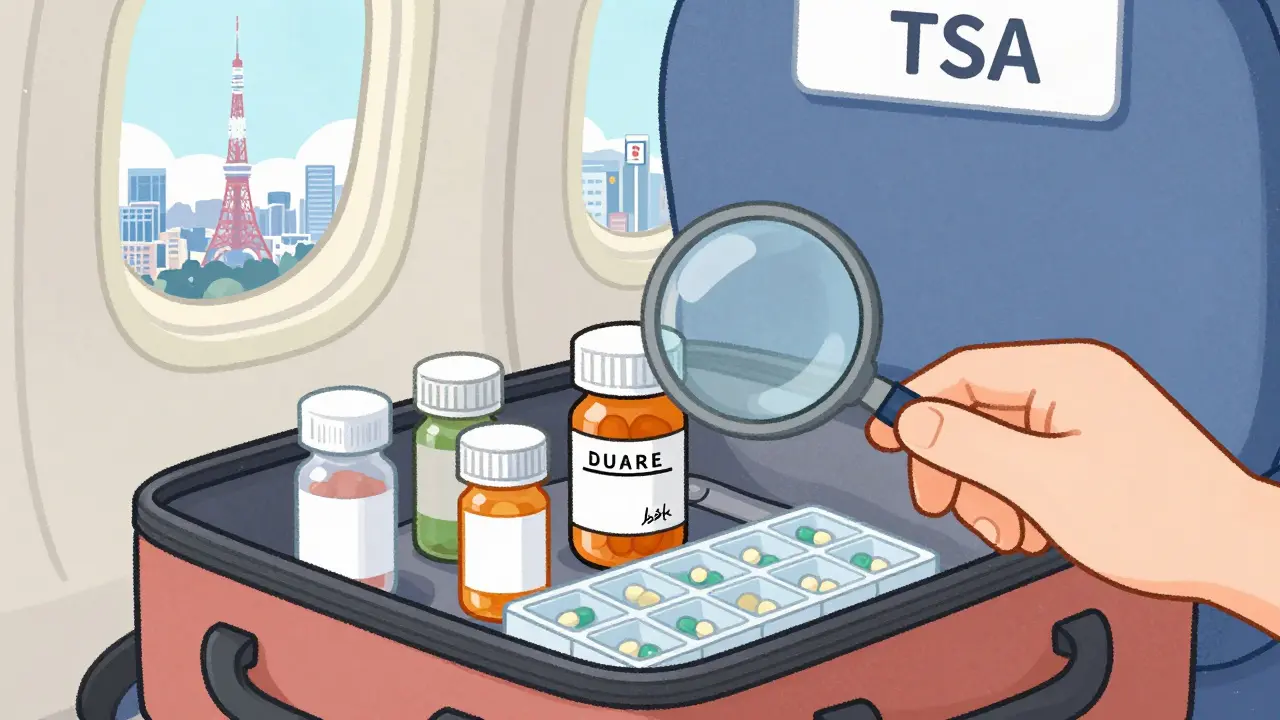
It’s January 2026. You’re packing for a trip to Tokyo, and you’ve got your passport, your boarding pass, and your pills in a little plastic case. You feel ready-until you remember: should your meds be in the original bottles? The answer isn’t as simple as you might think. While the TSA says you don’t have to keep them in pharmacy-labeled containers, skipping this step could cost you time, money, or even your medication at customs.
Why Original Containers Matter More Than You Think
The Transportation Security Administration (TSA) doesn’t require you to keep your pills in their original bottles. That’s the official line. But here’s the catch: TSA doesn’t control what happens after you clear security. State laws, international border agents, and even airline staff all have their own rules-and most of them demand original packaging. Think of it this way: a pill in a clear plastic case looks like any other pill. A pill in a bottle with your name, the pharmacy’s stamp, the doctor’s signature, and the dosage instructions? That’s verifiable. It’s not just about security-it’s about proof. If you’re flying into Japan and carrying a cold medicine with pseudoephedrine, you could be stopped. That same medicine is illegal there. If your bottle has a U.S. pharmacy label, you can explain it. If it’s in a travel case with no label? You’re out of luck. The Cleveland Clinic and the American Society of Health-System Pharmacists both say the same thing: keep your meds in original containers whenever possible. Why? Because it makes screening faster, reduces the chance of confiscation, and protects you legally. A 2023 study by the International Association for Medical Assistance to Travelers found travelers with original containers had 73% fewer delays at customs than those using pill organizers.What the TSA Actually Allows (and What They Don’t)
Let’s clear up the confusion. The TSA permits you to bring any amount of solid medication-pills, capsules, tablets-in your carry-on. No limit. No need for a prescription label. You can even use a pill organizer. But here’s what they don’t say: that you’ll be treated the same way everywhere else. Liquid medications are different. You can bring more than 3.4 ounces (100ml) of liquid medicine, but you must tell a TSA officer at the start of screening. Don’t wait for them to ask. Say it upfront: “I have medically necessary liquids.” Ice packs for temperature-sensitive drugs are allowed too, but they also need to be declared. Never put meds in checked luggage. Temperature swings in the cargo hold can ruin insulin, epinephrine, or other sensitive drugs. United Airlines and the International Air Transport Association both warn that over 17% of medications in checked bags experience unsafe temperature changes.State Laws in the U.S. Are a Patchwork
Even within the U.S., rules vary. Thirty-seven states, including California, New York, and Texas, require prescription medications to be in their original containers with the pharmacy label attached. In these states, carrying pills in a travel case could technically be illegal-even if TSA lets you through. Twelve states, like Florida and Illinois, follow only federal guidelines and don’t require original packaging. But here’s the problem: you can’t know which state you’ll be passing through if your flight has a layover. And if you’re pulled over by local law enforcement? They’re not bound by TSA rules. They follow state law. One wrong move, and you could face questioning-or worse. The safest path? Always keep your meds in original bottles. It’s the only way to cover all bases.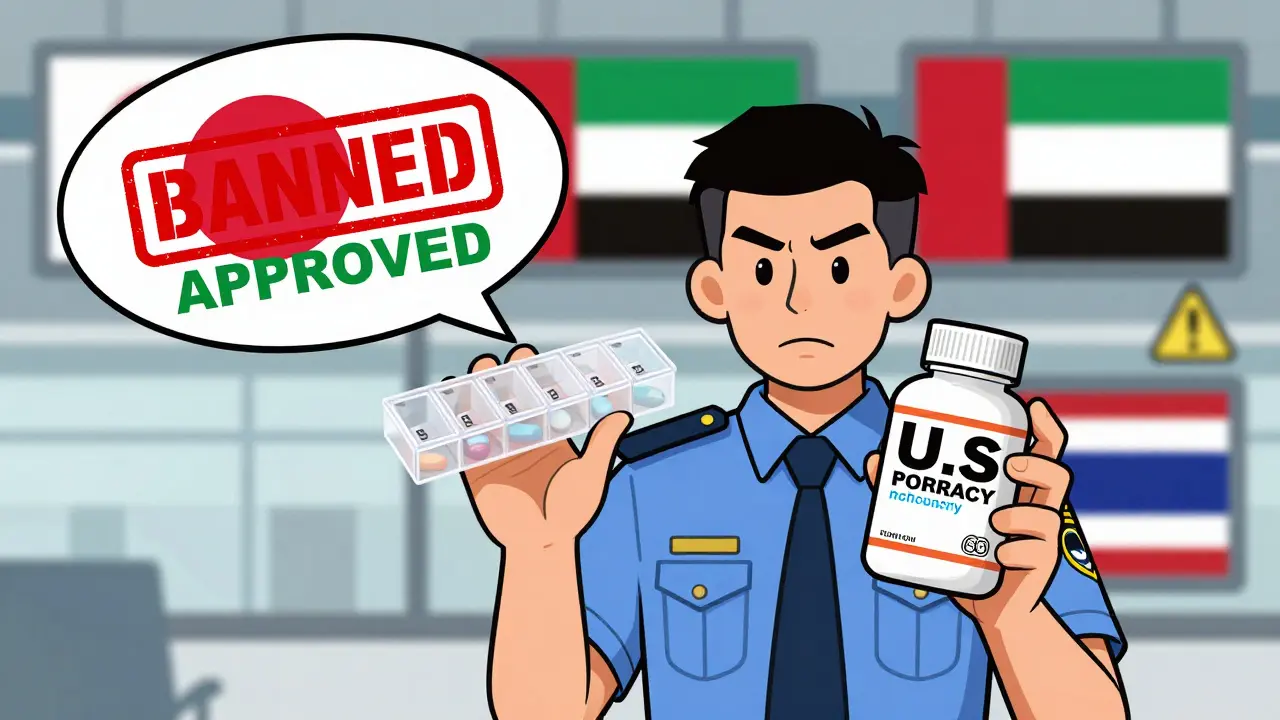
International Travel? It’s a Different World
This is where things get serious. Over 187 countries have specific rules about bringing in medications. Some ban common U.S. drugs outright. - Japan: Pseudoephedrine (Sudafed), codeine, and ADHD meds like Adderall and Ritalin are illegal without a special permit. Even with a prescription, you can only bring a 30-day supply. - United Arab Emirates: Codeine, oxycodone, and benzodiazepines like Xanax are controlled substances. You need a letter from your doctor and your original bottle. - Thailand: Any medication containing codeine or tramadol requires a prior permit. No exceptions. - United Kingdom: You can bring a 30-day supply of most prescription drugs, but anything stronger requires a license. Over-the-counter painkillers with codeine? Limited to 100 tablets. The U.S. Department of State reports that 47% of medication-related travel incidents in 2023 involved drugs that were legal in the U.S. but banned abroad. In Mexico, travelers who presented meds in original containers with a doctor’s letter had a 68% lower chance of being denied entry.What to Pack: The Checklist
Here’s what you actually need to bring:- Original prescription bottles with pharmacy labels (name, drug, dosage, prescriber, date)
- A copy of your prescription (printed, not just a photo on your phone)
- A letter from your doctor on official letterhead. Include: your name, condition, medication names (generic and brand), dosage, reason for use, and the doctor’s license number and contact info
- Extra medication-at least 3-5 days beyond your trip length. Delays happen.
- For liquids: Declare them at the security checkpoint. Keep them in a clear, sealed bag.
- For temperature-sensitive meds: Talk to your pharmacist about storage. Use a cooler with ice packs (declare them). Never check them.
- For pill organizers: Only use them as a supplement. Keep the original bottles in your carry-on. Label the organizer with the drug name, dose, and frequency.
What If You Can’t Keep Them in Original Bottles?
Sometimes, it’s not practical. Maybe you’re taking 12 different pills and your suitcase is full. Or your pharmacy won’t refill your bottle until next week. Here’s what to do:- Label your pill case with a permanent marker: drug name, strength, dosage, and expiration date.
- Take a clear photo of each original bottle and save it on your phone and in the cloud.
- Print out a list of all your meds with the same info, signed by your doctor.
- Carry your prescription copy and doctor’s letter. Always.
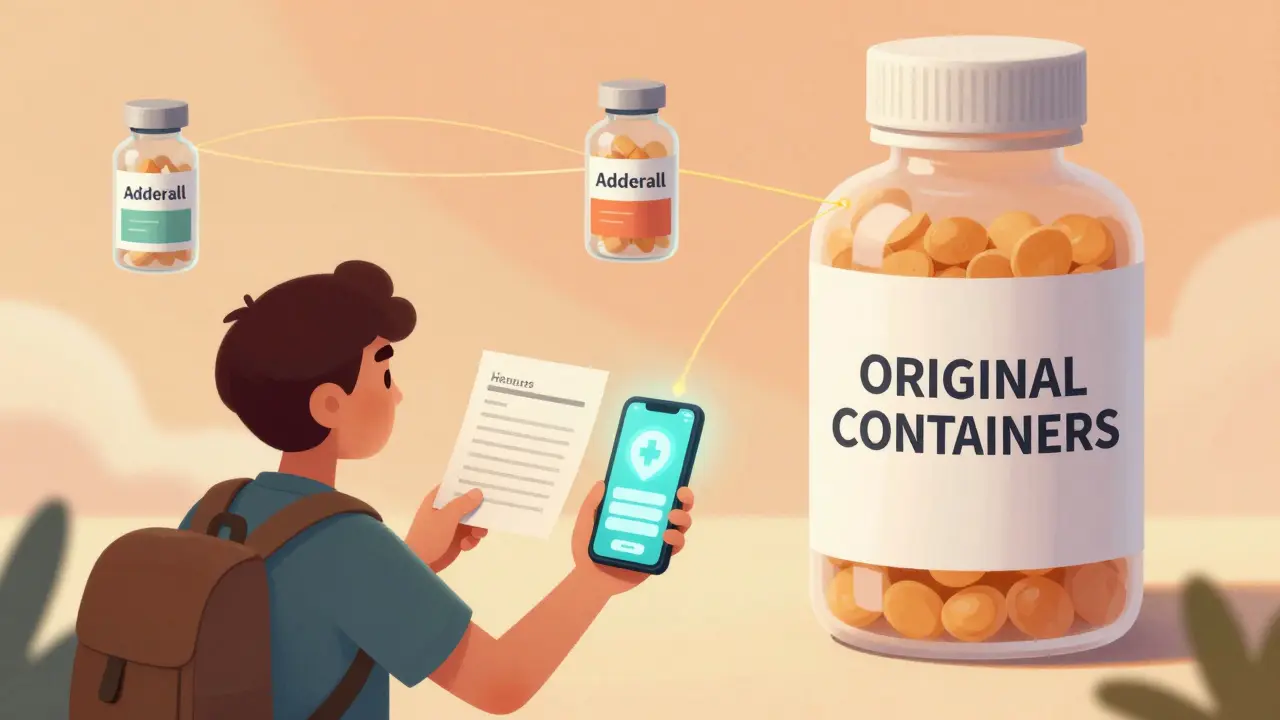
What Happens If You Get Stopped?
If a customs officer asks about your meds:- Stay calm. Don’t argue.
- Hand over your doctor’s letter and prescription.
- Point to the original bottle labels.
- If you don’t have them, explain clearly: “This is my medication for [condition]. Here’s the prescription.”
The Future: Digital Health Passes Are Coming
The Department of Homeland Security is testing a pilot program at 12 U.S. airports to let travelers verify medications through a smartphone app. It’s expected to launch in late 2024. The International Air Transport Association is also developing a global digital health pass for meds, with field tests starting in 2025. But here’s the truth: even when digital systems roll out, original containers will still be the gold standard. Paper labels are universal. Digital systems aren’t. Until every country accepts the same system, you can’t rely on your phone.Final Rule: When in Doubt, Keep It Original
The FDA warns that 11.7% of medications bought abroad are fake or substandard. That’s why they stress: don’t buy meds overseas. Bring your own. And bring them in the bottles they came in. Your medication isn’t just a pill. It’s your health. Your safety. Your right to travel without fear. Original containers aren’t about bureaucracy-they’re about clarity. They tell security: This is real. This is mine. This is necessary. Don’t gamble with your meds. Pack them right. Your future self will thank you.Can I carry my pills in a pill organizer when flying?
Yes, the TSA allows pills in organizers. But if you’re flying internationally or crossing state lines, you risk legal issues or delays. Always keep your original bottles in your carry-on, even if you use a pill organizer for convenience. Label the organizer with drug names, doses, and expiration dates, and carry a doctor’s letter and prescription copy.
Do I need a doctor’s note to fly with medication?
The TSA doesn’t require it, but many countries do. A doctor’s letter on official letterhead-listing your name, condition, medications (generic and brand), dosage, and prescriber details-can prevent delays or confiscation. It’s especially critical for controlled substances like opioids, ADHD meds, or benzodiazepines. Always bring one.
Can I bring liquid medication on a plane?
Yes, you can bring more than 3.4 ounces of liquid medication in your carry-on, but you must declare it to the TSA officer at the start of screening. Never put liquid meds in checked baggage. Keep them in a clear, sealed bag, and if they’re temperature-sensitive, use an ice pack (also declare it). United Airlines and the CDC both advise against checking liquid meds due to temperature risks.
What if my medication is banned in the country I’m visiting?
If your medication is illegal in your destination, don’t bring it-even with a prescription. Countries like Japan, UAE, and Thailand ban common U.S. drugs like pseudoephedrine, codeine, and Adderall. Contact the embassy of your destination country before you travel. You may need a special permit, or you may need to switch to an approved alternative. Never assume your U.S. prescription is valid abroad.
Should I pack extra medication?
Always. Pack at least 3-5 days’ worth extra. Flight delays, lost luggage, or sudden illness can extend your trip. Many countries don’t sell the same brand or dosage you use, and the quality of meds abroad can be unreliable. The FDA found that nearly 12% of medications bought overseas are counterfeit. Bring your own.
Can I get my meds refilled abroad?
It’s risky. Even if you find a pharmacy that will refill your prescription, the medication may not be the same brand, strength, or formulation. The FDA warns that 28.4% of medications bought in Southeast Asia are counterfeit. Don’t rely on refills abroad. Bring enough for your entire trip plus extra, and keep them in original containers.
Comments
Alexandra Enns
This article is laughably naive. Original containers? Please. I’ve flown to 47 countries with my meds in a pill organizer and never been questioned. The real issue? Overregulation. Governments love controlling what’s in your body. TSA? They’re just the frontman. The real enforcers are the paranoid customs agents who think every pill is a drug cartel’s secret weapon. I once had a guy in Bangkok try to confiscate my ibuprofen because it ‘looked suspicious.’ I showed him the bottle. He apologized. Then he asked for my phone number. I’m not joking.
January 26, 2026 at 09:21
Marie-Pier D.
Thank you for this! 🙏 I’m a diabetic traveling to Japan next month and was SO stressed about this. I just printed out my doctor’s letter, labeled my insulin pens with masking tape (generic name + dose), and kept the original boxes in my carry-on with the prescription. I also brought an extra 7 days’ worth - just in case. You’re right: it’s not about bureaucracy, it’s about safety. And honestly? It’s peace of mind. You’re not just carrying pills - you’re carrying your ability to breathe, to move, to live. Don’t risk it. 💪❤️
January 28, 2026 at 08:40
Phil Maxwell
I’ve been doing this for 15 years. Original bottles for international, organizers for domestic. Never had a problem. I always carry the prescription copy in my wallet, just in case. The key is consistency - don’t mix and match. If you’re gonna use a pill case, make sure the original is still in your bag. Simple. Done.
January 28, 2026 at 10:13
Tommy Sandri
While the article presents a pragmatic and well-researched overview, it is worth noting that the legal landscape for pharmaceutical transport remains fragmented across jurisdictions. The absence of a globally harmonized regulatory framework for personal medication importation necessitates a conservative approach. The cited 73% reduction in customs delays is statistically significant and corroborated by multiple international health travel advisories. Compliance with original-container protocols is not merely advisable - it is a demonstrably effective risk mitigation strategy in the absence of universal digital verification systems.
January 29, 2026 at 22:56
Juan Reibelo
Okay, I get it - original bottles are safer. But let’s be real: who carries 12 different bottles in their carry-on? My suitcase is already full of socks and underwear. I label my organizer with Sharpie, take photos of every bottle, and have the doctor’s letter printed on actual paper. I’ve flown to Mexico, Thailand, and Germany this way. No one asked. No one cared. I’m not a criminal. I’m just a guy with high blood pressure and a busy life. The system is designed for paranoia, not practicality. If you’re not smuggling, why should you be punished with luggage chaos?
January 30, 2026 at 18:45
Viola Li
Of course they say ‘keep it in the original bottle’ - that’s what the pharmaceutical lobby wants. They make money off extra bottles, extra labels, extra waste. Meanwhile, the environment drowns in plastic. I refill my pills in reusable glass containers. I’ve never had an issue. The real threat isn’t customs - it’s corporate greed masquerading as safety. This article is propaganda. Wake up.
February 1, 2026 at 05:36
Dolores Rider
EVERYONE KNOWS TSA is working with Big Pharma. I saw a video on TikTok where a woman’s Adderall was confiscated in Dubai and she was taken to a ‘special room’ with no windows. They scanned her blood. They’re tracking us. The doctor’s letter? Fake. The prescription? Doctored. They’re building a global medication database to control our moods. I only carry my meds in my socks now. And I don’t fly. I take the train. They can’t scan socks. 😈👁️
February 2, 2026 at 23:23
Jamie Hooper
mate i just chuck my pills in a tupperware and hope for the best. i’ve been to dubai, thailand, and spain and no one’s ever batted an eye. if they ask, i say ‘it’s for my anxiety’ and they nod and move on. why make life harder? the world’s not that strict. also, i spell ‘medication’ wrong in my notes so they think i’m dumb and leave me alone. 🤷♂️
February 3, 2026 at 23:06