
Naranjo Scale Causality Calculator
This interactive tool helps you assess whether an adverse drug reaction was caused by a medication using the Naranjo Scale. Answer the 10 questions below (yes/no or point values) and get your causality assessment result.
Have there been previous reports linking this drug to this reaction? (+1 if yes)
Previous reports provide strong evidence that a specific drug is associated with this reaction.
Did the reaction happen after the drug was started? (+2 if yes, -1 if it happened before)
Timing is crucial for establishing causality between drug administration and adverse effects.
Did the reaction improve when the drug was stopped? (+1 if yes)
Improvement after discontinuation supports the drug-reaction relationship.
Did the reaction come back when the drug was restarted? (+2 if yes, -1 if it got worse)
Rechallenge (restarting the drug) provides strong evidence of causality if the reaction returns.
Could another condition or drug have caused this? (-1 if yes, +2 if no)
Eliminating alternative causes strengthens the drug-reaction relationship.
Was a placebo given to see if the reaction returned? (-1 if yes, +1 if no)
Placebo challenge is rarely done in clinical practice due to ethical concerns.
Was the drug level in the blood toxic? (+1 if yes)
Toxic drug levels provide objective evidence of a causal relationship.
Did the reaction get worse with a higher dose? (+1 if yes)
Dose-response relationship strengthens the drug-reaction evidence.
Has the patient had this same reaction with this drug before? (+1 if yes)
Previous occurrence of the same reaction with the drug supports causality.
Is there objective proof—like lab tests or imaging—that confirms the reaction? (+1 if yes)
Objective evidence strengthens the causal relationship.
Results
Total Score: 0
What this means:
What Is the Naranjo Scale and Why Does It Matter?
When a patient gets sick after taking a new medication, how do you know if the drug caused the problem-or if it was just bad luck? That’s the exact question the Naranjo Scale was built to answer. Developed in 1981 by Dr. Carlos A. Naranjo and his team, this simple 10-question tool helps doctors, pharmacists, and nurses decide whether an adverse reaction is truly caused by a drug, or if something else-like an infection, another medication, or an underlying condition-is to blame.
It’s not fancy. No machines. No blood tests. Just a checklist you can fill out on paper or in an electronic form. But it’s one of the most used tools in the world for drug safety. In fact, 78% of published case reports on adverse drug reactions still rely on it, according to a 2022 analysis. Even though it’s over 40 years old, it’s still the gold standard in hospitals, pharmacies, and regulatory agencies.
How the Naranjo Scale Works: The 10 Questions
The scale asks 10 yes-or-no questions, each worth a certain number of points: +1, +2, 0, or even -1. You add them up, and the total tells you how likely the drug caused the reaction. There are four possible outcomes:
- Definite (9 or higher): Almost certain the drug caused it. The reaction happened after taking the drug, improved when it was stopped, and fits what’s known about that drug.
- Probable (5-8): Very likely, but not 100%. The timing makes sense, and there’s no clear alternative cause.
- Possible (1-4): Could be the drug, but other things might explain it too.
- Doubtful (0 or lower): Probably not the drug. Something else is more likely.
Here’s what the questions actually look like:
- Have there been previous reports linking this drug to this reaction? (+1 if yes)
- Did the reaction happen after the drug was started? (+2 if yes, -1 if it happened before)
- Did the reaction improve when the drug was stopped? (+1 if yes)
- Did the reaction come back when the drug was restarted? (+2 if yes, -1 if it got worse)
- Could another condition or drug have caused this? (-1 if yes, +2 if no)
- Was a placebo given to see if the reaction returned? (-1 if yes, +1 if no)
- Was the drug level in the blood toxic? (+1 if yes)
- Did the reaction get worse with a higher dose? (+1 if yes)
- Has the patient had this same reaction with this drug before? (+1 if yes)
- Is there objective proof-like lab tests or imaging-that confirms the reaction? (+1 if yes)
Some questions are straightforward. For example, if someone started a new blood pressure pill and got dizzy the next day, that’s a clear +2 for timing. But others? That’s where things get messy.
Where the Naranjo Scale Falls Short
Let’s be real: the Naranjo Scale wasn’t designed for today’s medicine. Most patients on chronic medications take five, six, or even ten drugs at once. The scale can’t handle that. It only looks at one drug at a time. If a 78-year-old on eight medications develops kidney trouble, the scale doesn’t tell you which one caused it-or if it’s a mix.
Another big problem? Question 6: the placebo challenge. It asks if a placebo was given to see if the reaction returned. But in real life, you don’t re-expose someone to a drug that made them seriously ill just to test a theory. That’s unethical. So clinicians usually answer “don’t know,” which lowers the score and makes the reaction seem less likely-even if it clearly was caused by the drug.
And what about new drugs? Immunotherapies, gene therapies, biologics-they work differently than old-school pills. Reactions might show up weeks or months later. The Naranjo Scale doesn’t account for that kind of delayed response. Experts in Nature Reviews Drug Discovery point out it’s not built for modern treatments.
Still, it’s widely used because nothing else has its simplicity and validation. Even the FDA and European Medicines Agency accept it for official reporting.
How Clinicians Actually Use It Today
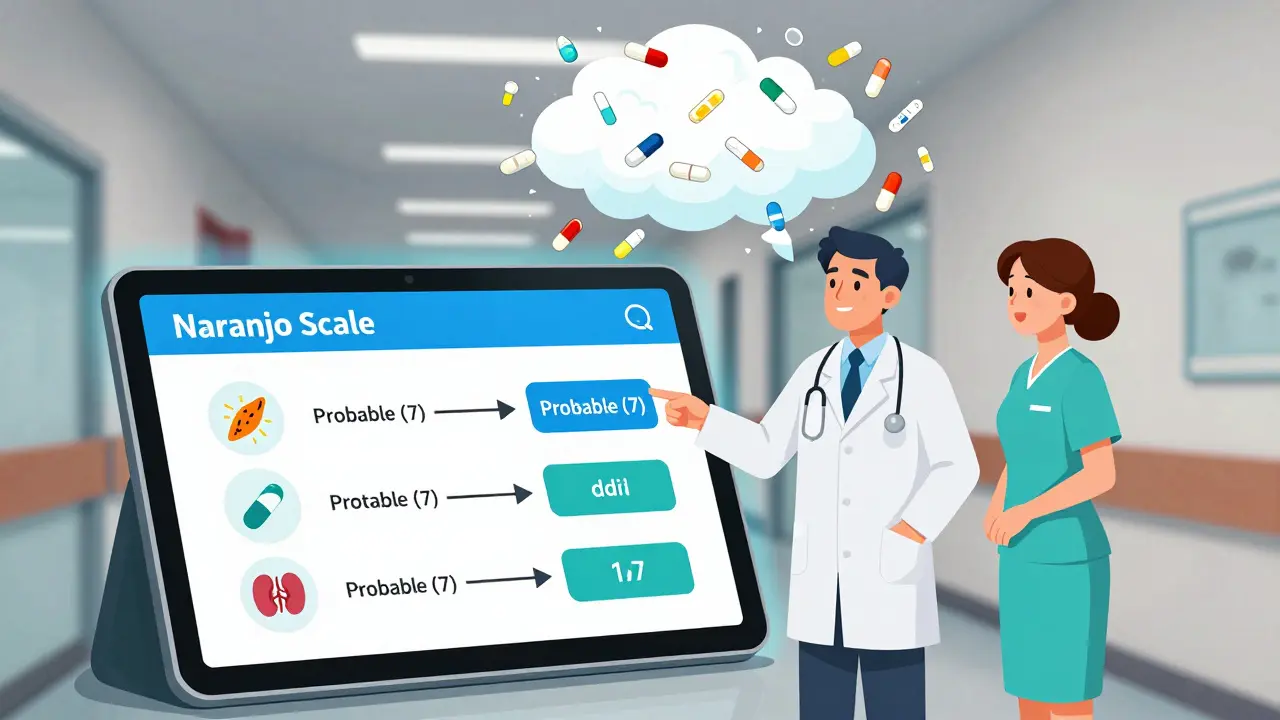
Most people don’t use the Naranjo Scale alone. They use it as a starting point. Pharmacists in hospitals often run through the 10 questions during daily safety rounds. One pharmacist from Massachusetts General Hospital said it forces them to look at evidence, not just gut feelings.
But they don’t do it by hand anymore. Digital tools are changing the game. A 2023 study showed that using a simple Python app to calculate the score cut assessment time from 11 minutes to just 4.2 minutes. Error rates dropped from 28% to 9%. That’s huge.
Some electronic health records, like Epic, now auto-fill parts of the scale-pulling data from when the drug was prescribed, when symptoms started, and lab results. That cuts down guesswork.
Still, the biggest hurdle isn’t the tool-it’s the training. A 2021 study found that doctors with less than five years of experience took 37% longer to score cases accurately than pharmacovigilance specialists. Why? Because the scale requires deep knowledge of how drugs behave in the body. You can’t just memorize the questions. You need to understand drug mechanisms, disease progression, and what counts as a “reasonable” alternative cause.
What’s Replacing It-and What Isn’t
There are other tools out there. The WHO-UMC system is simpler but less precise. The Liverpool Scale handles multiple drugs better. The PADRAT tool is made for kids. The ALDEN scale is great for antibiotics.
But none of them have the Naranjo Scale’s track record. In a 2022 review of over 1,000 published ADR reports, Naranjo was used in 78% of cases. WHO-UMC? Only 52%. The Liverpool Scale? Just 12%.
Why? Because it’s been tested, validated, and trusted for decades. It’s transparent-you can see exactly how the score was calculated. Other systems use vague categories like “probable” or “unlikely” without showing the math behind them.
Even the International Council for Harmonisation (ICH) is updating the scale in 2024, not replacing it. They’re replacing Question 6 (placebo) with a question about therapeutic drug monitoring-something more practical and ethical.
Is the Naranjo Scale Still Worth Learning?
Yes. Absolutely.
If you work in healthcare-whether you’re a nurse, pharmacist, doctor, or even a student-you need to understand it. It’s not just about filling out a form. It’s about thinking critically about cause and effect. In a world full of new drugs, complex patients, and conflicting information, the Naranjo Scale gives you a clear structure to ask: Is this really the drug?
It’s not perfect. It’s outdated in places. But it’s the best starting point we have. And in pharmacovigilance, where a missed reaction can mean another patient gets hurt, that’s worth a lot.
Try it yourself. Pick a case. Go through the 10 questions. You’ll be surprised how much you learn just by forcing yourself to slow down and look at the evidence.
Where to Find Tools and Training
You don’t need to buy anything to use the Naranjo Scale. Free resources are everywhere:
- The Naranjo Scale Worksheet from Nebraska ASAP has been downloaded over 3,200 times.
- Fiveable offers free interactive case studies used by 15,000+ nursing and pharmacy students.
- GitHub hosts an open-source Naranjo Calculator with over 2,100 stars-updated in 2023.
- The International Society of Pharmacovigilance has a 27-page training manual.
Practice with real cases. Start with simple ones: a patient on one new drug who develops a rash. Then move to complex cases with multiple meds. After 5-10 cases, you’ll start seeing patterns. After 20, you’ll be confident.
Final Thought: A Tool That Won’t Disappear
The Naranjo Scale isn’t going away. AI tools, machine learning models, and automated systems are coming-but they’re built on the same foundation. The scale gives us a common language. Without it, we’d all be guessing.
It’s not the end of causality assessment. It’s the beginning.
Comments
Brittany Marioni
Wow, this is such a clear breakdown-I’ve used the Naranjo Scale in my pharmacy rotations, and honestly, it’s the only thing that kept me from jumping to conclusions every time a patient got a rash after a new med.
It’s not perfect, but it forces you to slow down and ask: ‘What else could this be?’
I teach it to new students like it’s scripture-because in pharmacovigilance, guesswork kills.
And yes, Question 6 is ridiculous. No one’s giving placebos to someone who nearly died from a drug reaction.
But the fact that it’s still the gold standard? That says something.
Even Epic auto-filling parts of it now? That’s a win.
We need more tools like this-simple, transparent, and grounded in evidence, not hype.
Also, the GitHub calculator is a lifesaver. Link it again? I lost it last week.
February 3, 2026 at 08:20
Monica Slypig
This scale is so outdated its basically a relic from when doctors still wrote prescriptions on paper and called patients at home to check if they were still breathing. Who even uses this anymore? We have AI that can predict drug interactions before the patient even swallows the pill. The fact that the FDA still accepts this as gospel is embarrassing. Its not a tool its a crutch for lazy clinicians who dont wanna learn real pharmacovigilance. And dont get me started on the WHO-UMC being inferior-its not inferior its just less stupid.
February 5, 2026 at 02:22
jay patel
Let me tell you something-this scale isn’t just a checklist, it’s a mindset.
When I was working in a rural hospital in Kerala, we had a 72-year-old woman on seven meds, and she developed sudden confusion.
Everyone thought it was dementia-until we ran the Naranjo Scale.
Turns out, one of her antibiotics was interacting with her blood pressure med in a way no one had documented.
Score was 7-probable.
We stopped the antibiotic, and she was back to herself in 48 hours.
Now, I know some folks say it’s outdated because of polypharmacy-but that’s not the scale’s fault, that’s our failure to think holistically.
The scale doesn’t say ‘only one drug at a time,’ it says ‘consider each factor.’
And yes, Question 6 is absurd-but we just mark ‘not applicable’ and move on.
It’s not about the tool being perfect-it’s about having a structure when chaos hits.
And in places like mine, where we don’t have fancy labs or AI, this thing saves lives.
Also, the fact that you can do it on a napkin during a coffee break? That’s power.
Stop calling it outdated. Call it resilient.
February 7, 2026 at 00:34
Murarikar Satishwar
Excellent summary. The Naranjo Scale’s endurance isn’t accidental-it’s earned.
It’s not about being cutting-edge; it’s about being reliable.
AI models can predict patterns, but they can’t explain why a drug caused a reaction in one patient and not another without human context.
The scale forces clinicians to document their reasoning, which is critical for both patient safety and regulatory reporting.
And yes, the placebo question is a relic-but the ICH’s update replacing it with therapeutic drug monitoring is a smart, ethical fix.
What I appreciate most is its transparency: you can re-calculate someone’s score and trace their logic.
Compare that to proprietary algorithms that label reactions as ‘probable’ without showing their math.
That’s not science-that’s black-box magic.
The scale is a foundation, not a finish line.
It’s the first step in a chain of clinical reasoning that leads to better outcomes.
And for students? Learning it is like learning to tie your shoes before running a marathon.
You don’t need to run fast to start-you just need to know how to stand straight.
February 8, 2026 at 04:31
Ellie Norris
I used to hate this scale until I started using it with real patients. One lady got a rash after starting a new statin-everyone thought it was eczema. We ran the Naranjo, got a 6, stopped the drug, rash cleared. Now I use it on every new adverse event. Even if it's just to rule things out. The free worksheet from Nebraska ASAP? Lifesaver. Link it again? I need to share it with my team.
February 9, 2026 at 22:40
Nick Flake
THE NARANJO SCALE ISN’T JUST A TOOL… IT’S A PHILOSOPHY.
It’s the quiet voice in the chaos of polypharmacy saying: ‘Slow down. Look. Listen. Prove.’
When I first saw it in med school, I thought it was archaic-like using a slide rule in the age of smartphones.
Then I saw a 19-year-old with lupus nearly die because her new biologic was blamed on ‘flare-up’-no one bothered to score it.
She survived. But she lost two months of her life.
That’s when I realized: this isn’t about old-school paper forms.
This is about refusing to let convenience override caution.
The scale doesn’t care if you’re using AI or a pen.
It just asks: ‘Did you think? Did you question? Did you care enough to check?’
And in a world where we outsource judgment to algorithms…
…this? This is radical.
❤️
So yes-learn it. Teach it. Fight for it.
Because when a patient’s life hangs on a yes-or-no question…
…you don’t want to wing it.
February 10, 2026 at 12:09
clarissa sulio
I don't care if it's 40 years old, if it works and it's free and everyone uses it then why change it? We're not trying to invent the wheel here we're trying to keep people from dying. Also I used to work at a hospital where the nurses used to argue over whether a rash was from the drug or the laundry detergent. Naranjo settled it. No drama. Just numbers. That's all we need.
February 11, 2026 at 15:29
Bridget Molokomme
Funny how we call this the 'gold standard' like it's not basically a glorified bingo card for drug reactions. I've seen residents score it wrong because they didn't know what 'objective proof' meant-thought it meant an MRI. Meanwhile, the guy who actually wrote the scale probably didn't even have a smartphone. Still, it's better than nothing, I guess. Pass the coffee.
February 12, 2026 at 14:20