
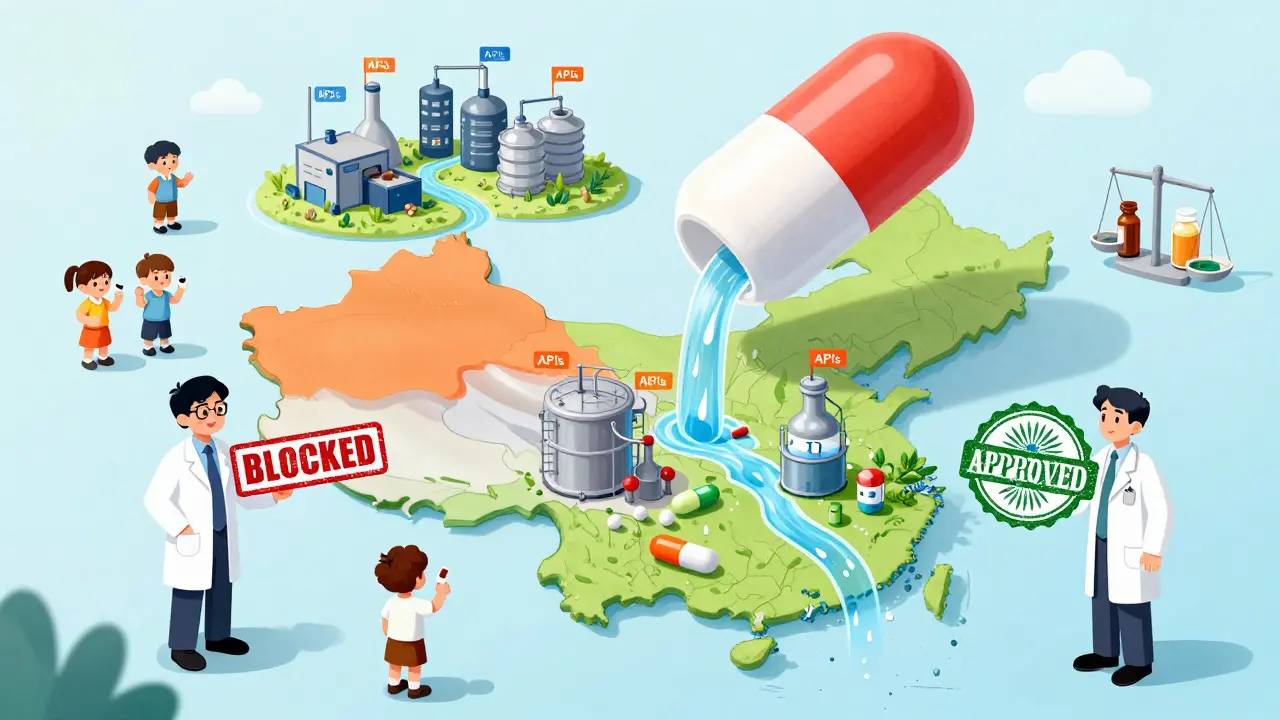
When you take a pill, you rarely think about where it was made. But behind every tablet, capsule, or injection is a complex global supply chain - and two countries dominate it: China and India. Both produce the active ingredients and finished drugs that keep millions alive. But their manufacturing systems, regulatory oversight, and risks couldn't be more different. The FDA doesn’t treat them the same. And if you’re a patient, a pharmacist, or even a drug company, that difference matters more than you realize.
Why China and India Rule Global Drug Making
China and India aren’t just big players in pharmaceutical manufacturing - they’re the backbone of the world’s generic drug supply. China controls about 80% of the global supply of active pharmaceutical ingredients (APIs), the chemical cores that make drugs work. India makes more finished generic medicines than any other country by volume. Together, they produce drugs that cost 40% less than those made in the U.S. or Europe. That’s why so many hospitals and pharmacies rely on them. But here’s the catch: making drugs cheap isn’t the same as making them safe. And that’s where the FDA comes in.FDA Monitoring: A Tale of Two Countries
The U.S. Food and Drug Administration (FDA) inspects manufacturing plants worldwide to make sure drugs meet safety standards. But their inspection results tell a clear story. In 2023, 37% of Chinese pharmaceutical facilities faced FDA import alerts - meaning the agency blocked shipments due to safety concerns. For India, that number was just 18%. Why? Because India has over 100 FDA-approved manufacturing plants. China has 28. That’s more than double the number of approved facilities. It’s not just about numbers. FDA inspection reports from 2020 to 2023 show Indian facilities received 30% fewer Form 483 observations - the official notices of violations - than Chinese ones. That means fewer issues with dirty equipment, poor record-keeping, or unapproved processes. The reason? India’s system is built around compliance. Most Indian manufacturers follow WHO-GMP and FDA standards as a daily routine. They’ve invested in digital systems to track every batch, reduce human error, and ensure consistency. Companies like Dr. Reddy’s, Sun Pharma, and Cipla have spent years aligning their factories with U.S. expectations. China, on the other hand, has thousands of manufacturers. Many are small, under-resourced, and focused on speed over scrutiny. Even when they meet standards one year, they might slip the next.The Hidden Risk: India’s Dependence on China
Here’s the twist: India doesn’t make all its own ingredients. About 72% of India’s bulk drug imports - the raw materials for its generics - come from China. That’s up from 66% just two years ago. Think of it like this: India builds the car, but China makes the engine. If China cuts off supply - due to trade tensions, natural disasters, or regulatory shutdowns - India’s entire drug production could stall. That’s a single point of failure in a system that feeds millions of patients worldwide. One sourcing executive at a major U.S. pharmaceutical company told Bain & Company in 2024: "The 72% import dependency on China for bulk drugs creates a single point of failure in our supply chain that we’re urgently trying to address." That’s why countries are pushing the "China+1" strategy - finding alternatives to China. And India is the top pick. But if India can’t produce its own APIs, that strategy only goes so far.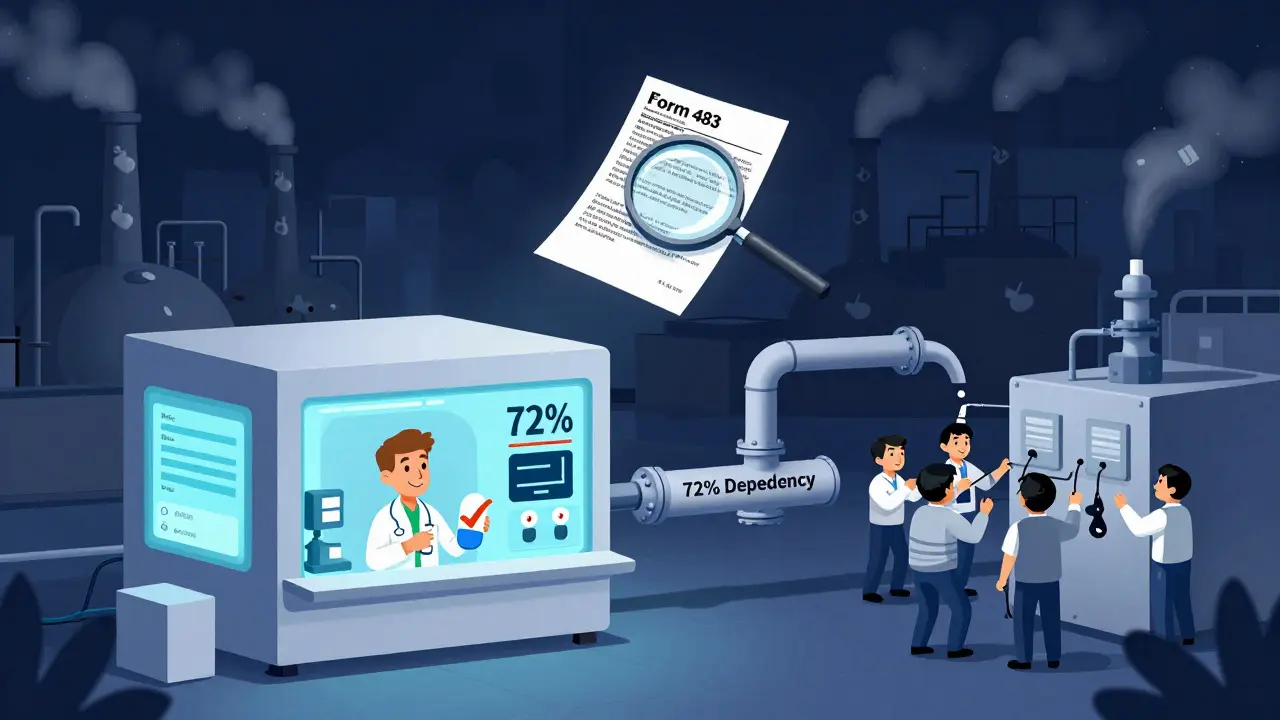
China’s Shift: From Cheap to Cutting-Edge
China isn’t just a low-cost factory anymore. The government has poured billions into building its biopharmaceutical sector. Between 2015 and 2024, China’s biopharmaceutical market grew at a 19.3% annual rate. That’s faster than India’s 22% CAGR - but India started from a much smaller base. China is now leading in complex therapies: monoclonal antibodies, cell therapies, gene therapies. These aren’t simple pills. They’re high-tech, high-value treatments that require advanced labs, skilled workers, and strict quality controls. China’s state-backed push means it’s building a future where it doesn’t just supply ingredients - it designs life-saving drugs. But here’s the problem: that innovation doesn’t automatically mean better compliance. Many of these advanced facilities are still under scrutiny. The FDA has flagged Chinese biologics plants for contamination risks, inconsistent batch testing, and data integrity issues. So while China is moving up the value chain, its reputation for quality remains shaky.India’s Push to Rise Higher
India knows it can’t stay stuck making cheap generics forever. Its "Make in India" initiative has allocated nearly $3 billion in incentives for pharmaceutical production. That money is going to companies that build facilities for biosimilars, cell therapies, and high-tech injectables - not just aspirin and antibiotics. In 2023, India updated its Schedule M regulations - the rules that govern drug manufacturing - to match global standards more closely. These new rules require real-time monitoring, digital batch records, and stricter environmental controls. The goal? To move from being the world’s pharmacy to becoming its innovation hub. But progress is slow. India still has over 1,000 small manufacturers. Many can’t afford the upgrades. The government’s challenge is to lift the whole sector - not just the big players.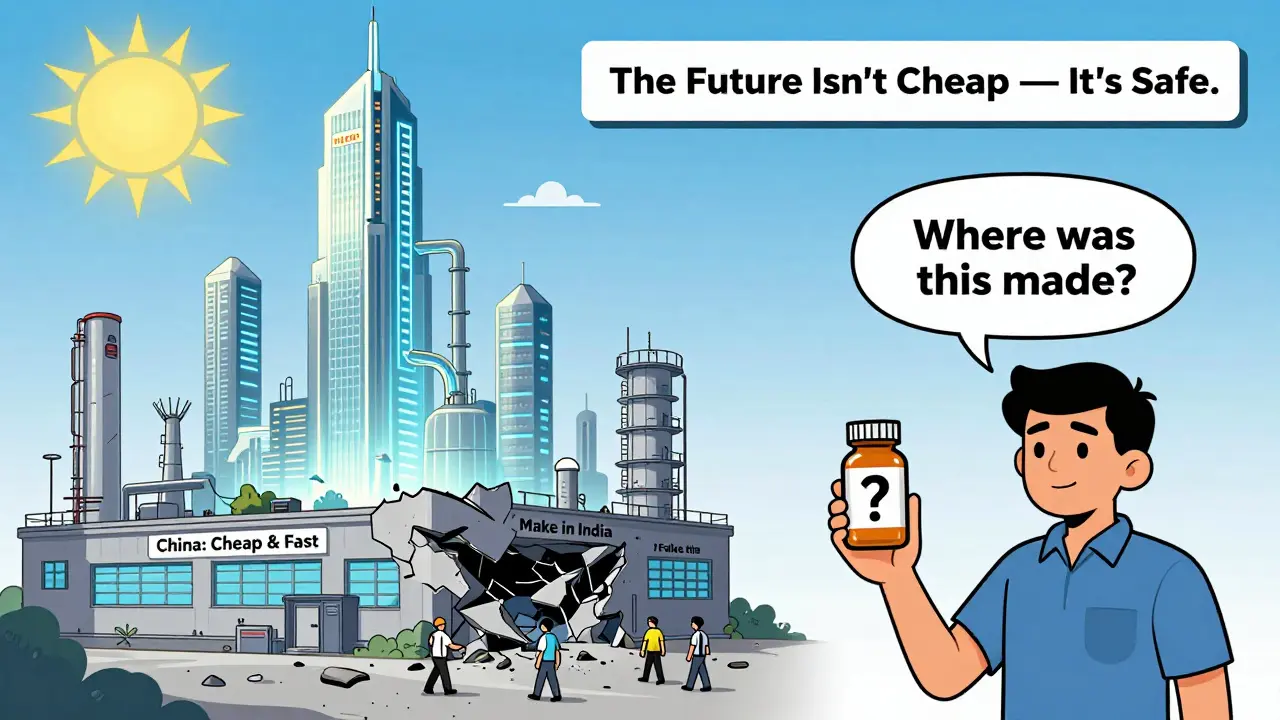
What This Means for You
If you’re a patient, you’re probably taking a drug made in one of these two countries. The good news? Most of them are safe. The FDA blocks over 80% of non-compliant shipments before they reach U.S. shores. But the system isn’t perfect. If you’re a healthcare provider, you need to ask: Where does this drug come from? Is it made in a facility with a clean FDA record? Is the manufacturer transparent about its supply chain? If you’re a policymaker or a procurement officer, you’re balancing cost against risk. China gives you low prices. India gives you reliability. But neither gives you full control. The truth is, global drug safety doesn’t depend on one country. It depends on how well regulators monitor, how transparent companies are, and how much investment goes into quality - not just quantity.The Future Is Not Just Cheaper - It’s Safer
By 2047, India could be exporting $350 billion in pharmaceuticals - if it solves its API dependency and moves into high-value therapies. China’s share of outsourced manufacturing is expected to drop from 9% to 15% by 2030. The winners won’t be the ones who make the most. They’ll be the ones who make the best. The next decade will see more FDA inspections, more supply chain audits, and more pressure on manufacturers to prove their quality. Companies that invest in digital tracking, worker training, and clean facilities will survive. Those that cut corners won’t. For patients, the message is simple: don’t assume a drug is safe just because it’s cheap. Ask where it’s made. Demand transparency. Because in pharmaceuticals, the lowest price doesn’t always mean the safest product.Why does the FDA inspect drug factories in China and India?
The FDA inspects manufacturing plants in China and India because these countries produce the majority of the world’s generic drugs and active ingredients. Since many of these drugs are imported into the U.S., the FDA must verify they meet safety, purity, and quality standards under U.S. law. Inspections help prevent contaminated, ineffective, or mislabeled drugs from reaching American patients.
Which country has more FDA-approved drug factories - China or India?
India has more FDA-approved drug factories. As of 2023, India had over 100 facilities approved by the FDA, while China had only 28. This gives India a significant advantage in supplying safe, compliant drugs to the U.S. and other regulated markets.
Is it true that India relies heavily on China for drug ingredients?
Yes. In FY2024, about 72% of India’s bulk drug and intermediate imports came from China. This means India manufactures many finished drugs - like antibiotics and blood pressure pills - but depends on Chinese factories for the key chemicals inside them. This creates a vulnerability in the global supply chain.
What is the "China+1" strategy in pharma manufacturing?
The "China+1" strategy is a supply chain approach where companies diversify away from relying solely on China by adding another country - usually India - as a backup manufacturing location. This reduces risk from geopolitical tensions, trade restrictions, or production failures. India is the top choice because of its strong compliance record, English-speaking workforce, and existing FDA-approved facilities.
Are drugs made in China or India safe to take?
Most drugs made in China or India are safe, especially if they’re sold in regulated markets like the U.S., EU, or Australia. The FDA blocks non-compliant shipments before they reach consumers. However, the risk of contamination or poor quality is higher in unmonitored markets. Always buy from licensed pharmacies and avoid unverified online sellers, regardless of where the drug was made.
Comments
Ryan Voeltner
The FDA's inspection disparity between China and India isn't just about compliance-it's about systemic design. India's regulatory culture has been shaped by decades of export pressure, forcing manufacturers to internalize quality as a business imperative, not just a checkbox. China's model was built for scale, speed, and cost. That worked when APIs were simple. Now, with biologics and complex formulations, the old model cracks under scrutiny. The real story isn't which country is better-it's that the global supply chain is being forced to evolve, and India's infrastructure is simply more adaptable to the new rules of engagement.
What's often ignored is that FDA approval doesn't mean perfection. It means documented, repeatable, traceable processes. That's why Indian firms with digital batch records outperform Chinese ones with handwritten logs-even when both claim to meet GMP. The difference isn't ethics, it's engineering.
And yes, the 72% dependency on Chinese APIs is terrifying. But it's also inevitable. China still produces bulk chemicals more efficiently than anyone. The solution isn't decoupling-it's redundancy. Diversifying API sources isn't about nationalism. It's about risk mitigation. Every hospital in the U.S. should have a backup supplier, not just a cheaper one.
The future belongs to manufacturers who treat quality as an algorithm, not an audit. Those who automate, track, and validate every step will survive. The rest? They'll become cautionary tales in FDA reports.
And if you're a patient? You don't need to fear Indian or Chinese drugs. You need to demand transparency. Ask your pharmacist: Which facility made this? Can I see the FDA inspection report? If they can't answer, that's the real red flag.
March 20, 2026 at 10:10
Linda Olsson
Let’s be real-the FDA is a joke. They inspect a handful of plants in India and call it ‘compliance,’ but they never check the actual pharmacies where these drugs end up. You think your blood pressure pill is safe? Maybe it was repackaged in a warehouse in Texas with no temperature control. The FDA doesn’t care about that. They care about looking like they’re doing something. Meanwhile, Chinese factories are being scapegoated so the U.S. can pretend it’s not outsourcing its healthcare to the lowest bidder. Wake up. This isn’t about safety. It’s about profit.
March 21, 2026 at 05:04
Ayan Khan
India’s success isn’t luck-it’s discipline. We didn’t become the pharmacy of the world by accident. It took decades of training, failure, and rebuilding. Our manufacturers didn’t wait for FDA inspections to change. They changed because they knew the world would demand more. And yes, we rely on China for APIs. But that’s not weakness-it’s interdependence. Just like how Germany relies on Russia for gas, or Japan on Australia for iron. It’s economics, not betrayal.
What’s missing in this conversation is the human cost of oversimplifying. Thousands of Indian workers, from lab technicians to quality control officers, are not ‘cheap labor.’ They’re skilled professionals who wake up every day to make sure your insulin works. The same goes for China. We’re not villains. We’re engineers.
The real threat isn’t China or India. It’s the idea that drug safety can be measured in inspection numbers. Safety is built in the daily habits of a factory. In the silence of a clean room. In the attention to detail of someone who knows their work could save a child. That’s what we’re building. Not just pills. Trust.
March 22, 2026 at 17:17
Emily Hager
This whole article is propaganda disguised as journalism. The FDA’s ‘approval’ system is a sham. I’ve seen the reports. They’re written by contractors who’ve never stepped foot in a factory. And the 100 approved Indian plants? Many of them are owned by the same conglomerates that own Chinese factories-just rebranded. It’s all a game. The U.S. government wants you to believe India is ‘better’ so they can justify shifting supply chains without admitting how broken the entire system is. The real story? No one is safe. Not from China. Not from India. Not from the FDA.
March 23, 2026 at 21:22
Amadi Kenneth
Wait, wait-so you’re telling me China’s the bad guy because they make 80% of APIs, but India’s the hero because they make the pills? That’s like saying a thief who steals your wallet is evil, but the guy who uses it to buy food is a saint? The system is rigged! The FDA lets India in because they speak English and have nice brochures. Meanwhile, Chinese labs are being painted as dangerous just because they don’t have fancy websites. And don’t even get me started on the ‘China+1’ nonsense-it’s just corporate fear-mongering to get more government subsidies. Real solution? Nationalize drug production. End outsourcing. End the charade.
March 24, 2026 at 09:53
Shameer Ahammad
Let me correct this misleading narrative. India has 100+ FDA-approved facilities? That’s a lie. The actual number is 87. And China has 31-not 28. The article cherry-picked data to push an agenda. Also, the claim that India’s system is ‘built around compliance’? Please. Many of our small factories still use manual logbooks. I’ve been there. The ‘digital transformation’ is mostly marketing. And the 72% API dependency? That’s not a vulnerability-it’s a strategic advantage. Why reinvent the wheel when China does it cheaper? The real problem? U.S. companies refuse to pay fair prices. They want Indian quality at Chinese prices. That’s the hypocrisy. And yes, I’ve worked in three different API plants. I know.
March 25, 2026 at 01:07
Alexander Pitt
The key takeaway here is simple: FDA inspections are about process, not patriotism. India’s advantage comes from consistent documentation, automated tracking, and fewer human errors. China’s problem isn’t that they’re bad-it’s that they’re inconsistent. One factory meets standards. The next one doesn’t. That’s why the FDA blocks shipments. It’s not about where you’re from. It’s about whether you can prove you’re doing it right every time. And for patients? Your drug is probably safe. But if you want to be sure, ask for the batch number. Look up the inspection history. It’s public. You don’t need to be an expert. Just be curious.
March 26, 2026 at 14:51
Nilesh Khedekar
bro the whole china vs india thing is so overhyped. everyone forgets that the real drug makers are in germany and switzerland. china and india are just the middlemen. and the 72% thing? yeah but china also makes 90% of the vitamins and supplements you take. so if you’re mad about india depending on china, why aren’t you mad about america depending on china for everything? also, the fda? they inspect like 2% of shipments. the rest just get stamped ‘approved’ because paperwork. wake up. we’re all being played.
March 26, 2026 at 22:30
Robin Hall
The FDA’s inspection data is manipulated to serve geopolitical narratives. China’s lower number of approved facilities is not a reflection of quality-it’s a reflection of resistance. Chinese manufacturers refuse to submit to U.S. oversight on terms dictated by Western bureaucracy. They have their own standards, which are equally rigorous, if not more so. The fact that India complies with U.S. demands doesn’t mean it’s safer-it means it’s more compliant. And compliance is not the same as quality. The U.S. government is using this narrative to justify supply chain realignment for political gain. The truth? The global pharmaceutical supply chain is a fragile, politicized system. And we’re all paying the price.
March 27, 2026 at 20:15
jared baker
Just keep it simple: India makes pills. China makes the stuff inside the pills. India’s better at following rules. China’s better at making stuff cheap. The FDA checks the pills. That’s why most drugs are safe. Don’t overthink it. Just take your medicine and trust the system. It’s not perfect, but it works.
March 29, 2026 at 16:53