
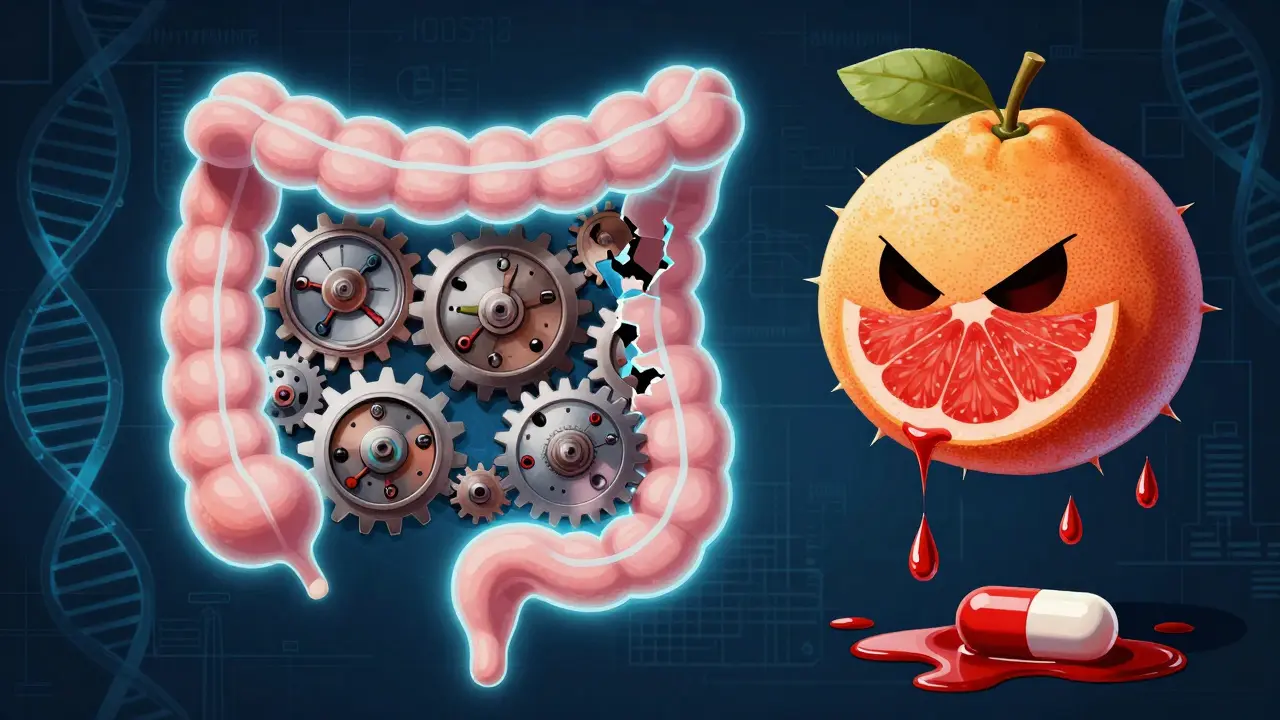
Every morning, millions of people drink a glass of grapefruit juice to start their day-packed with vitamin C, refreshing, and considered healthy. But if you’re taking warfarin or an SSRI, that glass might be doing more harm than good. The problem isn’t the fruit itself. It’s what happens inside your body when grapefruit meets your medication. The CYP450 system, your body’s main drug-processing engine, can get knocked off balance by just one serving of grapefruit. And the consequences? Dangerous, sometimes life-threatening.
How Grapefruit Disrupts Your Medications
Grapefruit doesn’t just slow down drug metabolism-it breaks it. The culprit? Furanocoumarins, chemicals like bergamottin and DHB found in the fruit and its juice. These compounds don’t just block the CYP450 enzymes temporarily. They permanently disable them, especially in your intestines, where most drugs get absorbed. Once these enzymes are destroyed, your body can’t break down certain medications the way it should. That means more drug stays in your bloodstream than intended.
This isn’t a short-term issue. Even if you take your pill at 8 a.m. and drink grapefruit juice at noon, the damage is already done. The enzyme doesn’t come back until your gut cells make new ones-usually 24 to 72 hours later. So timing doesn’t help. The only safe move? Avoid grapefruit entirely if you’re on a medication that interacts with it.
Warfarin and Grapefruit: A Risk You Can’t Ignore
Warfarin is a blood thinner with a razor-thin safety margin. Too little, and you risk a clot. Too much, and you could bleed internally. It’s metabolized mostly by CYP2C9 (80-90%), with a smaller part handled by CYP3A4. Grapefruit doesn’t just affect CYP3A4-it also inhibits CYP2C9, according to research from Dresser et al. (1998). That means even though CYP2C9 is less sensitive to grapefruit than CYP3A4, the risk is still real.
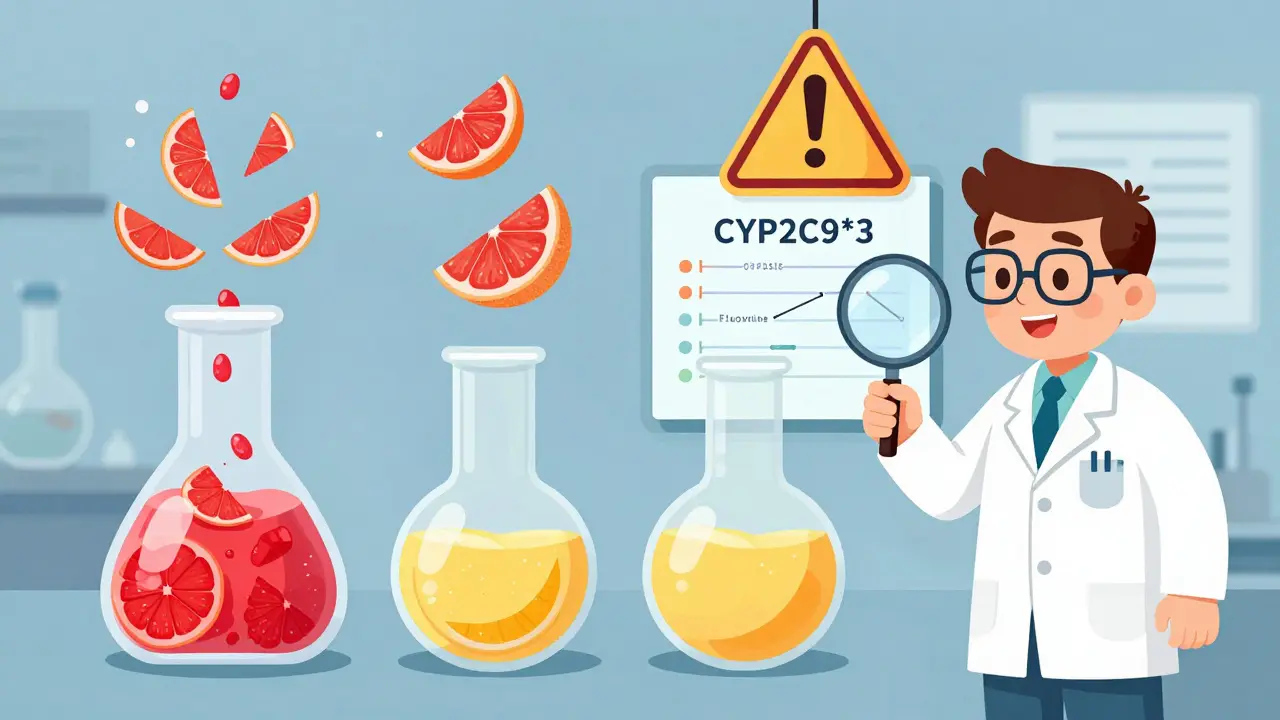
Studies show some patients on warfarin see their INR (a measure of blood clotting time) jump by 15-25% after consuming grapefruit. That’s enough to put them in danger. A 2022 Reddit survey of 142 warfarin users found 32% reported unusual bruising or bleeding after accidentally eating grapefruit. Not everyone reacts the same. People with CYP2C9*2 or *3 gene variants are at much higher risk. These genetic differences mean their bodies process warfarin slower to begin with-so grapefruit pushes them over the edge.
That’s why the Clinical Pharmacogenetics Implementation Consortium (CPIC) recommends avoiding grapefruit if you have these variants. Genetic testing for CYP2C9 costs $250-$400, and for warfarin patients with unexplained INR spikes, it’s often worth it. But even without testing, caution is smart. If you’re on warfarin, skip grapefruit. Period.
SSRIs and Grapefruit: Not All Are Equal
Not every SSRI reacts the same way to grapefruit. That’s because each one uses a different CYP450 pathway to break down.
- Fluoxetine and paroxetine are mainly broken down by CYP2D6. Grapefruit has minimal effect on this enzyme, so the risk here is low.
- Sertraline is metabolized by CYP2C9, CYP2C19, and CYP3A4. This makes it the most vulnerable SSRI to grapefruit. A 2015 case series found grapefruit juice increased sertraline levels by 27-39% in regular users. That can lead to nausea, dizziness, or serotonin syndrome.
- Citalopram and escitalopram rely on CYP2C19 and CYP3A4. While CYP3A4 inhibition by grapefruit could theoretically raise levels, a March 2024 study in Clinical Pharmacology & Therapeutics found no clinically significant interaction with escitalopram in healthy volunteers.
So why do some doctors tell all SSRI users to avoid grapefruit? Because of confusion. Many assume all SSRIs are the same. They’re not. The American Psychiatric Association’s 2022 guidelines say grapefruit avoidance is only necessary for sertraline in high-risk patients. For others, the risk is theoretical, not proven.
Still, if you’re taking sertraline and notice new side effects-headaches, jitteriness, or stomach upset-after eating grapefruit, stop it. Talk to your pharmacist. It might be the cause.
Why Some People Are More at Risk
Not everyone who drinks grapefruit juice and takes warfarin or an SSRI will have a problem. Why? Because genetics, age, and liver health all play a role.
People over 65 have slower enzyme production, meaning it takes longer to replace the CYP450 enzymes grapefruit destroys. Older adults also tend to take more medications, increasing the chance of overlapping interactions.
Genetics matter too. If you’re a poor metabolizer of CYP2C9 (about 15% of Caucasians), your body handles warfarin poorly even without grapefruit. Add grapefruit, and the risk multiplies. The same goes for CYP2D6 poor metabolizers-though this is less relevant for grapefruit, since it barely affects CYP2D6.
And here’s a hidden factor: the type of grapefruit. The FDA warned in 2023 that newer varieties like ‘Oroblanco’ and ‘Sweetie’ can have up to 300% more furanocoumarins than traditional pink or red grapefruit. That means even if you’ve had grapefruit before without issues, a new brand could be dangerous.
What You Should Do Right Now
If you’re on warfarin:
- Avoid all grapefruit, pomelo, Seville oranges, and tangelos.
- Don’t assume “small amounts” are safe. Even one glass can trigger a reaction.
- Ask your doctor if you should get tested for CYP2C9 variants.
- Keep a log of your INR levels and note any dietary changes.
If you’re on an SSRI:
- Check which one you’re taking. Sertraline? Avoid grapefruit.
- Fluoxetine, escitalopram, citalopram? The risk is low, but monitor for side effects.
- Don’t assume your pharmacist already told you. Many don’t-only 8% of SSRI prescriptions include grapefruit warnings in 2023 CMS data.
- If you’re unsure, call your pharmacy. Ask: “Does my SSRI interact with grapefruit?”
And if you’re not on either, but take other meds? Check the list. The FDA identifies 85 drugs with serious grapefruit interactions. Statins, blood pressure pills, anti-anxiety meds-all can be affected.
What’s Being Done About It?
Pharmacists in the U.S. spend an average of 3.2 minutes per patient counseling on grapefruit interactions-mostly about warfarin. But only 15% of their patients are on warfarin. That means they’re spending disproportionate time on a smaller group, while many on SSRIs or other high-risk drugs go unadvised.
The FDA is pushing for better labeling. Their 2024 draft guidance now requires drug makers to test for CYP inhibition early in development. That means future drugs will come with clearer warnings. But for now, you can’t rely on labels. You have to be your own advocate.
And the problem is growing. Grapefruit consumption in the U.S. has risen 17% since 2019. At the same time, more older adults are taking multiple medications. The European Medicines Agency predicts a 22% rise in grapefruit-related adverse events by 2030 if nothing changes.
Final Takeaway: Know Your Meds, Know Your Fruit
Grapefruit isn’t evil. Warfarin and SSRIs aren’t dangerous by themselves. But together? They can be a silent threat. The science is clear: grapefruit disables your body’s ability to process certain drugs. The result? Too much drug in your system. Too much risk.
Don’t guess. Don’t assume. If you’re on warfarin, skip grapefruit. If you’re on sertraline, do the same. For other SSRIs, the risk is low-but if you’re unsure, ask. Your pharmacist can tell you in under a minute. And if you’ve been drinking grapefruit juice for years without issues? That doesn’t mean it’s safe. Your body changes. Your meds change. The fruit changes.
One glass might not hurt today. But tomorrow? It could.
Can I just eat grapefruit a few hours after taking my medication?
No. Grapefruit doesn’t just block enzymes temporarily-it destroys them. Once you consume it, the enzymes in your gut are disabled for 24 to 72 hours. Taking your pill hours later won’t help. The damage is already done. Avoid grapefruit entirely if you’re on a medication that interacts with it.
Is it safe to drink orange juice instead of grapefruit juice?
Yes, regular orange juice is safe. The problem is specific to grapefruit, pomelo, Seville oranges, and tangelos. These fruits contain furanocoumarins, which other citrus fruits don’t have in significant amounts. Sweet oranges, tangerines, and clementines won’t interfere with your meds.
Which SSRIs are most affected by grapefruit?
Sertraline is the only SSRI with clear clinical evidence of interaction. It’s metabolized by CYP3A4, which grapefruit strongly inhibits. Studies show grapefruit can raise sertraline levels by 27-39%. Other SSRIs like fluoxetine, escitalopram, and citalopram have lower or no proven risk. Always check your specific medication.
Why do some people have reactions and others don’t?
It depends on genetics, age, and liver health. People with CYP2C9 gene variants process warfarin slower, making grapefruit more dangerous. Older adults produce fewer enzymes, so recovery takes longer. Also, newer grapefruit varieties like ‘Oroblanco’ have up to 300% more of the harmful chemicals. What was safe last year might not be today.
Should I get genetic testing if I’m on warfarin?
If you’ve had unexplained INR spikes or bleeding episodes, yes. Testing for CYP2C9 and VKORC1 variants can tell you if you’re genetically more sensitive to warfarin and grapefruit. The test costs $250-$400 and can help personalize your diet and dosing. It’s not needed for everyone, but it’s valuable if your warfarin levels are hard to control.
What to Do Next
If you’re on warfarin or sertraline, the next step is simple: check your pantry. Toss any grapefruit, pomelo, or Seville orange juice. Replace it with regular orange juice or water. Talk to your pharmacist and ask them to review all your medications-not just your main one-for grapefruit interactions. Many people don’t realize their blood pressure pill, cholesterol drug, or anti-anxiety med also interacts with grapefruit.
If you’re unsure about your SSRI, look up your medication’s name on the FDA’s drug interaction table. Or ask your pharmacist: “Is my SSRI on the list of drugs that interact with grapefruit?” Don’t wait for a reaction. Prevention is easy. Just say no to grapefruit.
Comments
Lawrence Jung
So grapefruit kills enzymes and your body takes days to replace them? That’s wild. I always thought timing was the key but nope it’s just a full system wreck. Makes me wonder how many other foods are doing this silently
January 12, 2026 at 04:26
Jennifer Phelps
Wait so sertraline is the only SSRI I need to worry about? I’ve been drinking grapefruit juice for years with citalopram and never had an issue
January 12, 2026 at 10:15
Alice Elanora Shepherd
Thank you for this incredibly detailed breakdown. Many people don’t realize that grapefruit doesn’t just 'slow down' metabolism-it permanently disables enzymes in the gut. The 24–72 hour window is critical. Also, the note about newer grapefruit varieties like Oroblanco having up to 300% more furanocoumarins? That’s a terrifying detail most labels don’t mention. Please, if you’re on warfarin or sertraline-just skip it. Your liver will thank you.
January 14, 2026 at 00:55
Rinky Tandon
Everyone’s acting like this is some groundbreaking revelation but let’s be real-this has been known since the 90s. Why are we only talking about it now because some blogger wrote a long post? The FDA has had warnings for decades. People just ignore them until they get scared by a Reddit thread. Also why is everyone acting like sertraline is the only problem? I’ve seen case reports with fluvoxamine too but nobody mentions that
January 14, 2026 at 21:53
Sona Chandra
I’ve been on warfarin for 8 years and I’ve had one glass of grapefruit juice every Sunday for 5 years. My INR? Perfect. So don’t scare people with your medical fearmongering. Not everyone is a genetic disaster waiting to happen. My doctor says I’m fine. Who are you to tell me what to eat?
January 15, 2026 at 23:12
Audu ikhlas
So you’re telling me a fruit from Africa that’s been eaten for centuries is now dangerous because some white doctors in labs say so? I don’t trust this. We’ve had grapefruit in Nigeria for generations and nobody’s dropping dead from INR spikes. This is just another Western medical myth to control our diets. You want us to stop eating fruit? What’s next? No rice? No yams? This is cultural erasure disguised as science
January 17, 2026 at 02:36
Craig Wright
As a British pharmacist with 22 years’ experience, I must stress: the CYP3A4 inhibition is well-documented, but the assumption that all SSRIs are equal is dangerously misleading. Sertraline is the only one with robust clinical evidence. The rest? Theoretical. Pharmacists are over-counselling on grapefruit because they’re terrified of litigation-not because the risk is real for all. Please, stop blanket warnings. Educate, don’t frighten.
January 18, 2026 at 04:33
beth cordell
OMG I just realized I’ve been drinking grapefruit juice with my escitalopram 😱 I’m so glad I read this before something bad happened 🙏 I’m switching to orange juice now! 🍊💛
January 19, 2026 at 08:05
Cassie Widders
Interesting. I’ve never heard about the newer grapefruit varieties being more dangerous. That’s the kind of detail that actually saves lives. Most people think ‘all citrus is the same’-this is why we need better public health messaging.
January 19, 2026 at 20:08
Prachi Chauhan
So the real issue isn’t grapefruit. It’s that we treat medicine like it’s one-size-fits-all. Your genes, your liver, your age-they all matter. But doctors don’t have time to dig into that. So we get blanket warnings. And then people either panic or ignore it. We need personalized medicine, not fear-based rules. Grapefruit is just the symptom. The disease is how we deliver care.
January 21, 2026 at 20:08
Lelia Battle
My grandfather took warfarin for 12 years and drank grapefruit juice daily. He lived to 94. Genetics matter. Some people are just built differently. I’m not saying ignore the science-but don’t treat everyone like a lab rat. Individual variation is real, and dismissing it does more harm than good.
January 23, 2026 at 09:04
Lauren Warner
Let’s be honest-this whole post is just fear porn dressed up as education. You cite studies, but you cherry-pick the worst-case scenarios. You ignore the fact that 90% of people on warfarin never have an issue with grapefruit. You don’t mention that INR variability is more often due to vitamin K intake, alcohol, or inconsistent dosing. This is not helpful. It’s anxiety-inducing and medically irresponsible.
January 24, 2026 at 07:30
Ben Kono
Wait so if I take my pill at 8am and drink juice at 2pm it’s still dangerous? That’s insane. So I can’t even have it on weekends? No grapefruit ever? That’s brutal. I love it. Is there any way to test if I’m genetically at risk without spending $400?
January 24, 2026 at 07:57
Lelia Battle
Actually, there is. Some direct-to-consumer genetic tests like 23andMe include CYP2C9 variants. You can download your raw data and upload it to sites like Promethease for $5. It’s not perfect, but it gives you a good starting point. If you’re on warfarin and have unexplained INR swings, it’s worth it.
January 24, 2026 at 18:16