
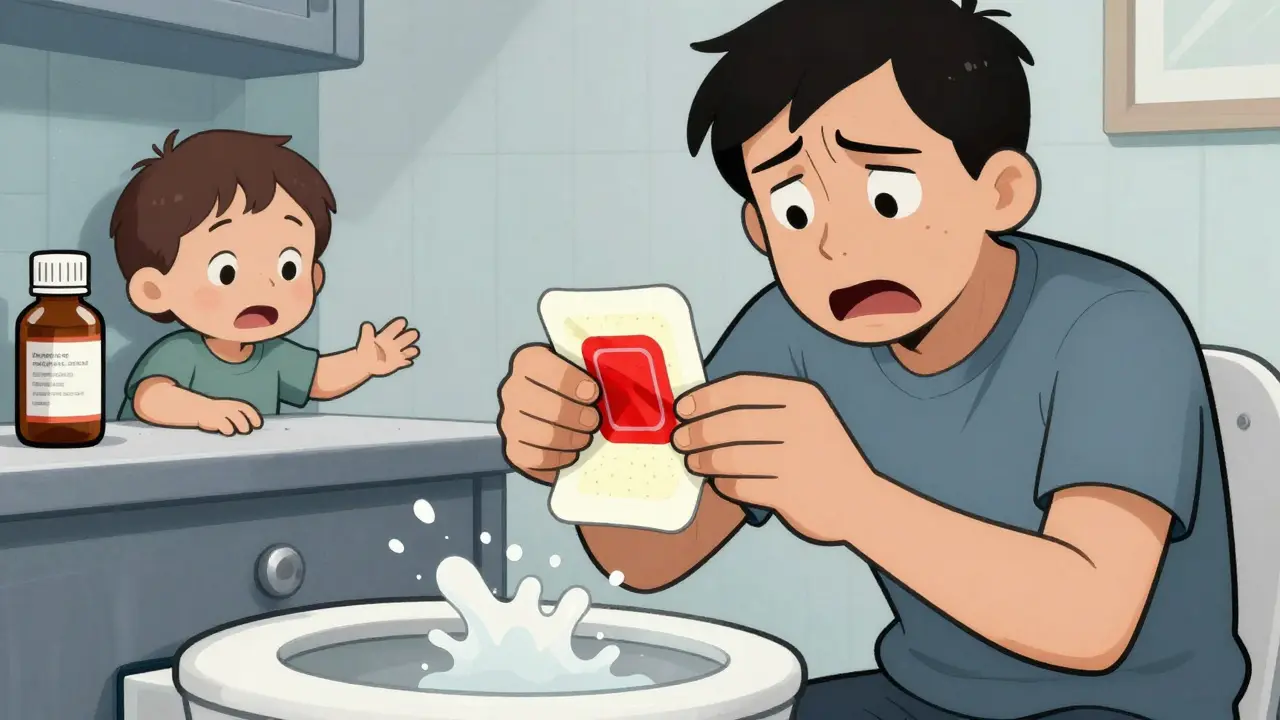
Most people think flushing pills down the toilet is bad for the environment - and they’re right. But there are exceptions. The FDA has a very short list of medications that, under specific conditions, should be flushed immediately - not because it’s convenient, but because not doing so could kill someone.
Why Flushing Is Normally a Bad Idea
Flushing medicine used to be common. People would toss old painkillers, antidepressants, or blood pressure pills into the toilet without thinking. But over time, scientists found traces of these drugs in rivers, lakes, and even drinking water. The EPA stepped in and told everyone: stop flushing. It’s not safe for fish, frogs, or future water supplies.That’s why most drug disposal guides now say: don’t flush. Instead, use a take-back program. Pharmacies, hospitals, and police stations often have drop-off bins. Some towns even host annual collection days. But here’s the problem - not everyone knows where to find them. And if you live in a rural area, the nearest drop-off might be 50 miles away.
When Flushing Is the Only Safe Choice
The FDA doesn’t want you to flush. But they care more about preventing deaths.Some medications are so powerful that a single dose - even a fraction of one - can kill a child, a pet, or an unsuspecting adult. If one of these pills ends up in the trash, and a toddler finds it, the result can be fatal within minutes.
That’s why the FDA created the Flush List. It’s not a suggestion. It’s a last-resort safety rule. The list is tiny - only 15 active ingredients - and it’s updated regularly. The most recent version came out in April 2024.
The FDA Flush List: What Medications Can You Flush?
These are the only medications you’re allowed to flush - and only if you can’t get to a take-back program right away:- Buprenorphine - found in SUBOXONE, SUBUTEX, BELBUCA, BUTRANS
- Fentanyl - in ABSTRAL, ACTIQ, DURAGESIC patches, FENTORA, ONSOLIS
- Hydromorphone - specifically EXALGO extended-release tablets
- Meperidine - sold as DEMEROL
- Methadone - DOLOPHINE, METHADOSE
- Morphine - ARYMO ER, AVINZA, EMBEDA, KADIAN, MORPHABOND ER, MS CONTIN, ORAMPH SR
- Oxymorphone - OPANA and OPANA ER
- Tapentadol - NUCYNTA, NUCYNTA ER
- Sodium oxybate - XYREM, XYWAV
- Diazepam rectal gel - DIASTAT, DIASTAT ACUDIAL
- Methylphenidate transdermal system - DAYTRANA
That’s it. No others. No pain relievers like ibuprofen or acetaminophen. No antibiotics. No antidepressants. Only these. The FDA spent years reviewing overdose data, accidental exposure reports, and death statistics before approving this list. They removed 11 drugs from earlier versions because safer alternatives became available.
Fentanyl Patches: A Special Case
Fentanyl patches are especially dangerous. They’re sticky. They look like bandages. Kids think they’re toys. Pets lick them. Even a used patch can still contain enough fentanyl to kill.The FDA says: if you’re flushing a fentanyl patch, fold it in half - sticky side to sticky side - before you drop it in the toilet. This keeps the drug from leaking out in the pipe and reduces environmental risk. Don’t just toss it in whole. Don’t peel off the adhesive and throw it in the trash. Fold it. Flush it. Immediately.
Between 2010 and 2022, the FDA recorded 217 cases of accidental fentanyl exposure in children. Nine of them died. Most happened because the patch was left in a drawer, on a counter, or in the trash. Flushing is the only way to guarantee it’s gone.
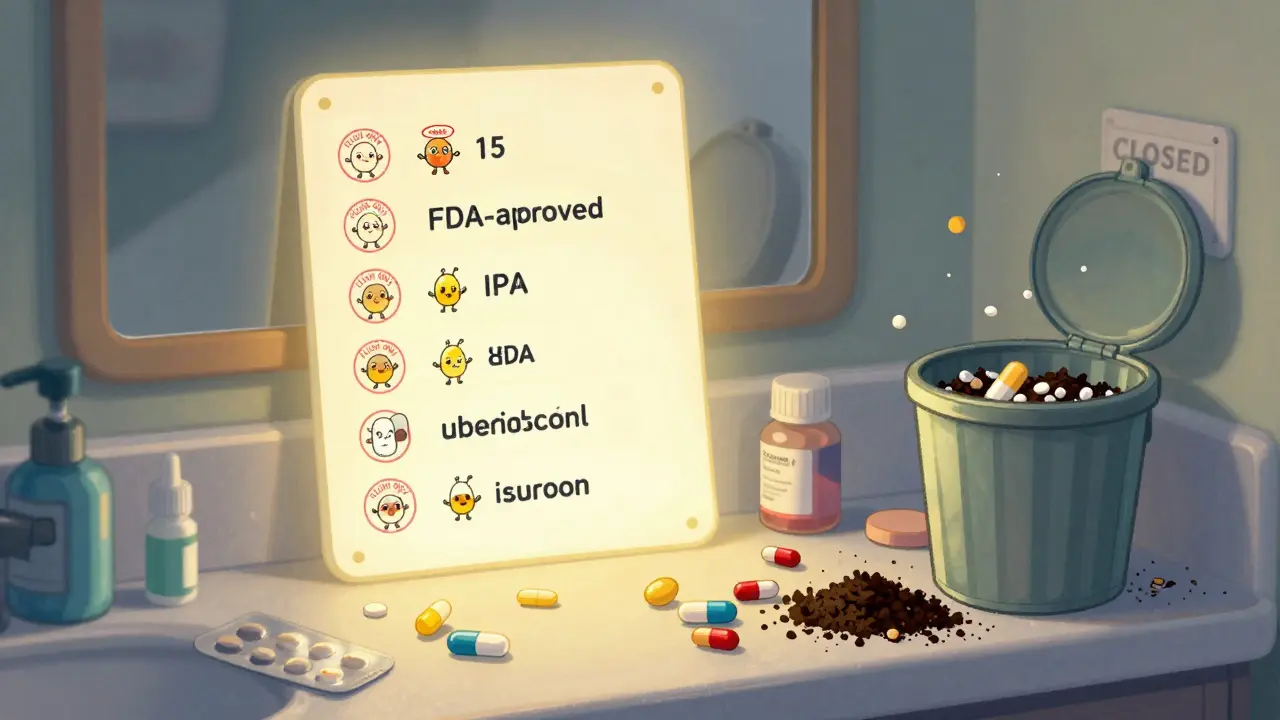
What If You Can’t Find a Take-Back Program?
The FDA’s #1 rule is always: use a take-back program. But if you can’t - and you have one of these drugs - flushing is the right thing to do.Here’s how to check:
- Look at the pill bottle or box. Does it say “Do not flush”? If yes, don’t flush - unless it’s on the FDA list. Then, flush anyway.
- Go to DEA’s website and search for a nearby drop-off location. Many pharmacies participate.
- If there’s nothing within 20 miles, and you’re worried a child or pet might get to the pills, flush them.
Don’t wait. Don’t store them “just in case.” Don’t give them to a friend. Don’t throw them in the trash. If it’s on the list, and you can’t get it to a drop-off, flush it.
What About the Environment?
You’re probably thinking: “But won’t flushing hurt rivers and fish?”Yes, it can. But the FDA weighed that risk against the risk of death. In their 2021 environmental review, they found that the chance of someone dying from accidental exposure to these drugs was thousands of times higher than the risk of environmental harm from flushing them.
Even so, the EPA and FDA agree: flushing should be rare. In 2023, the USGS found detectable levels of flush-list drugs in 23% of tested streams - but at concentrations so low they posed no health risk to aquatic life. That’s because the amount flushed by households is tiny compared to the volume of water in rivers.
Meanwhile, the DEA reports over 12,000 take-back locations across the U.S. - and that number is growing. Thanks to the 2021 Infrastructure Law, funding for these programs has increased by 37% since 2021.
What to Do After Flushing
Once you flush, don’t forget the packaging.Remove any labels with your name, address, or prescription number. Tear them up. Shred them. Throw them away. This protects your privacy and prevents identity theft.
And if you’re using a patch, make sure you flush the whole thing - including the plastic backing. Don’t leave bits behind.

What NOT to Do
Never flush these:- Antibiotics
- Birth control pills
- Aspirin, ibuprofen, or acetaminophen
- Antidepressants
- Cholesterol meds
- Insulin
- Vitamins
Even if they’re expired. Even if they’re taking up space. Even if you’re frustrated. These should go in the trash - mixed with coffee grounds, cat litter, or dirt - to make them unappealing to kids or pets.
And never, ever flush anything from a nursing home, hospital, or clinic. Those places are legally required to use licensed hazardous waste disposal services. Flushing there is a violation.
What’s Changing in 2025?
The FDA is reviewing the Flush List again. In 2023, there were 17 cases of children accidentally exposed to buprenorphine patches. That’s up from just 3 in 2020. The agency is considering adding new transdermal formulations to the list.They’re also looking at whether newer versions of some drugs - like abuse-deterrent opioids - might be safe enough to remove. Early signs suggest 3 drugs on the list could be taken off by 2025.
One thing won’t change: the FDA’s priority. Safety over convenience. Human life over environmental guesswork.
Final Rule: When in Doubt, Flush
If you have a medication on the FDA Flush List - and you can’t get it to a take-back program within a day or two - flush it. Don’t wait. Don’t store it. Don’t hope someone else will handle it.That patch on the counter. That pill in the drawer. That bottle under the sink. If it’s on the list, and you’re not sure what to do, flush it. It’s the only way to be 100% sure it won’t hurt someone.
And if you’re ever unsure whether your drug is on the list, check the FDA’s website. Or call your pharmacist. They know. And they’ll tell you - even if you’re embarrassed to ask.
Comments
Anna Weitz
Flushing fentanyl patches is the most fucked up thing I've ever heard of but also the only thing that makes sense
My cousin died from a patch his kid found in the trash
So yeah if you got one of these and no dropoff nearby just flush it
Stop being lazy and scared of the toilet
December 26, 2025 at 22:58
Liz MENDOZA
This is such an important post thank you for sharing
I work at a pharmacy and so many people come in asking if they can just toss old meds in the trash
I always tell them about the flush list
It's heartbreaking how many families don't know this exists
Especially in rural areas where the nearest drop-off is hours away
Thank you for making this clear and urgent
Also please share this with your grandparents they need to know
December 27, 2025 at 15:21
Raushan Richardson
Yesss this is the kind of info that should be on every prescription bottle
Like a little icon or something
Not just fine print
I had no idea about the flush list until I read this
Now I'm gonna print it out and stick it on my fridge
And tell my mom she's been storing her oxycontin in the bathroom cabinet for 3 years 😳
December 28, 2025 at 01:15
Robyn Hays
Can we just take a moment to appreciate how terrifying it is that a sticky patch that looks like a Band-Aid can kill a toddler
It's like a silent landmine in every household
I used to think flushing was gross
Now I think not flushing is the real crime
And the fact that they removed 11 drugs from the list because safer options came out
That's actually kind of beautiful
Like they're constantly trying to reduce the risk
Not just throw their hands up and say 'oh well'
That's public health done right
December 29, 2025 at 22:48
Liz Tanner
Important clarification: only flush medications explicitly listed on the FDA’s official Flush List.
Do not flush antibiotics, antidepressants, or ibuprofen under any circumstances.
These medications should be mixed with kitty litter or coffee grounds and disposed of in the trash.
Improper disposal contributes to environmental contamination and increases the risk of accidental ingestion.
Always check the label first.
If in doubt, call your pharmacist.
This is not a suggestion-it is a life-saving protocol.
December 30, 2025 at 09:29
Babe Addict
Okay but let’s be real the FDA is just covering their asses
They know the entire opioid crisis was their fault
Now they’re like oh hey if you accidentally poison your kid it’s not our fault we told you to flush it
Meanwhile the pharmaceutical companies made billions off these drugs
And now they’re telling us to flush them like it’s some kind of moral victory
It’s a Band-Aid on a hemorrhage
And the EPA? They’re just happy the water’s not full of opioids
But they’re still fine with microplastics in every fish
So yeah flush your patches
Meanwhile the real problem is still alive and well
December 30, 2025 at 12:03
Satyakki Bhattacharjee
India never had this problem
Our people know better
Why do Americans need a list to know not to poison their children
My grandmother used to burn old medicine
Simple
No flushing
No take-back
Just respect
You don't throw poison in the river
You don't leave it where children can touch
It is basic
Why is America so broken
December 31, 2025 at 09:03
Kishor Raibole
It is with profound regret that I observe the current state of pharmaceutical stewardship in the United States.
The fact that a government agency must issue a formal directive permitting the disposal of potent narcotics via domestic plumbing is not merely a regulatory anomaly-it is a societal indictment.
One cannot help but reflect upon the erosion of familial vigilance, the normalization of pharmaceutical negligence, and the alarming prevalence of domestic environments where lethal substances are left unsecured.
The environmental implications, while statistically negligible, are nevertheless ethically untenable.
Yet the moral imperative to prevent pediatric fatality overrides all other considerations.
This is not a policy-it is a tragedy dressed in bureaucratic language.
And still, we proceed.
January 2, 2026 at 00:17
John Barron
OMG I JUST FLUSHED MY MOM’S METHADONE LAST WEEK 😭
She’s in hospice and I thought I was being responsible by throwing it in the trash
Then I saw this post and I almost cried
Thank you for saving my soul
Also I’m gonna buy a shredder for all my pill bottles
And maybe a lockbox
And maybe therapy
😂
January 2, 2026 at 13:27
Olivia Goolsby
Wait… so the FDA is telling us to flush deadly drugs… but they’re also the same agency that approved OxyContin… and let Purdue Pharma market it like candy… and then when people got addicted… they didn’t do anything… and now they want us to flush the leftovers like it’s a clean slate??
THIS IS A COVER-UP.
They know the water systems are already contaminated with opioids from hospitals and nursing homes… and they’re trying to make it look like it’s just ‘accidental home disposal’…
They’re shifting blame.
They’re hiding the real source.
And now they’re making parents feel guilty for not flushing… while the real criminals are still making billions.
And don’t get me started on the ‘take-back programs’… how many of those are run by the same pharmacies that sold the drugs in the first place??
It’s all connected.
It’s all a lie.
And you’re being manipulated.
January 3, 2026 at 15:27
Alex Lopez
Let me guess-you're the kind of person who thinks flushing pills is 'environmentally irresponsible' but doesn't mind using plastic water bottles for 5 years straight.
Here's the math: one child dies from accidental opioid exposure every 3 days in the U.S.
Meanwhile, the concentration of flush-list drugs in U.S. rivers is 1/10,000th of the EPA’s safety threshold.
So yes, flush the patches.
And yes, your guilt is misplaced.
Also, your 'eco-warrior' persona is just performative.
Go recycle your Amazon boxes instead of judging people who are trying to keep their toddlers alive.
January 4, 2026 at 06:02
Gerald Tardif
Reading this made me realize I’ve been storing my dad’s old pain meds under the sink for 4 years
I told myself I’d deal with it later
But later never comes
So today I flushed the last of his EXALGO
It felt weird
But also right
He wouldn’t want it to hurt someone
And I won’t let his pain become someone else’s tragedy
Thanks for the reminder
It’s not about convenience
It’s about love
January 4, 2026 at 15:53
Monika Naumann
In India, we do not have such problems because our people respect the sanctity of life and the dignity of medicine.
Our elders teach us that drugs are not to be discarded like garbage.
They are to be returned to the temple or the doctor.
It is the American culture of disposability that has led to this crisis.
Not the medicine.
Not the FDA.
But the lack of spiritual discipline.
We must return to tradition.
Not flush.
Not dispose.
But honor.
January 5, 2026 at 16:43
Elizabeth Ganak
my aunt just called me crying because her grandkid opened a drawer and found a fentanyl patch
she flushed it right away
thank god
she didn’t know about the list
but she knew something was wrong
so she did what she had to
thank you for making this so clear
please share this with everyone you know
January 6, 2026 at 15:04