
When you fill a prescription in the U.S., the price you pay at the pharmacy isn't the full cost of the drug. It's a copay - a fixed amount you pay out of pocket, while your insurance covers the rest. But here’s the thing: that amount can vary wildly depending on whether you're getting a generic or a brand-name drug. In 2024, this difference isn't just a small footnote - it can mean hundreds, even thousands, of dollars a year in extra costs. And if you're on Medicare or have a commercial plan, you're probably paying more than you think.
How Copay Tiers Work in 2024
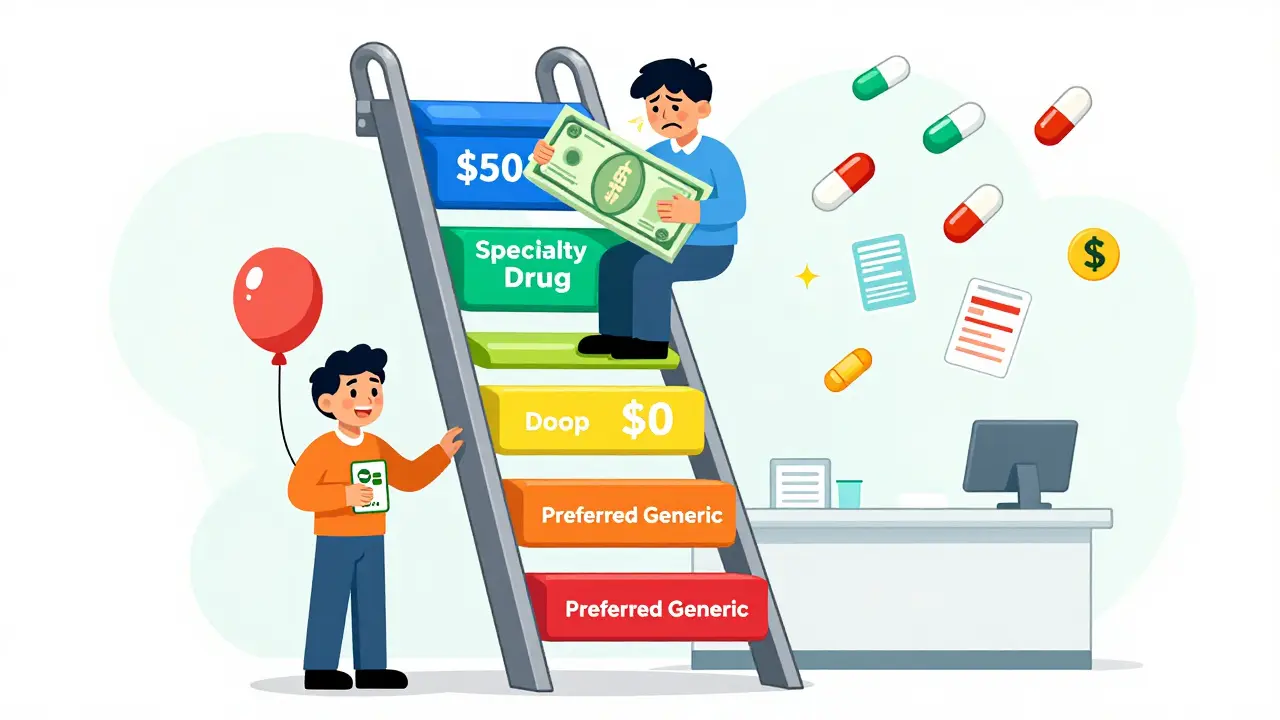
Almost every prescription drug plan in the U.S. uses a tiered system. Think of it like a ladder. The lower the tier, the cheaper your copay. Most plans have four or five tiers, with generics at the bottom and specialty drugs at the top.
- Tier 1: Preferred Generic - These are the cheapest. In 2024, Medicare Part D plans often charge $0 to $5 for these. Some plans even have $0 copays for preferred generics.
- Tier 2: Non-Preferred Generic - Still generic, but not on the plan's preferred list. Copays here usually run $7 to $15.
- Tier 3: Preferred Brand - Brand-name drugs that your plan encourages. Copays range from $35 to $60.
- Tier 4: Non-Preferred Brand - These are the most expensive. Copays can hit $100 or more per prescription.
- Tier 5: Specialty - For complex, high-cost drugs like those for cancer or MS. Copays here are often 30% coinsurance or $150+ per month.
Medicare Advantage Prescription Drug (MA-PD) plans mostly use fixed copays. Standalone Medicare Part D plans (PDPs) often use coinsurance - meaning you pay a percentage of the drug’s price. That can be risky. If your brand-name drug costs $500, and your coinsurance is 47%, you're paying $235 out of pocket. A fixed $100 copay might be cheaper.
Average 2024 Copay Numbers
Let’s cut through the jargon. Here’s what real people paid in 2024 based on Medicare and commercial plan data:
| Drug Type | Medicare Part D (MA-PD) | Medicare Part D (PDP) | Commercial Insurance |
|---|---|---|---|
| Preferred Generic | $0-$5 | 10-20% of cost | 10-20% of cost |
| Non-Preferred Generic | $7-$15 | 20-30% of cost | 20-30% of cost |
| Preferred Brand | $35-$60 | 20-30% of cost | 30-50% of cost |
| Non-Preferred Brand | $100 | 40-50% of cost | Up to 50% + "pay the difference" |
| Specialty Drug | $150-$500+ | 30-40% coinsurance | 30-50% coinsurance |
For people with low income who qualify for Extra Help, the government caps copays at $4.50 for generics and $11.20 for brand drugs - no matter what your plan says. But if you don’t qualify, you’re on your own.
Why Brand Drugs Cost So Much More
Generic drugs are chemically identical to brand-name versions. They work the same way. So why do they cost 10 times less?
It’s not about manufacturing. It’s about patents. Brand-name companies spend years and millions developing a drug. Once the patent expires, other companies can make copies. They don’t have to repeat the research. That’s why a 30-day supply of brand-name Lipitor might cost $300, while generic atorvastatin runs $10.
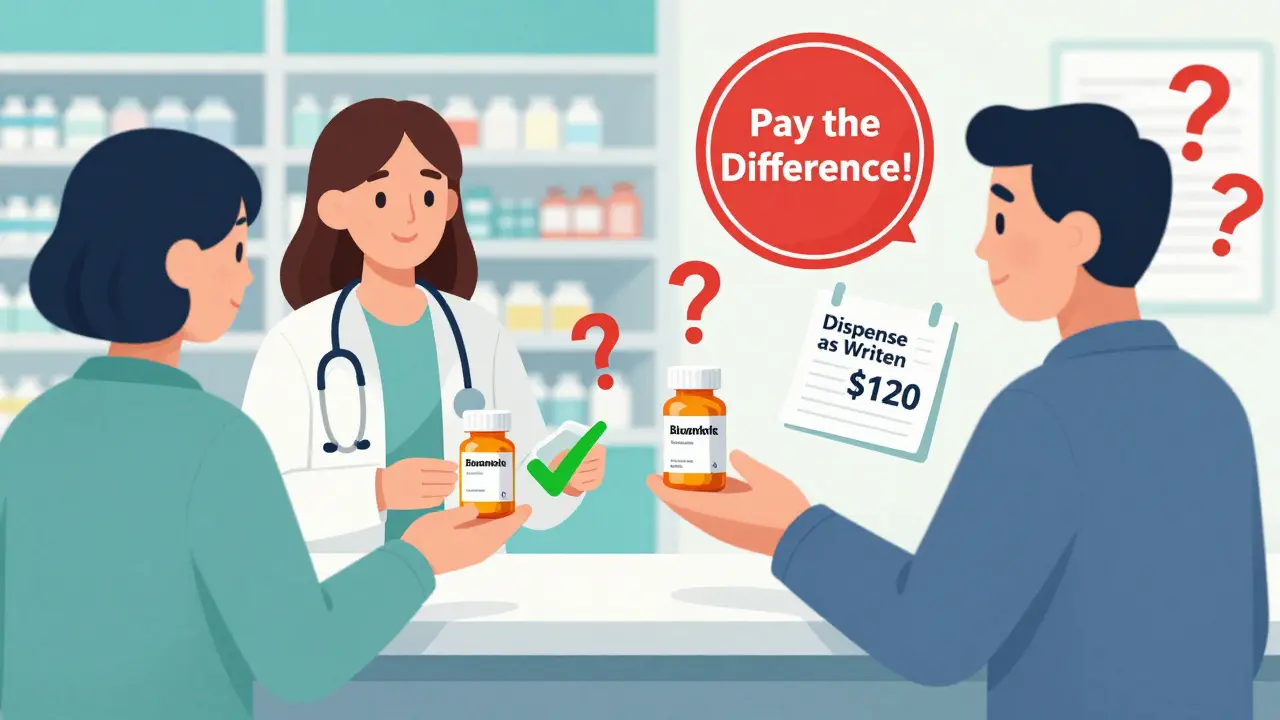
But here’s where it gets messy: your plan might not let you switch. Your doctor might write "dispense as written," meaning the pharmacist can’t substitute the generic. Or worse - your plan might charge you the difference. Some commercial plans have a "Member Pay the Difference" rule. If you pick a brand drug when a generic is available, you pay your copay plus the price gap. One Reddit user paid $42 extra just because his doctor didn’t approve the switch.
What Happens When You Hit the Coverage Gap
Medicare Part D has a "donut hole" - a gap in coverage that kicks in after you and your plan have spent $1,700 on drugs in 2024. From $1,700 to $8,000, you pay 25% of the drug cost. That sounds manageable… until you realize:
- A $100 brand-name drug? You pay $25.
- A $500 specialty drug? You pay $125.
That’s where the real pain starts. People who take multiple brand-name drugs can hit this gap quickly. And even though you pay 25%, the plan still counts the full price toward your out-of-pocket total. That means you’ll reach catastrophic coverage faster - and pay more overall.
The Inflation Reduction Act Changed Everything
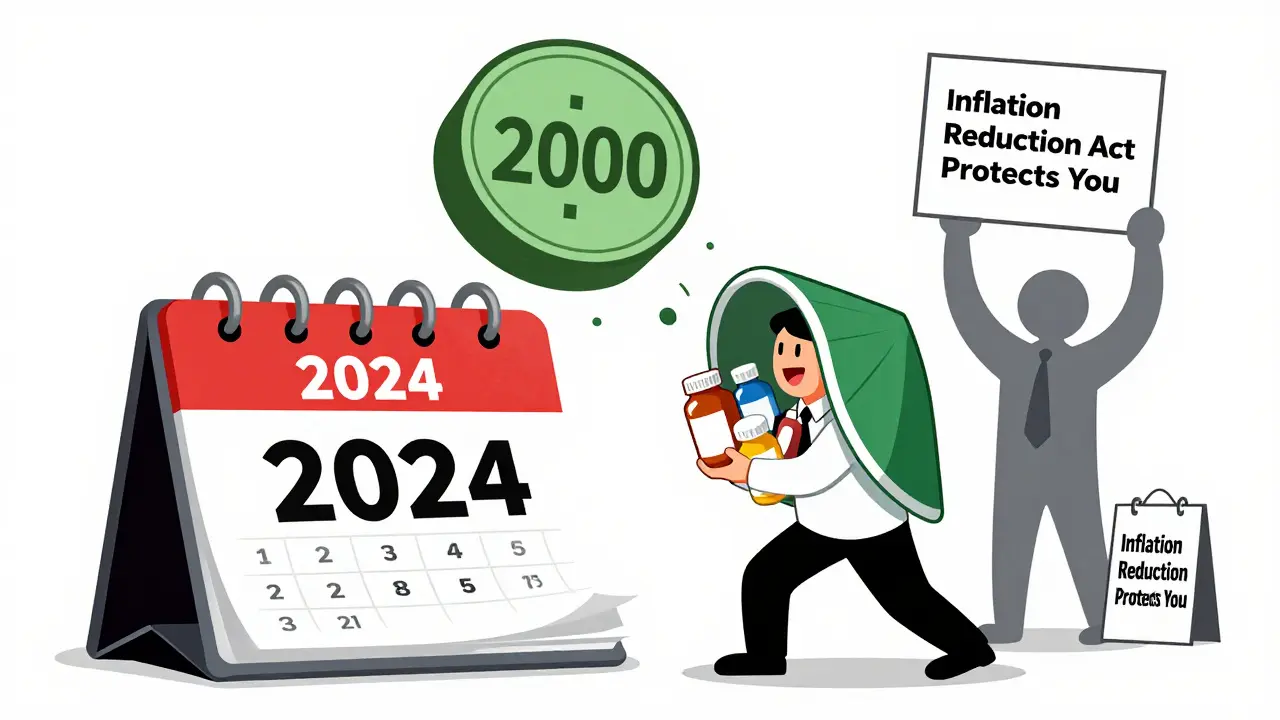
Starting in 2024, the Inflation Reduction Act made big changes:
- Insulin costs are capped at $35 per month - for both brand and generic.
- Catastrophic coverage now caps your total out-of-pocket at $3,800 for the year.
- By 2025, the out-of-pocket maximum drops to $2,000.
These rules help everyone - but they help brand-name users the most. Someone taking expensive biologics for rheumatoid arthritis might save $1,200 a year just from the cap. But if you’re on generics? You were already paying $5 a month. The change helps, but it’s not a game-changer.
What You Can Do Right Now
Don’t just accept what your plan says. Here’s how to take control:
- Check your plan’s formulary. Every plan must publish a list of covered drugs and their tiers. Look for it on your insurer’s website by October each year.
- Use the Medicare Plan Finder. Enter your exact medications. Compare plans side by side. A plan with $0 generics might have $120 brand copays - but if you take 3 brand drugs, it could still cost less than a plan with $10 generics and $50 brands.
- Ask your doctor about alternatives. 72% of Medicare plans offer a generic alternative for common brand drugs. If your current drug isn’t working, ask: "Is there a similar generic on a lower tier?"
- Consider cash prices. Sometimes, paying cash at Walmart or Costco is cheaper than your copay. A 30-day supply of generic metformin might cost $4 cash - but $15 with insurance.
- Use Extra Help if eligible. If your income is under $21,500 (individual) or $29,100 (couple), you may qualify for government help that caps your copays.
Real Stories, Real Costs
A 72-year-old in Florida told the Medicare Rights Center she paid $95 for a 90-day supply of a non-preferred brand drug. The generic version cost $15. Her doctor refused to switch her due to "side effects." She didn’t know she could appeal.
Another man in Texas, on a bronze-level commercial plan, got hit with a $120 charge because his plan said he "chose the brand over the generic." His doctor wrote "dispense as written," but the plan still made him pay the difference.
Meanwhile, people on generics report satisfaction. Plans with $0 generic copays have 4.7/5-star ratings. Plans with high generic costs? They average 3.2/5.
What’s Coming in 2025
By January 2025, 98% of Medicare Part D plans will offer $0 copays for preferred generics. That’s up from 87% in 2024. Non-preferred brand copays are expected to rise to $105. But the real shift? The $2,000 annual out-of-pocket cap. That means even if you’re on five expensive brand drugs, you won’t pay more than $2,000 for the year. It’s the biggest change to drug pricing in 20 years.
But beware: some wholesalers are still manipulating generic drug prices. Independent pharmacies report being forced to pay higher prices for generics just to get better deals on brand drugs. That trickles down - even if your copay is $0, the system is still rigged.
Final Advice
Don’t assume your plan is fair. Don’t assume your doctor knows your copay. And don’t assume generics are "lesser." They’re the same medicine, often cheaper, and sometimes better for your wallet.
If you take one drug, check the price. If you take three, compare plans. If you take five, consider a free plan review. Many nonprofit groups offer them for free. The average savings? $420 a year.
The system isn’t perfect. But you’re not powerless. With the right info, you can cut your drug costs - no matter if you’re on Medicare, Medicaid, or a commercial plan.
Why is my generic drug more expensive than the brand?
It’s rare, but it can happen. Some pharmacies charge more for generics if they have to order them in small batches. Or, your plan might not have a preferred generic on formulary. Cash prices at retailers like Walmart are often cheaper than insurance copays. Always compare.
Can I switch from a brand drug to a generic?
Yes - but your doctor must agree. Some medications, like seizure drugs or thyroid meds, require close monitoring. Your doctor may prefer to keep you on the brand. If you’re paying too much, ask: "Is there a therapeutic equivalent on a lower tier?" Many plans allow substitutions if the doctor approves.
What if my plan doesn’t cover a generic I need?
You can file an exception request. If your doctor says the generic won’t work for you, they can submit documentation. Medicare and commercial plans must respond within 72 hours for urgent cases. If denied, you can appeal. Many people win these appeals.
Do all insurance plans have the same copay structure?
No. Medicare Advantage plans usually have fixed copays. Standalone Medicare Part D plans often use coinsurance. Commercial plans vary wildly - some charge a percentage, others use "pay the difference" rules. Always check your specific plan’s formulary before choosing.
Is it worth switching plans just for lower copays?
If you take regular prescriptions, yes. A plan with a $5 generic copay but $100 brand copay might cost you $1,200 a year for one brand drug. A different plan with $0 generics and $40 brand copays might cost only $480. Use the Medicare Plan Finder. It takes 10 minutes. You could save hundreds.
Comments
Jessica Chaloux
Ugh, I just paid $87 for my brand-name thyroid med. The generic is $12 but my doctor won’t switch me. Like, I get it, but I’m on a fixed income. 😭 Why do they make this so hard? I’m crying into my coffee right now.
March 2, 2026 at 23:18
Mariah Carle
It’s not just about cost-it’s about power. The system is designed to make you feel powerless so you’ll keep paying. Generics are chemically identical, yet we treat them like second-class citizens. This is capitalism’s quiet violence. 🤔
March 3, 2026 at 04:32
Raman Kapri
The data presented is misleading. Medicare Part D coinsurance figures are averaged across all drugs, not representative of typical usage. Most beneficiaries take only one or two medications. Furthermore, the claim that ‘$0 generics’ are widespread is inflated-only 17% of plans offer this for non-preferred generics. Your source lacks transparency.
March 4, 2026 at 11:11
Megan Nayak
Let’s be real-the entire pharmaceutical industry is a pyramid scheme built on fear. Doctors don’t care about your copay. Pharmacies don’t care. Insurance companies? They’re just middlemen with spreadsheets and zero empathy. I once had to choose between my insulin and my rent. I chose rent. 💔
And now we’re supposed to be grateful for a $35 insulin cap? Like, congrats? We’re still paying $250 for my other meds. This isn’t reform. It’s a PR stunt with a side of guilt-tripping.
March 5, 2026 at 22:29
Tildi Fletes
According to the 2024 Medicare Advantage Benchmark Report, 89% of plans now offer preferred generics at $0 copay, up from 78% in 2023. The most significant improvement has been in plans serving rural populations, where prior-year gaps in access were most acute. Additionally, the ‘pay the difference’ policy has been eliminated in 14 states as of Q1 2024 under state-level mandates. Patients should verify their formulary annually via the CMS website, not third-party aggregators, which often lag in updates. For those on commercial insurance, consider requesting a formulary exception if a therapeutic equivalent exists on a lower tier. Documentation from your provider increases approval rates by 63%.
March 6, 2026 at 12:16
Alex Brad
Check your formulary. Ask your doctor. Compare cash prices. Do all three. It takes 10 minutes. You’ll save money.
March 7, 2026 at 19:55
Renee Jackson
Every single person reading this has the power to advocate for themselves-and you’re not alone. The system is broken, but your voice matters. Reach out to a nonprofit like Medicare Rights Center. They offer free plan reviews. You deserve to breathe without worrying about your next prescription. You are worthy of care. You are not a burden. 💪❤️
March 9, 2026 at 07:25
RacRac Rachel
OMG YES!! I switched from brand to generic for my blood pressure med and saved $210/month 😍 I didn’t even know I could! My pharmacist said ‘most people don’t ask’-so I asked. And then I told my whole family. 🙌 Also, Walmart’s $4 generic metformin? LIFE CHANGER. 🥹✨
March 11, 2026 at 04:54