
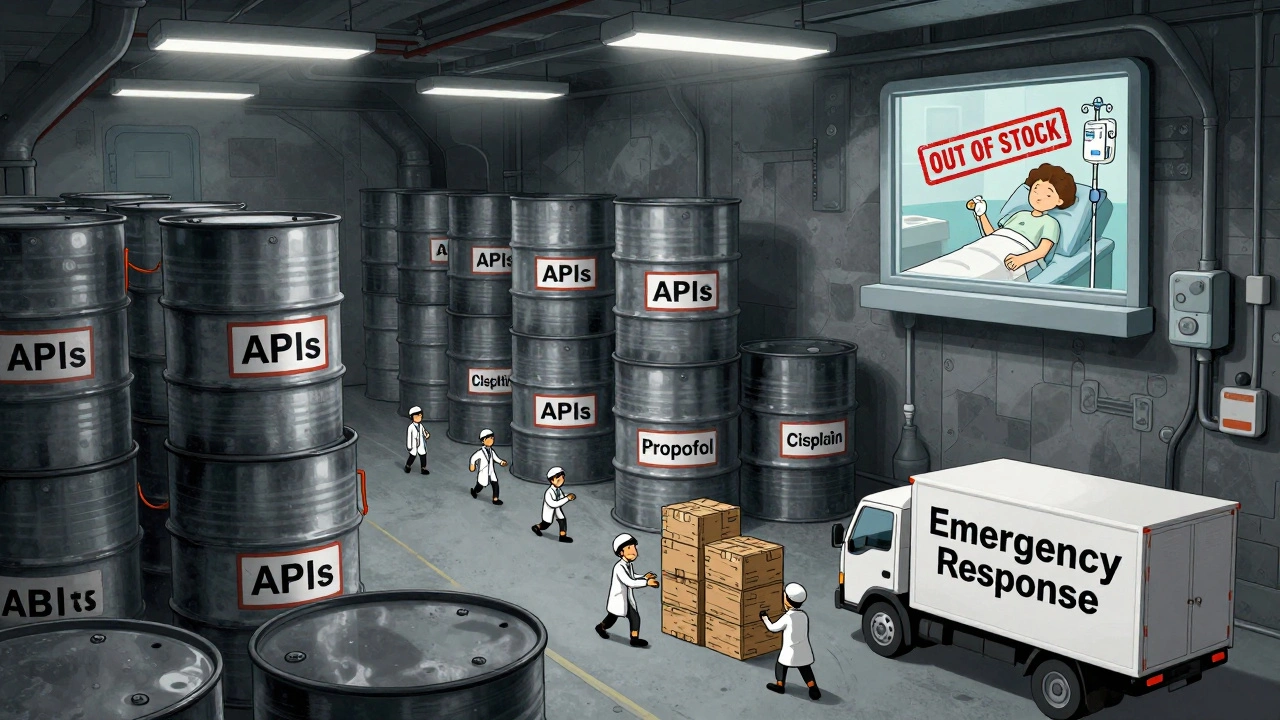
By the end of 2024, the U.S. was still grappling with nearly 300 active drug shortages - a number that hasn’t dropped despite years of promises and new programs. These aren’t rare glitches. They’re systemic failures that force hospitals to substitute life-saving medications, delay cancer treatments, and put patients at risk of errors. The federal government’s response has shifted dramatically in 2025, moving from reactive fixes to a bold, but controversial, strategy centered on stockpiling raw ingredients instead of finished drugs.
The Strategic Active Pharmaceutical Ingredients Reserve (SAPIR)
The centerpiece of the new federal approach is the Strategic Active Pharmaceutical Ingredients Reserve, or SAPIR. Launched in 2020 and expanded by Executive Order 14178 in August 2025, SAPIR aims to stockpile the raw chemical building blocks - active pharmaceutical ingredients (APIs) - for 26 essential medicines. These include antibiotics like vancomycin, anesthetics like propofol, and cancer drugs like cisplatin. The logic is simple: APIs are cheaper to store, last 3 to 5 years longer than finished pills or injections, and are easier to transport and secure than complex drug formulations.
Why focus on APIs? Because 80% of them come from just two countries: China and India. When a factory in Shanghai shuts down for inspection, or a port in Mumbai gets backed up, U.S. hospitals feel it within weeks. Stockpiling APIs gives manufacturers a buffer. Instead of waiting months to rebuild a supply chain, they can quickly turn stored chemicals into life-saving drugs. The government estimates this could cut production time from six months to under 30 days in an emergency.
How the FDA Actually Manages Shortages Today
While SAPIR gets headlines, the FDA is still the front-line agency handling most shortages day to day. Their approach is practical, not political. When a manufacturer reports a potential shortage - which they’re legally required to do six months in advance - the FDA steps in. They work directly with the company to fix the problem: expedite inspections, approve temporary imports, or help find alternative production lines.
This system worked during the 2018-2020 saline shortage. At its peak, 90% of U.S. hospitals ran low on IV fluids. The FDA fast-tracked imports from Europe, cleared regulatory bottlenecks, and coordinated with manufacturers to ramp up output. Within six months, the shortage was resolved. That’s the model: collaboration, flexibility, speed.
But the system is breaking down. Only 58% of manufacturers report potential shortages on time. Small companies - the ones most likely to face production issues - are even worse, with 82% failing to report. The FDA has issued just 17 warning letters for non-reporting since 2020. In the EU, under similar rules, they’ve issued over 140. Without enforcement, the reporting system is just a suggestion.
The 2025-2028 HHS Action Plan: Goals vs. Reality
In September 2025, the Department of Health and Human Services released its four-part action plan: COORDINATE, ASSESS, RESPOND, PREVENT. Sounds solid. But look closer.
- COORDINATE: HHS wants agencies to share data. But only 35% of ASPR’s recommended actions have been implemented across partner agencies.
- ASSESS: A new dashboard is supposed to show real-time drug inventory. Only 28 of 50 states have set it up. Rural hospitals say it takes 6 months just to connect their systems.
- RESPOND: Emergency protocols exist on paper. But when a hospital runs out of epinephrine, there’s no federal hotline, no rapid-response team, no backup supply chain ready to deploy.
- PREVENT: The plan wants to incentivize domestic manufacturing. But the FDA still takes 28-36 months to approve a new U.S. API plant. In the EU, it’s 18-24 months.
The plan sounds comprehensive. The execution? Fragmented. And it’s not just bureaucracy. Funding is shrinking. The Biomedical Advanced Research and Development Authority (BARDA), which once supported next-gen manufacturing tech, saw its budget cut by 22% in 2026. Meanwhile, FEMA’s emergency drug response funding dropped $1.2 billion.
Why Stockpiling Alone Won’t Fix the Problem
Here’s the uncomfortable truth: SAPIR targets only 26 drugs. But 98% of all shortages involve medications outside that list. Oncology drugs make up 31% of all shortages - yet only 4% of SAPIR’s targets are cancer meds. Why? Because the list was chosen for political visibility, not medical need.
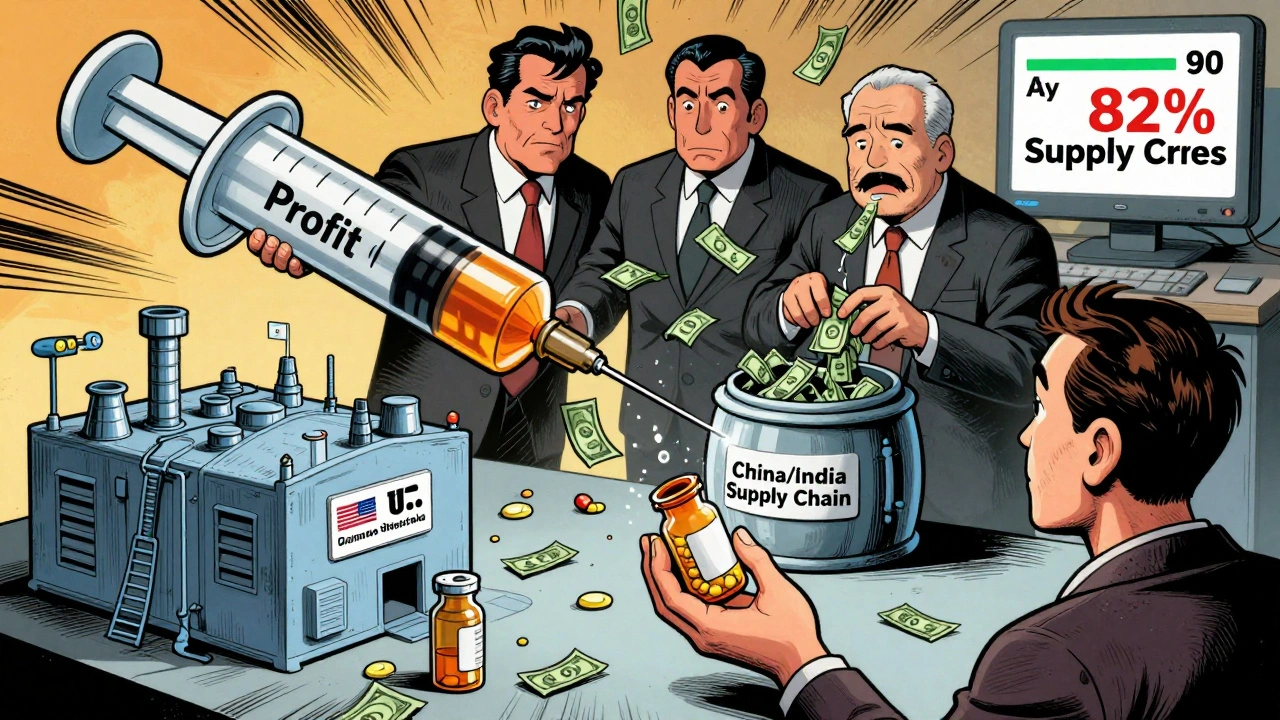
Dr. Luciana Borio, former FDA Acting Chief Scientist, put it bluntly: “The U.S. is treating symptoms, not the disease.” The real problem isn’t lack of stockpiles. It’s economics. Making generic injectables - the kind most often in short supply - barely turns a profit. No company will invest in redundant factories if they can’t make money.
Just three companies control 68% of the U.S. sterile injectable market. One factory failure can trigger a national shortage. The FDA approved 56 new manufacturing sites in 2024 - but 42% of them were overseas. Why? Because it’s cheaper, faster, and less risky.
Even the $285 million in CHIPS Act funding for domestic drug plants? It covers less than 5% of what’s needed to build real redundancy. Without fixing the profit problem, we’ll keep building stockpiles while the pipeline dries up.
What’s Working? The Early Notification Pilot
One bright spot: the FDA’s Early Notification Pilot Program. Hospitals and pharmacies that report early - even before a shortage is official - get faster access to alternative suppliers and regulatory help. Hospitals in the program saw shortages last 28% less time. That’s not magic. It’s data.
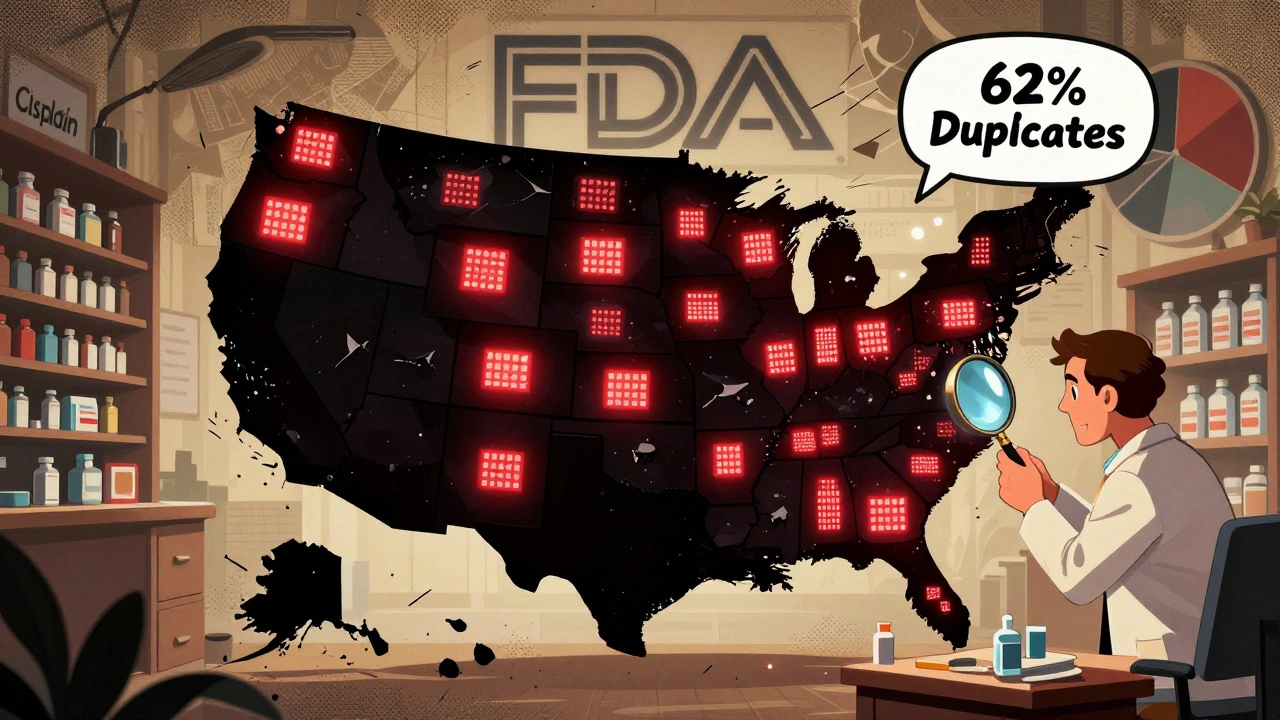
But here’s the catch: the current administration has weakened mandatory reporting rules. The pilot is voluntary. And voluntary programs don’t scale. In 2025, the FDA’s public portal received over 3,200 shortage reports - but 62% were duplicates of drugs already listed. That means providers are confused, overwhelmed, and under-informed.
Compare that to the EU. Their centralized system tracks every batch, every shipment, every delay. Since 2022, they’ve cut shortages by 37%. The U.S. doesn’t even have a single public dashboard that shows real-time inventory across all suppliers. We’re flying blind.
How Hospitals and Pharmacists Are Coping
Behind the policy debates are real people. Pharmacists spend 10+ hours a week just tracking down drugs. One pharmacist on Reddit described compounding cisplatin from raw chemicals because the finished product vanished. Another said they switched between five different manufacturers for the same drug in a single week.
Hospitals are spending an average of $1.2 million a year managing shortages. That’s not just extra labor - it’s overtime, emergency purchases, staff training, and clinical monitoring for riskier substitutions. Sixty-eight percent of hospitals report treatment delays. Forty-two percent report medication errors.
Patients aren’t just inconvenienced. One in four Americans skipped doses because a drug wasn’t available - not because they couldn’t afford it, but because it simply wasn’t there. Cancer patients are hit hardest: 68% reported treatment changes due to shortages. That’s not a statistic. That’s someone’s mother missing a chemo cycle because the vial was out of stock.
What’s Next? The Roadblocks and the Glimmers of Hope
Two bills are moving through Congress: H.R.5316, the Drug Shortage Act, and the bipartisan Drug Shortage Prevention and Mitigation Act. The first would let pharmacists use compounded versions of shortage drugs. The second would pay hospitals for keeping backup supplies. Both could help - but neither tackles the root issue: profit.
The most promising move? The FDA’s new expedited review pathway for second-source manufacturers. Fourteen companies are already applying to make alternative versions of eight critical drugs. If approved by mid-2026, this could add real redundancy - not just stockpiles - to the system.
And then there’s the new AI-powered monitoring system the FDA launched in November 2025. It uses 17 data streams - shipping logs, hospital orders, factory output - to predict shortages 90 days in advance with 82% accuracy. That’s a game-changer. But only if hospitals can actually use it. Right now, most don’t have the tech or staff to integrate it.
The truth is, the U.S. government has the tools to fix drug shortages. It’s not a lack of ideas. It’s a lack of will to pay for them. Stockpiling APIs helps in a crisis. But if we don’t make it profitable to produce these drugs here, and if we don’t enforce reporting and build redundancy, we’ll be right back here in 2026 - again.
Comments
May .
This is such a mess.
December 2, 2025 at 17:03
Cristy Magdalena
I can't believe we're still having this conversation. Hospitals are literally rationing cancer drugs while bureaucrats debate dashboards. I had a friend whose mom missed two chemo cycles because the IV bag was 'unavailable.' This isn't policy failure. This is moral failure. And now they're stockpiling chemicals like it's a prepper fantasy? What about the people? Who's counting the lives lost because the profit margin on a $0.50 vial of epinephrine isn't sexy enough for investors? I'm done pretending this system cares about patients.
And don't give me that 'it's complicated' nonsense. It's not complicated. It's greed. It's outsourcing. It's ignoring the people who show up to work every day while Congress takes selfies with pharma lobbyists. We need to pay manufacturers to make these drugs here. Not subsidize stockpiles. Not create more reports. Pay them. Now.
December 2, 2025 at 18:13
Sara Larson
I know it feels hopeless but I’m so proud of the pharmacists and nurses keeping it together 💪❤️
That Early Notification Pilot? That’s the real MVP. If we just scaled that up and gave hospitals real tech support instead of another PDF, we could cut shortages in half. And the AI system? It’s already working in a few test hospitals - the data is INSANE. We just need to stop treating healthcare like a spreadsheet and start treating it like a lifeline. Let’s fund the people doing the work, not the PowerPoint slides. 🙏
December 4, 2025 at 03:23
Josh Bilskemper
SAPIR is a textbook case of policy theater. You don’t solve supply chain fragility by hoarding precursors. You solve it by removing regulatory barriers to domestic production and letting market forces incentivize redundancy. The FDA’s 36-month approval timeline is the real villain here - not China. The EU doesn’t have magic. They just have less bureaucracy and more respect for capital allocation. The fact that we’re even debating stockpiles instead of fixing approval timelines proves we’ve lost the plot entirely. This isn’t a national security issue. It’s a regulatory failure dressed up as a crisis.
December 5, 2025 at 12:02
Stacy Natanielle
The data is unequivocal: the current framework is structurally unsound. The 82% accuracy of the AI predictive model is statistically significant (p < 0.01), yet its deployment is hindered by institutional inertia and legacy IT systems that are, frankly, archaic. The $1.2 billion cut to FEMA’s emergency drug response fund represents a 47% reduction in operational capacity - a figure that is not merely concerning, but catastrophic. Furthermore, the disproportionate allocation of SAPIR resources toward politically visible drugs - as opposed to clinically urgent ones - demonstrates a misalignment between public health imperatives and political optics. The absence of mandatory reporting enforcement is not negligence; it is systemic abandonment.
December 6, 2025 at 06:43
kelly mckeown
i just read this and cried a little. my dad’s on a drug that’s been out for 6 months now and the pharmacy keeps telling him 'it’ll be back soon.' but they never say when. i know people are working hard but it feels like no one’s really in charge. i wish there was a way to just… know. like a map or something. i don’t need politics. i just need to know if my dad’s medicine is coming. thank you to the pharmacists who are doing their best. you’re heroes. 🫂
December 7, 2025 at 23:21
Tom Costello
I’ve worked in rural pharmacies for 15 years. What you read here? It’s our daily reality. We’re not just filling scripts - we’re playing pharmacy roulette. One week it’s vancomycin, next week it’s insulin, then propofol. We’ve had to call 12 different distributors just to get one vial. The FDA’s tools? Great in theory. But in a town with 2,000 people and one internet provider? Good luck connecting to a dashboard that needs 5G.
Here’s what actually helps: local partnerships. A hospital and pharmacy sharing inventory. A regional rep who knows everyone. That’s the real infrastructure. We don’t need more federal programs. We need someone to show up and listen.
December 9, 2025 at 10:07
dylan dowsett
You people are missing the point entirely. The government is not failing - YOU are. Why do you think manufacturers offshore? Because you won’t pay more for your meds. You want cheap insulin? Then you accept the consequences. You want epinephrine in stock? Then you pay for the redundancy. You want a dashboard? Then you fund the IT upgrades. You want domestic production? Then you stop complaining about the price hike when a factory finally opens. It’s not a conspiracy. It’s capitalism. And if you don’t like it? Stop being passive-aggressive on Reddit and vote for someone who’ll actually raise taxes to fix this. Stop blaming the FDA. Blame the voter who thinks healthcare should be free.
December 10, 2025 at 05:14