
Every day, millions of people take generic drugs without even realizing it. They’re cheaper, just as effective, and often sit right next to brand-name pills on pharmacy shelves. But how are they actually made? It’s not just copying a pill and selling it for less. The process is tightly controlled, scientifically complex, and regulated down to the last milligram. If you’ve ever wondered why a $5 generic version of a $500 brand drug works the same way, here’s exactly how it’s done.
Starting with the Original: Reverse Engineering the Brand-Name Drug
Before a single batch of generic medicine is made, manufacturers have to figure out exactly what’s inside the brand-name version. This isn’t about stealing secrets-it’s required by law. The FDA calls the original drug the Reference Listed Drug (RLD). Generic makers must analyze it completely: the active ingredient, the fillers, the coating, even how it dissolves in the body. They use advanced lab tools to break down the pill or capsule. They identify every chemical, measure particle sizes, and test how the drug releases over time. This step is critical because even small differences in excipients-like lactose or starch-can change how fast the medicine gets absorbed. One pharmaceutical engineer on Reddit shared that a slight change in lactose particle size once ruined an entire batch of tablets because it altered how tightly they compressed. This reverse engineering isn’t guesswork. It’s science. And it’s the foundation for everything that comes next.Designing the Formula: Quality by Design (QbD)
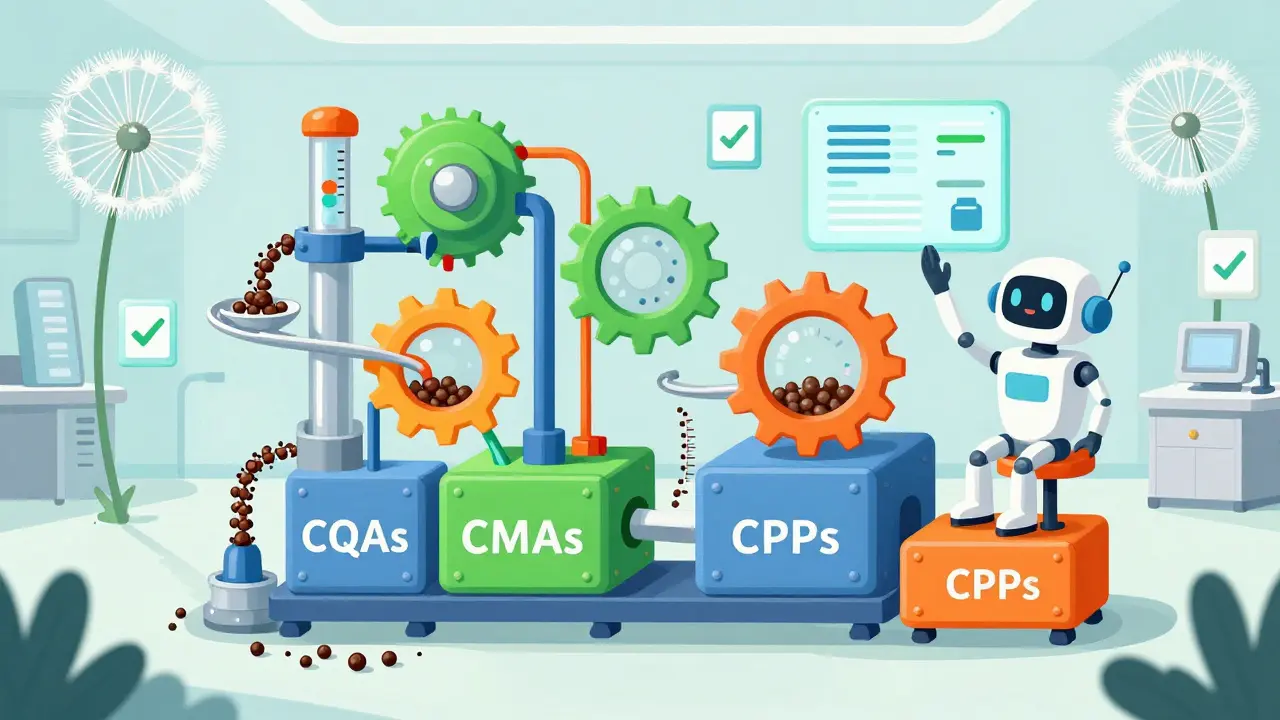
Once they know what the original drug is made of, manufacturers start designing their own version. But they don’t just copy it exactly. They use a system called Quality by Design (QbD), which is now the global standard for drug manufacturing. QbD asks three key questions:- What are the critical quality attributes (CQAs)? These are the features that affect safety and effectiveness-like how quickly the drug dissolves or how stable it is over time.
- What raw materials affect those attributes? These are the critical material attributes (CMAs), like the purity of the active ingredient or the moisture content of the filler.
- What steps in the process change those attributes? These are the critical process parameters (CPPs)-temperature, pressure, mixing time, drying speed.
The Manufacturing Steps: From Powder to Pill
Once the formula is locked in, production begins. The process is highly controlled and follows strict steps:- Formulation: The active pharmaceutical ingredient (API) is mixed with excipients like binders, fillers, and lubricants. This mixture must be perfectly uniform. Even a few grams of uneven distribution can lead to some pills being too strong and others too weak.
- Mixing and Granulation: The powder blend is turned into granules-tiny clumps that flow better and compress evenly. Wet granulation uses liquid binders; dry granulation uses rollers. The method chosen affects how the tablet breaks down later.
- Drying: If wet granulation was used, the granules are dried in ovens at precise temperatures. Too much heat? The active ingredient can degrade. Too little? Moisture ruins shelf life.
- Compression and Encapsulation: Granules are pressed into tablets using high-speed machines. Each tablet must weigh within ±5% for pills under 130mg, or ±7.5% for heavier ones. Capsules are filled with powder using automated fillers that measure each dose down to the microgram.
- Coating: Tablets get a thin outer layer. This isn’t just for looks. Coatings protect the drug from moisture, mask bitter tastes, control release timing, or make the pill easier to swallow. The coating must be consistent-too thick, and the drug won’t absorb properly.
- Quality Control: At every stage, samples are tested. Tablets are checked for weight, hardness, dissolution rate, and purity. A single batch can go through 50+ tests before it’s approved.
- Packaging and Labeling: Pills are sealed in blister packs or bottles with child-resistant caps. Labels must match the brand-name drug’s wording exactly-dosage, warnings, expiration date. But the color and shape? Those can be different. U.S. law actually bans generics from looking identical to brand-name drugs to avoid confusion.
Proving It Works: Bioequivalence Testing
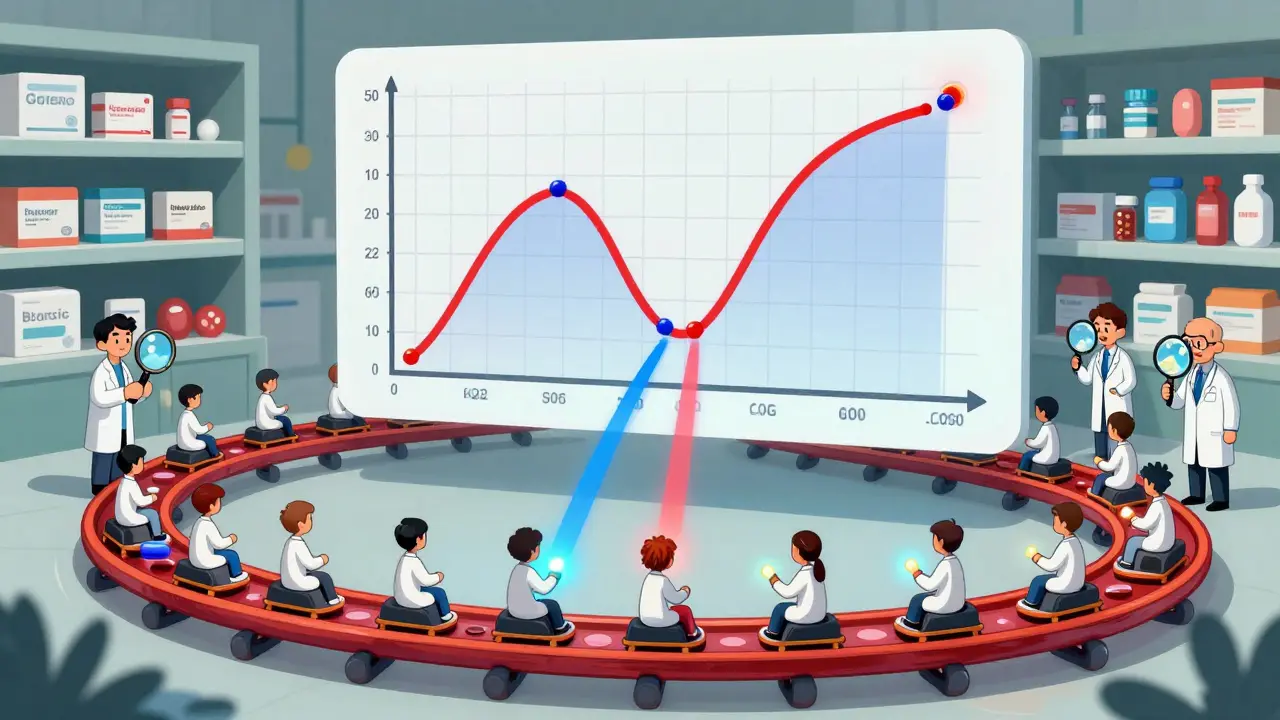
You can make a pill that looks and feels like the brand-name version-but if your body doesn’t absorb it the same way, it’s not a generic. It’s just a copy. That’s why the FDA requires bioequivalence testing. In a controlled study, 24-36 healthy volunteers take both the generic and the brand-name drug on separate days. Blood samples are taken over several hours to measure how much of the drug enters the bloodstream and how fast. The generic is approved only if:- The maximum concentration (Cmax) is within 80-125% of the brand-name drug.
- The total exposure (AUC) is also within 80-125%.
Getting Approved: The ANDA Process
To sell a generic drug in the U.S., manufacturers must submit an Abbreviated New Drug Application (ANDA) to the FDA. Unlike brand-name drugs-which require years of clinical trials-ANDAs are called "abbreviated" because they don’t need to prove safety and efficacy from scratch. They rely on the brand-name drug’s existing data. The ANDA process has five stages:- Submission: The application includes detailed info on the drug’s chemistry, manufacturing, testing, and bioequivalence results. It’s often 5,000-10,000 pages long.
- Review: The FDA spends about 17 months reviewing it. Complex drugs-like inhalers or slow-release pills-can take up to 36 months.
- Inspection: The FDA sends inspectors to the manufacturing plant. They check for compliance with Current Good Manufacturing Practices (CGMP). Common issues? Poor record-keeping, unexplained test failures, or lack of training.
- Labeling Approval: The label must match the brand-name drug’s in all key details-dosage, warnings, indications.
- Post-Approval Monitoring: Even after approval, the FDA keeps watching. They inspect facilities randomly and track adverse events.
Why Some Generics Are Harder to Make
Not all generic drugs are created equal. Simple pills-like metformin or lisinopril-are easy to copy. But complex products? That’s where things get tough. Topical creams, inhalers, injectables, and extended-release tablets are harder because:- You can’t just test blood levels-skin absorption or lung deposition matters more.
- Physical properties like particle size, viscosity, or spray pattern affect how the drug works.
- Traditional bioequivalence tests don’t always predict real-world results.
Quality Concerns and Real-World Results
Some people worry that cheaper means lower quality. But the data tells a different story. A 2023 survey found that 89% of pharmacists have high confidence in generic drugs. Only 3% reported any meaningful difference in patient outcomes. There have been recalls-like Teva’s 2021 recall of 14 products due to CGMP violations in Puerto Rico. But these are exceptions, not the rule. The FDA issued 122 warning letters to generic manufacturers in 2023, mostly for documentation errors or inadequate investigations of failed tests-not for unsafe products. One real success? The generic version of Sovaldi (sofosbuvir), which cut the cost of hepatitis C treatment from $84,000 to $28,000 per course-with no drop in cure rates. The biggest risk isn’t quality-it’s consistency across multiple manufacturers. A patient switching between different generic brands might get slightly different dissolution rates. For most people, this doesn’t matter. But for drugs with a narrow therapeutic index-like warfarin or levothyroxine-it can. That’s why doctors sometimes stick with one brand or generic. It’s not because generics are unsafe. It’s because small differences can add up over time.What’s Next for Generic Drugs?
The future of generics is changing fast:- Continuous Manufacturing: Instead of making drugs in batches, some factories now run production nonstop. Vertex’s cystic fibrosis drug uses this method and now has 99.98% batch acceptance-up from 95% with old methods.
- AI in Quality Control: Pfizer’s pilot program used AI to inspect pills for defects. It cut visual inspection errors by 40%.
- Digital Twins: Manufacturers are creating digital replicas of their production lines to predict problems before they happen.
- Authorized Generics: Brand-name companies now sell their own generics under different labels. In 2023, they captured 23% of first-generic market share.
Final Thoughts
Generic drugs aren’t cheap knockoffs. They’re scientifically engineered copies, built to the same standards as brand-name drugs, but without the marketing costs. The process is long, expensive, and highly regulated. Every pill you take has passed through labs, cleanrooms, and FDA inspections. The next time you pick up a $5 generic, remember: it’s not luck. It’s precision. And it’s one of the most successful public health innovations in modern history.Are generic drugs as safe as brand-name drugs?
Yes. The FDA requires generic drugs to have the same active ingredients, strength, dosage form, and route of administration as the brand-name version. They must also prove bioequivalence-meaning they’re absorbed in the body at the same rate and extent. Generic drugs go through the same quality controls and inspections as brand-name drugs. The FDA reports that 90% of U.S. prescriptions are filled with generics, and they’ve saved over $1.7 trillion in the past decade without compromising safety.
Why do generic drugs look different from brand-name drugs?
U.S. trademark law prohibits generic drugs from looking identical to brand-name versions. This prevents confusion and ensures patients can tell them apart. Differences in color, shape, or flavor come from using different inactive ingredients (excipients), which don’t affect how the drug works. The active ingredient and its effect remain the same.
How long does it take to make a generic drug?
It typically takes 3-4 years and $5-10 million to develop and approve a generic drug, compared to 10-15 years and over $2 billion for a new brand-name drug. The timeline includes formulation development, bioequivalence testing, regulatory submission, and facility inspections. Complex generics-like inhalers or extended-release tablets-can take longer, sometimes up to 7 years.
Can switching between different generic brands affect my treatment?
For most medications, switching between generic brands has no effect. But for drugs with a narrow therapeutic index-like warfarin, levothyroxine, or seizure medications-small differences in absorption can matter. If you’re on one of these, your doctor may recommend sticking with the same generic manufacturer to avoid potential fluctuations in blood levels. Always talk to your pharmacist or doctor before switching.
Why are generic drugs so much cheaper?
Generic drugs cost 80-85% less because manufacturers don’t have to repeat expensive clinical trials. They rely on the brand-name drug’s existing safety and efficacy data. They also don’t spend money on advertising, sales teams, or patent litigation. The main costs are manufacturing, testing, and regulatory compliance-still significant, but far lower than developing a new drug from scratch.
Comments
James Rayner
I never thought about how much science goes into a $5 pill. It's like... the body doesn't care if it's branded or not, but the *process*? That's where the magic is. 🤯
December 15, 2025 at 21:22
Souhardya Paul
This is one of those topics that sounds boring until you actually dig in. The QbD framework is genius-treating drug manufacturing like a system of variables instead of just following a recipe. It’s not just chemistry, it’s engineering with purpose.
December 15, 2025 at 23:28
Josias Ariel Mahlangu
People think generics are cheap because they're lazy. They don't realize how much work goes into making sure they don't kill someone. This is why America needs to stop treating medicine like a commodity.
December 16, 2025 at 05:33
anthony epps
So they just copy the pill? But how do they know it’s the same?
December 16, 2025 at 09:44
Andrew Sychev
Let me get this straight. You're telling me a $5 pill that looks nothing like the $500 one does the exact same thing? And the FDA just... believes them? No wonder people are dying from counterfeit meds. This is a scam wrapped in a lab coat.
December 17, 2025 at 13:17
Dan Padgett
Man, this is like the universe whispering: 'You don’t need the shiny box to get the same soul.' I’ve seen folks in Lagos take generics for malaria and TB-same results, no fanfare. The real tragedy ain’t the pill-it’s the price tag people think they gotta pay for dignity.
December 18, 2025 at 22:22
Hadi Santoso
I love how they can't make the generic look like the brand-like, why? So we don't confuse aspirin with a unicorn? 😅 Also, did you know some generics are made in the same factory as the brand? Crazy, right?
December 19, 2025 at 09:34
Kim Hines
I switched my thyroid med to generic last year. No change. But I still buy the same brand every time. Just... feels safer.
December 20, 2025 at 01:45
Ron Williams
The bioequivalence range of 80-125% always trips me up. It sounds wide, but it’s actually razor-thin when you think about how the body reacts. Like, if your blood level is 126%, you’re out. Not because it’s dangerous-just because the math says so.
December 21, 2025 at 12:28
Kitty Price
I used to hate generics until I found out my mom’s $1200/month heart med was $12 as a generic. She’s been on it for 5 years. Still alive. Still stable. Still grateful. 💙
December 22, 2025 at 07:22