
By 2025, the world will spend over $1.6 trillion on medicines. That’s more than the GDP of all but the top 15 economies. And yet, billions of people still can’t afford the drugs they need. The reason? A broken system where brand-name drugs keep prices sky-high - and generics are the only thing holding it together.
Generics Are the Silent Heroes of Global Health
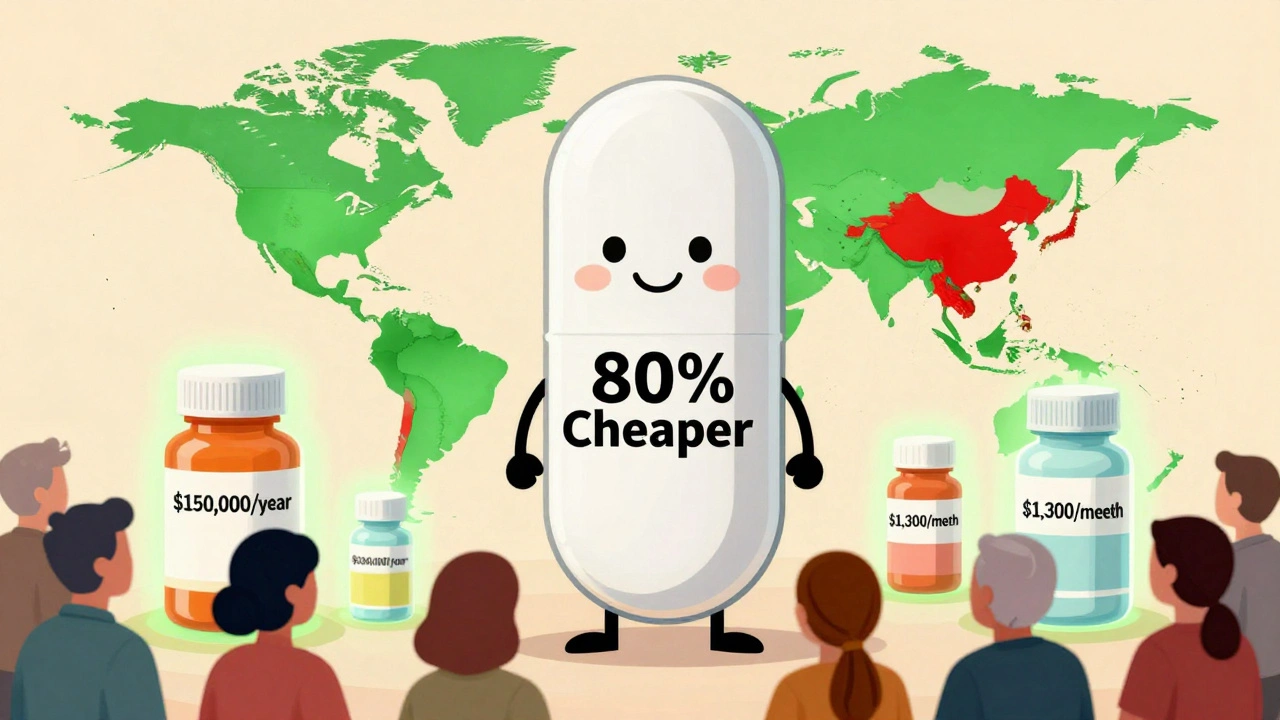
When you hear about a new cancer drug costing $150,000 a year, you’re hearing about a brand-name product. But behind the scenes, 80 to 90% of all prescriptions filled in the U.S., Canada, and Western Europe are for generics. These are the same medicines, made to the same standards, but priced at 80% less. In India, Brazil, and South Africa, generics make up even more of the market - often over 95%.
Without generics, global healthcare spending would be double what it is today. In the U.S. alone, generic drugs saved patients $375 billion in 2024, according to the Generic Pharmaceutical Association. That’s $1,100 per household. In low-income countries, where public health budgets are stretched thin, generics are the difference between life and death.
Why Brand-Name Drugs Are Driving Costs Up
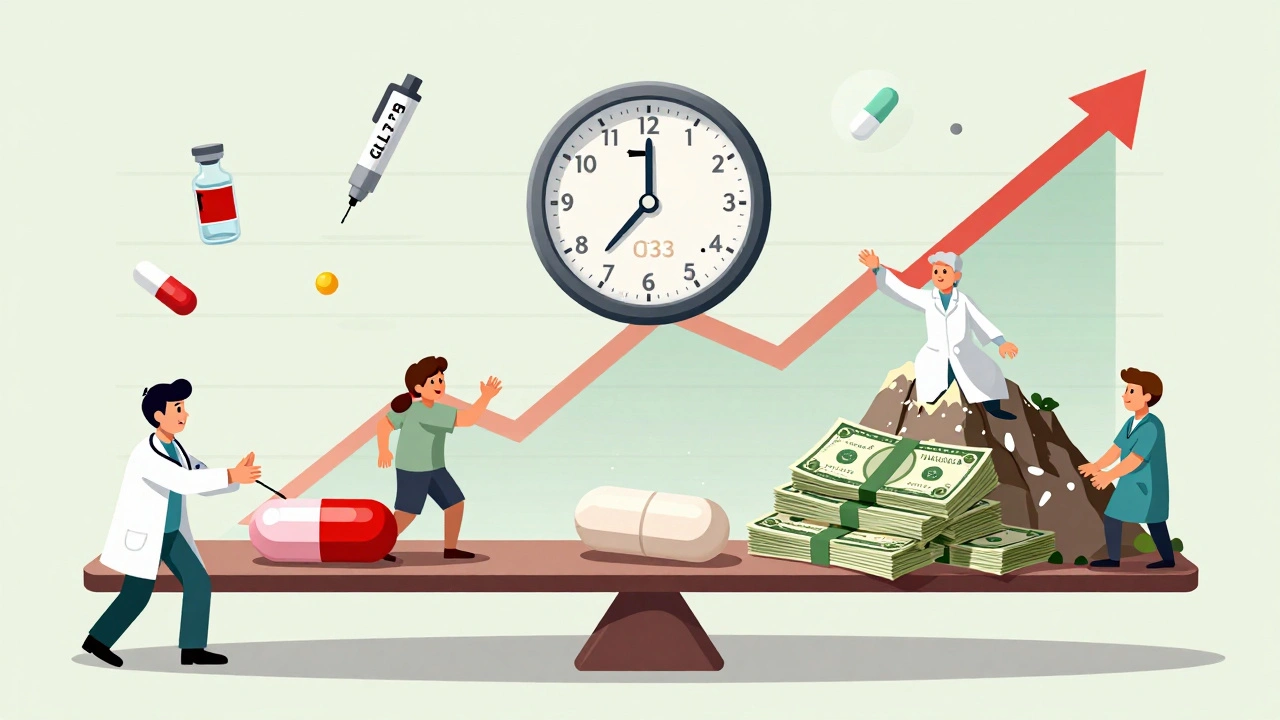
The pharmaceutical industry spends billions on research, but most of that money goes into marketing, patent extensions, and legal battles - not innovation. A single new drug can cost $2.6 billion to develop, but once it’s approved, companies get 20 years of monopoly pricing. That’s why oncology, diabetes, and autoimmune drugs now dominate spending.
In 2024, U.S. drug spending jumped $50 billion, mostly because of new specialty drugs for obesity and rare diseases. These aren’t cheap. A single monthly dose of a new GLP-1 weight-loss drug can cost $1,300. But there’s no generic version yet - and won’t be for another 5 to 10 years. That’s not because science is slow. It’s because the system is designed to delay competition.
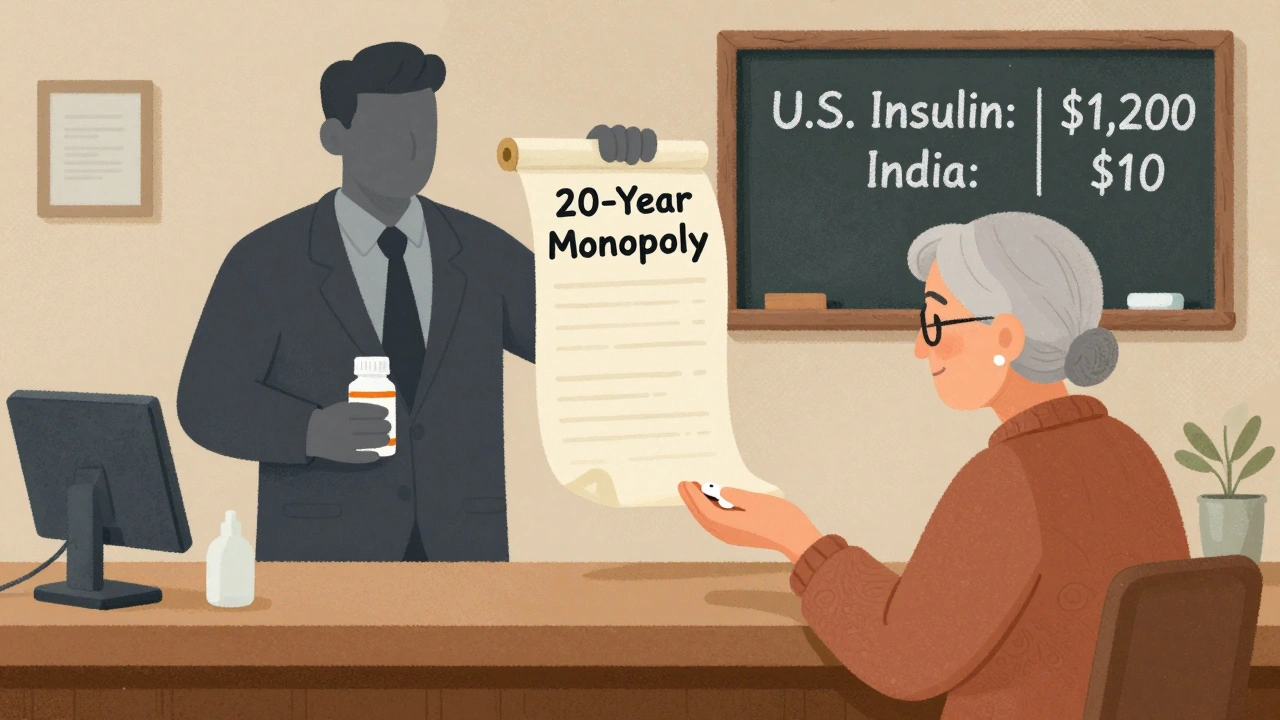
Meanwhile, insulin - a drug discovered in 1921 - still has no affordable generic in the U.S. Three companies control 90% of the market. Patients pay 10 times more than in Canada or Germany. Generics exist for insulin elsewhere. In the U.S., they’re blocked by patents, contracts, and regulatory hurdles.
How Countries Pay for Health - And Who Gets Left Behind
Global healthcare spending averages just 3.8% of GDP. That’s not enough. In 2022, only high-income countries spent above 5% of GDP on health. Low-income countries spent 1.2%. In Nigeria, Afghanistan, and Turkmenistan, more than 75% of health spending comes straight out of people’s pockets. That means families sell land, skip meals, or take loans just to buy medicines.
When public funding is low, generics become the only affordable option. But even that’s not enough. In Malawi, public health spending dropped 41% between 2019 and 2021. In Lebanon, it crashed 71%. These aren’t temporary dips. They’re systemic collapses. Generics are the last line of defense.
Meanwhile, development aid for health is falling. In 2025, it’s expected to drop to $39.1 billion - the lowest since 2009. That means countries can’t rely on outside help. They have to make do with what they have. And what they have? Generics.
The Generics Gap: Why Some Countries Use Them More Than Others
Not all countries use generics the same way. In the U.S., doctors prescribe them often, but patients still pay high out-of-pocket costs because insurance doesn’t cover them well. In Germany and the U.K., generics are automatically substituted unless a doctor writes "do not substitute." In Japan, pharmacists can switch to generics without asking the doctor.
In emerging economies like China and Indonesia, the story is different. These countries used to rely almost entirely on generics. But now, as incomes rise and health systems expand, they’re buying more brand-name drugs. China’s market for new originator medicines grew 18% in 2024. That’s good for innovation - but bad for affordability.
The real problem? Biosimilars. These are generic versions of complex biologic drugs - like those used for rheumatoid arthritis or cancer. They’re harder to make, harder to approve, and harder to get insurers to cover. In the U.S., only 3 out of 10 biosimilars approved by the FDA have actually reached patients. In Europe, adoption is better, but still slow.
What’s Driving Medical Costs Higher - And Why Generics Can’t Fix Everything
Insurers say two-thirds of rising costs come from new medical technologies - not just drugs, but diagnostic tools, robotic surgeries, and AI-powered imaging. In the Americas, 88% of insurers blame new tech. In Asia Pacific, it’s 73%. Generics don’t help with these. They’re only one piece of the puzzle.
Even in drug spending, generics aren’t always enough. The fastest-growing drug categories - mental health, obesity, diabetes - have few or no generic alternatives. A new antidepressant might cost $400 a month. There’s no generic. A new weight-loss drug? $1,200. No generic. And by 2033, U.S. out-of-pocket drug spending per person is projected to hit $231 - up from $177 in 2025.
Meanwhile, medical cost growth is accelerating. Globally, insurers expect a 10.4% increase in 2025. In the Middle East and Africa, it’s 12.1%. In Asia Pacific, it’s 12.3%. Generics are slowing the rise - but not stopping it.
The Real Power of Generics: Access, Not Just Savings
Generics aren’t just about saving money. They’re about access. In rural India, a generic version of a heart medication costs $0.10 a pill. The brand-name version? $2.50. That’s 25 times cheaper. For a patient taking it daily, that’s $90 a year vs. $2,250. That’s the difference between living with the condition - and dying from it.
In sub-Saharan Africa, generic antiretrovirals turned HIV from a death sentence into a manageable disease. Before generics, treatment cost $10,000 a year. Now, it’s under $100. Millions are alive because of that drop.
But here’s the catch: generics only work if they’re available, affordable, and trusted. In some countries, counterfeit drugs flood the market. In others, doctors don’t prescribe them because they’re paid by brand-name companies. In the U.S., some pharmacies won’t stock generics because insurance reimbursements are too low.
What Needs to Change
Generics are powerful - but they’re not magic. To make them work better, we need:
- Stronger patent laws - Stop companies from extending patents through tiny changes to drugs.
- Automatic substitution - Let pharmacists switch to generics unless a doctor says no.
- Public procurement - Governments should buy generics in bulk, like the U.N. does for HIV drugs.
- Invest in biosimilar approval - Speed up reviews and pay for them like regular generics.
- Price transparency - Make it easy to see what drugs cost, and who’s making what profit.
Right now, the system rewards secrecy. Drug companies hide prices. Insurers don’t disclose what they pay. Patients have no idea what they’re spending. Generics could fix that - if we let them.
Generics Are the Answer - But Only If We Let Them Be
The world spends too much on health. Too many people go without. Too many families are ruined by medical bills. Generics are the most proven, scalable, and cost-effective tool we have to fix this.
They’re not perfect. They won’t solve every problem. But they’re the only thing keeping healthcare from collapsing under its own weight. In a world where new drugs cost more than houses, generics are the only thing that still makes sense.
The question isn’t whether we need generics. It’s whether we’re willing to fight for them - against patent monopolies, corporate lobbying, and broken policies. Because if we don’t, the next generation will pay the price.
Are generic drugs as safe as brand-name drugs?
Yes. Generic drugs must meet the same strict quality, safety, and effectiveness standards as brand-name drugs. In the U.S., the FDA requires generics to have the same active ingredient, strength, dosage form, and route of administration. They’re tested to ensure they work the same way in the body. The only differences are in inactive ingredients like color or filler - which don’t affect how the drug works.
Why are generic drugs cheaper?
Generic manufacturers don’t have to repeat expensive clinical trials. They only need to prove their product is bioequivalent to the brand-name drug. That cuts development costs by 80-90%. They also face competition from multiple makers, which drives prices down. Brand-name companies, on the other hand, recover R&D costs through monopoly pricing during patent protection.
Do all countries use generics equally?
No. High-income countries like the U.S., Germany, and Japan use generics in 80-90% of prescriptions. In low-income countries, usage is lower due to supply chain issues, lack of local manufacturing, and distrust in quality. Some countries, like India and Brazil, are major producers but still struggle with domestic access because of pricing and distribution gaps.
Why aren’t there generics for all drugs?
Patents protect brand-name drugs for 20 years. Even after patents expire, companies often use legal tricks - like filing new patents on delivery methods or formulations - to delay generics. Complex drugs like biologics (used for cancer or autoimmune diseases) are especially hard to copy. Their generic versions, called biosimilars, take years to develop and get approved.
Can generics help reduce out-of-pocket costs for patients?
Absolutely. In the U.S., switching from a brand-name drug to a generic can cut a patient’s monthly cost from $300 to $10. For chronic conditions like high blood pressure or diabetes, that’s thousands saved per year. In countries without insurance, generics make the difference between buying medicine and going without.
Comments
Audrey Crothers
Generics saved my life. I take blood pressure meds daily - used to cost $280/month. Now? $12. I cry every time I pick it up. 🥲 Thank you, generics. 🙏
December 12, 2025 at 22:02
Stacy Foster
Let’s be real - the FDA and Big Pharma are in bed together. Generics? They’re not ‘the same.’ They use cheaper fillers, different coatings, and skip stability tests. You think your ‘generic’ insulin isn’t slowly killing you? Think again. 🕵️♀️ #PharmaCoverUp
December 13, 2025 at 17:09
Reshma Sinha
As someone working in pharma logistics in Mumbai, I’ve seen the raw power of generics - but also the chaos. Local manufacturers cut corners due to pricing pressure, and counterfeit supply chains thrive in rural pockets. We need GMP enforcement, not just price caps. Biosimilars? Still a nightmare - regulatory delays, zero reimbursement protocols, and zero awareness among prescribers. We’re not just fighting patents - we’re fighting institutional inertia. 🚨
December 14, 2025 at 04:24
Lawrence Armstrong
Generics are 99% identical. FDA bioequivalence testing is rigorous. The 1% difference? Usually inactive ingredients - like dye or binder - which rarely matter unless you have a rare allergy. And yeah, insulin pricing is a scandal. But blaming generics? Nah. Blame the 3 companies holding the market hostage. 💡
December 16, 2025 at 00:40
Donna Anderson
omg i had to pay $500 for my antidepressant last year… switched to generic and now it’s $15. i feel like a new person. also my dog is happier. 🐶❤️
December 17, 2025 at 17:12
Levi Cooper
Why are we letting foreign countries dictate our drug prices? India makes generics? Great. But they’re not paying for R&D. We fund innovation. So why should Americans subsidize the world? If you want cheap meds, move to Bangladesh. We built this system - don’t tear it down because you can’t afford it.
December 18, 2025 at 23:18
nikki yamashita
Generics are why my grandma is still here. No drama. No politics. Just science and savings. 🌍❤️
December 20, 2025 at 20:19
Rob Purvis
There’s a deeper layer here: insurance reimbursement structures. In many states, pharmacies lose money on generics because the copay is lower than the dispensing fee - so they stock brand-name even when generic is cheaper. It’s not patient choice - it’s perverse incentive. Add to that: pharmacists aren’t trained to educate patients on substitution. We’ve built a system where the cheapest option is the hardest to access. We need policy reform - not just moral outrage.
December 22, 2025 at 07:43