
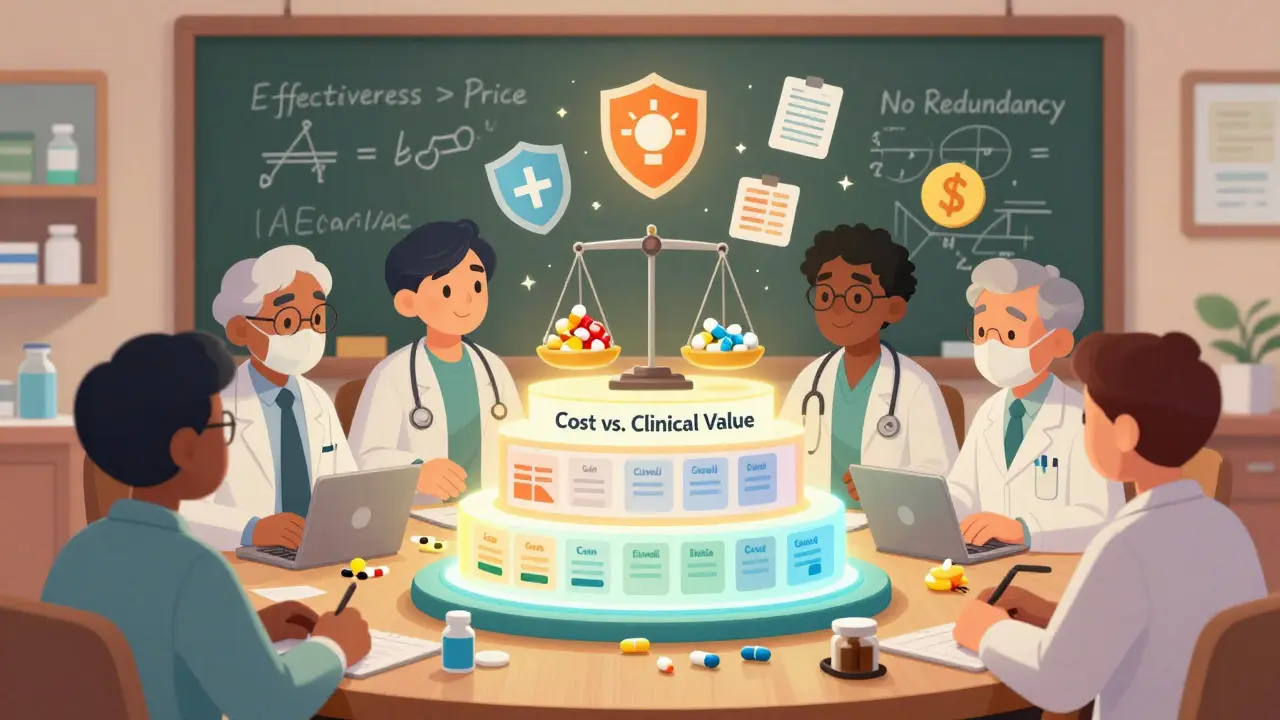
When you pick up a prescription at the pharmacy, you might not think about why your insurer covers one generic drug but not another. But behind every covered medication is a detailed, data-driven process that balances cost, safety, and effectiveness. Insurers don’t pick generics randomly. They use a system built over decades - and it affects what you pay, what you get, and sometimes even whether you can get the medicine you need.
How Formularies Work
Every health plan has a formulary - a list of drugs it agrees to cover. This isn’t just a catalog. It’s a tiered system designed to guide patients toward the most cost-effective options without sacrificing care. Generics almost always land in Tier 1, the lowest cost-sharing tier. That means you’ll pay $0 to $15 for a 30-day supply, compared to $40 or more for brand-name drugs in higher tiers. In fact, 92% of Medicare Part D plans use this exact structure, according to CMS data from 2023. Private insurers like UnitedHealthcare, Cigna, and Humana follow nearly the same model. The goal? Keep out-of-pocket costs low while encouraging the use of drugs that work just as well - but cost 80% to 85% less.The Pharmacy & Therapeutics (P&T) Committee
The real decision-makers aren’t insurance agents or CEOs. They’re Pharmacy & Therapeutics (P&T) committees. These are panels of doctors, pharmacists, and health economists who review every drug before it gets added to a formulary. Their job isn’t to cut costs at all costs. It’s to find the best balance between clinical value and affordability. These committees look at three things:- Clinical effectiveness: Does the drug actually work? Studies, real-world data, and patient outcomes matter more than marketing claims.
- Safety: What are the side effects? Drugs with known risks or high rates of adverse reactions get flagged - even if they’re cheap.
- Cost-effectiveness: If two generics do the same thing, the cheaper one wins. But if a slightly more expensive generic has fewer side effects or better dosing, it might get the nod.
Why Some Generics Get Rejected
You might wonder: if a generic is FDA-approved and cheaper, why wouldn’t it be covered? The answer is often about redundancy. Insurers don’t need five versions of the same blood pressure pill. If three generics are already on the formulary and work just as well, adding a fourth - even if it’s slightly cheaper - doesn’t add value. It just adds complexity. Also, some generics come from manufacturers with poor quality control. Insurers track drug performance across pharmacies. If a certain generic keeps showing up in reports of inconsistent absorption or patient complaints, it gets pulled - even if it’s technically FDA-approved. In 2023, the FDA reported 372 active drug shortages, and 78% of them were generics. When supply is unstable, insurers avoid listing those drugs to prevent patients from showing up at the pharmacy and finding nothing on the shelf.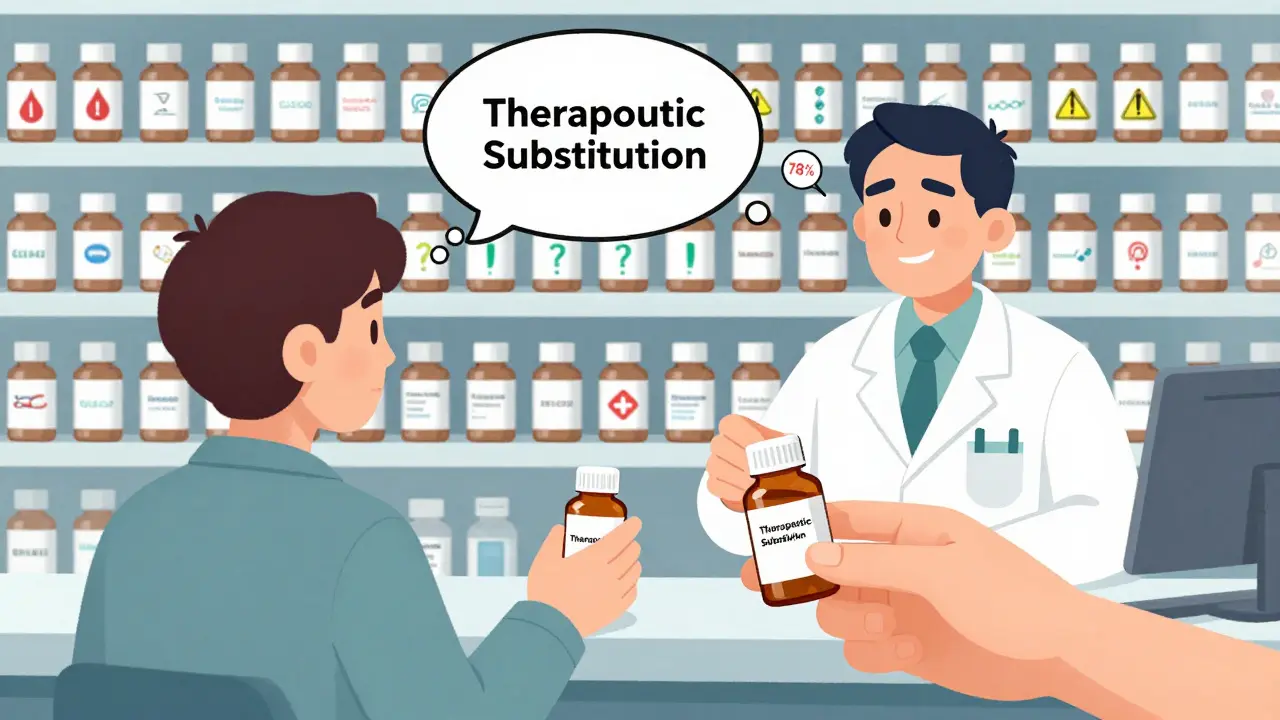
Therapeutic Substitution: When Your Doctor’s Prescription Gets Changed
One of the most frustrating parts of the system is therapeutic substitution. This is when your pharmacy automatically switches your brand-name drug for a generic - even if your doctor didn’t specify it. In 78% of commercial insurance plans, this happens at checkout. It’s legal, common, and designed to save money. But here’s the catch: not all generics are created equal. A 2023 Drug Topics survey found that 31% of patients reported adverse effects after being switched to a different generic. For example, a patient on a specific generic version of levothyroxine for hypothyroidism might feel fine - until the pharmacy switches to another brand, and their thyroid levels go haywire. That’s because while the active ingredient is the same, inactive ingredients (like fillers or coatings) can vary between manufacturers and affect how the drug is absorbed. Doctors often don’t know this is happening. Patients, meanwhile, feel blindsided. That’s why some states - like Washington - require insurers to notify patients before switching, and allow doctors to write “Do Not Substitute” on prescriptions.What Happens When Your Drug Isn’t Covered?
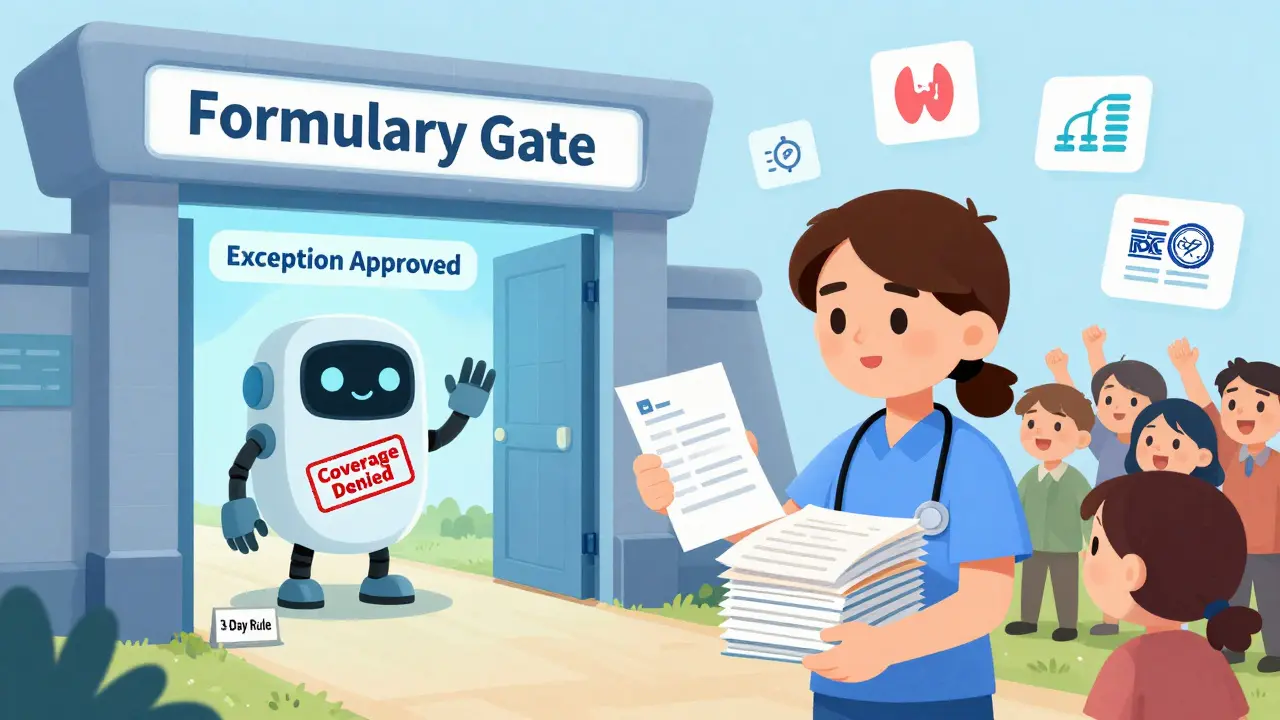
If your prescribed generic isn’t on the formulary, you’re not stuck. You can file an exception request. All plans must allow this. You’ll need:- A letter from your doctor explaining why the covered alternative won’t work for you
- Proof that you tried a similar drug and had bad side effects
- Documentation that the drug you need is medically necessary
Who’s Winning and Who’s Losing?
The system works well for most people. Eighty-seven percent of all prescriptions in the U.S. are for generics - a sign that insurers have successfully pushed adoption. Medicare beneficiaries report high satisfaction with predictable, low costs for generic drugs. In 2023, 82% said they understood their generic drug costs clearly. But the system has blind spots. Critics like Dr. Aaron Kesselheim from Harvard point out that insurers sometimes favor older, cheaper generics over newer ones that might be better for specific patient groups - like seniors with kidney disease or people with rare allergies. And while the Inflation Reduction Act caps out-of-pocket drug spending at $2,000 for Medicare Part D starting in 2025, it may push insurers to double down on high-volume, low-cost generics, potentially squeezing out newer options. Meanwhile, drug manufacturers are racing to keep up. The FDA is trying to cut generic approval times from 42 months to 10 months under GDUFA III. That could mean more choices on formularies. But it also means more complexity - and more pressure on P&T committees to evaluate drugs faster.What You Can Do
If you’re on a generic drug and it’s not working:- Ask your pharmacist if your medication was switched. Ask for the manufacturer name.
- If you notice side effects, talk to your doctor. Ask them to write “Do Not Substitute” on your prescription.
- If your drug isn’t covered, don’t accept “no” as the final answer. File an exception. Bring your doctor’s note. Be persistent.
- Check your plan’s formulary online. Most insurers update it quarterly. Know what’s covered before you refill.
Why do insurers only cover certain generics?
Insurers cover only certain generics because they use Pharmacy & Therapeutics (P&T) committees to evaluate drugs based on clinical effectiveness, safety, and cost. Even if a generic is FDA-approved, it won’t be covered if it doesn’t offer a meaningful advantage over other generics already on the formulary. The goal is to reduce costs without compromising care.
Can I request a different generic if my current one isn’t working?
Yes. If a generic isn’t working for you - whether due to side effects or lack of effectiveness - your doctor can file an exception request with your insurer. You’ll need documentation showing why the covered alternative isn’t suitable. Insurers must respond within three business days, and if they don’t, your request is automatically approved.
Why does my pharmacy switch my generic without asking?
Most insurers allow pharmacies to automatically substitute one generic for another if they’re considered therapeutically equivalent. This is called therapeutic substitution and happens in 78% of commercial plans. It’s legal and designed to save money, but it can cause problems if the new version affects how your body absorbs the drug. You can stop this by asking your doctor to write “Do Not Substitute” on your prescription.
Are all generic drugs the same?
The active ingredient in FDA-approved generics must be identical to the brand-name drug. But inactive ingredients - like fillers, dyes, or coatings - can differ between manufacturers. These differences can affect how quickly the drug is absorbed, especially for drugs with narrow therapeutic windows like thyroid meds or seizure drugs. That’s why some patients react differently to generics from different companies.
How do insurers decide which generics to prioritize?
Insurers prioritize generics that are proven to be safe, effective, and significantly cheaper than alternatives. P&T committees look at real-world data, not just clinical trials. They also consider supply chain reliability - if a generic has frequent shortages, it’s often excluded. The most common reason a generic gets cut is redundancy: if three similar generics are already covered, adding a fourth doesn’t improve outcomes.
Comments
Sam Pearlman
I swear, insurers are just playing chess with our health. They cover the cheapest generic but then we get stuck with one that makes us feel like zombies. My cousin switched to a different generic for her thyroid med and suddenly she couldn't sleep, gained 20 pounds, and cried during commercials. No one warned her. This isn't healthcare-it's a game of Russian roulette with pill bottles.
February 16, 2026 at 20:07
Steph Carr
You know what's wild? We let corporations decide what medicines we can take based on spreadsheets. Meanwhile, the guy who invented the drug probably died broke. I'm not mad, I'm just disappointed. We've turned healing into a cost-benefit analysis and called it progress.
Also, why do we still think 'FDA-approved' means 'safe for me'? My grandma took a generic and it gave her a rash that looked like a map of the Pacific Northwest. Turns out, the dye in the pill was the culprit. Not the drug. The dye.
February 17, 2026 at 09:27
Brenda K. Wolfgram Moore
This is exactly why we need better transparency. Patients shouldn't have to become pharmacists just to get their meds. If a pharmacy can switch your generic without telling you, that's not efficiency-that's negligence. Doctors need to be in the loop. Pharmacies need to notify patients. And insurers need to stop treating people like numbers. It's not that hard.
February 18, 2026 at 12:28
Oliver Calvert
The P&T committee model makes sense but the execution is messy. In the UK we have NICE which does similar work but with way more public input. Here it feels like a black box. Also, supply chain issues are huge. If a generic keeps having shortages, it shouldn't be on formulary. Period. Simple logic.
February 20, 2026 at 07:14
Kancharla Pavan
Let me be blunt. This entire system is a scam. Big Pharma rigs the game by paying off P&T committees through consulting fees disguised as "research grants." The FDA approves generics based on outdated standards. Meanwhile, patients suffer because some company in China cut corners on fillers and no one checks. We're not talking about minor side effects-we're talking about people going into cardiac arrest because their blood pressure med wasn't absorbed properly. And yet, the system keeps chugging along like nothing happened. Where's the accountability? Where's the outrage? Or are we just too numb to care anymore?
February 20, 2026 at 17:36
PRITAM BIJAPUR
Every pill has a story. 🌱
Behind every generic is a lab in Hyderabad, a quality control check in New Jersey, a pharmacist in rural Ohio, and a patient who just wants to feel human again.
It's easy to hate insurers, but the real tragedy is that everyone in this chain-manufacturers, committees, pharmacists, even patients-is trying to do the right thing... but the system is broken.
We need to stop thinking of medicine as a product and start seeing it as a promise. And promises shouldn't be decided by quarterly earnings reports. 💙
February 22, 2026 at 13:39
Dennis Santarinala
I think the real win here is that 87% of prescriptions are generics. That’s huge. We’re saving billions. But yeah, the substitution thing? That’s wild. My mom got switched from one levothyroxine to another and her TSH went from 1.2 to 7.8. She was exhausted, depressed, gained 15 pounds. Took three months to fix.
Doctors need to be trained on this. Pharmacies need to print the manufacturer name on the label. And patients? You gotta ask. Always ask. Don’t be shy.
February 22, 2026 at 17:32
Haley DeWitt
I had to file an exception for my generic antidepressant last year. Took 11 days. Got approved. But I almost gave up. I was crying in the pharmacy parking lot. I didn’t know I could appeal. No one told me.
So if you’re reading this and you’re struggling-don’t quit. Call your doctor. Write the letter. Send the fax. Even if they say no, keep going. They have to respond. And sometimes? They just don’t know they’re supposed to.
February 23, 2026 at 19:27
John Haberstroh
It’s wild how we’ve turned medicine into a spreadsheet. One pill, five brands, same active ingredient, but your body treats them like different aliens. It’s like giving someone the same coffee but with different water, different cups, different ambient temperature-then wondering why they’re jittery.
And the kicker? The most expensive part of this whole system isn’t the drug. It’s the confusion. The anxiety. The hours spent on hold. The fear that the next refill won’t work.
Maybe we need to stop calling them ‘generics’ and start calling them ‘sibling drugs.’ They’re not clones. They’re cousins with different temperaments.
February 25, 2026 at 14:29