
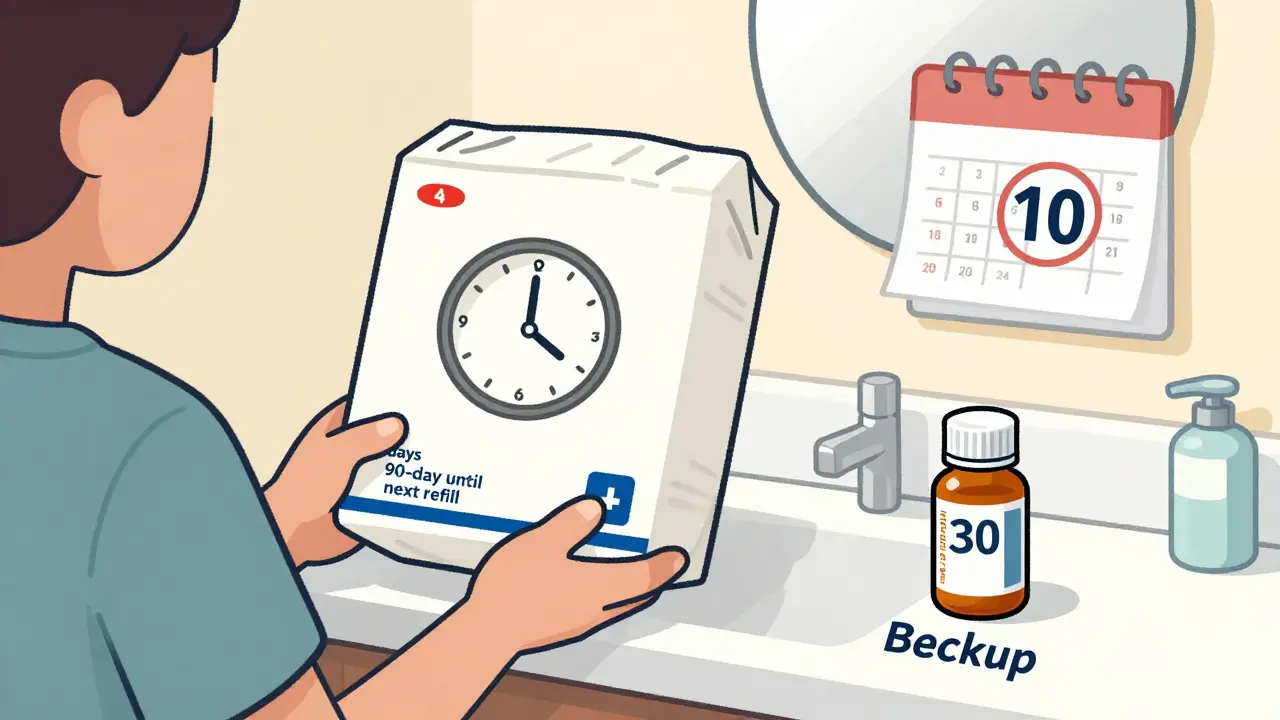
Running out of your blood pressure pill and not being able to pick it up until tomorrow? Or paying $45 for a 30-day supply when you could get 90 days for $115? Most people don’t realize they can save hundreds a year just by switching how they refill their meds. It’s not about choosing between mail-order and local pharmacy-it’s about using both the right way.
Know Which Meds Belong Where
Not all medications are created equal when it comes to how you get them. Think of your prescriptions in three groups:- Maintenance meds: These are the ones you take every day, for years-like blood pressure, cholesterol, or diabetes drugs. These are perfect for mail-order.
- Acute or short-term meds: Antibiotics, pain relievers after surgery, or steroid packs. These need to be available fast. Use your local pharmacy.
- Variable-dose meds: Things like antidepressants or thyroid meds where your dose might change. These should stay local until you’re stable.
Mail-order works best for maintenance drugs because you get a 90-day supply at a lower cost per pill. Local pharmacies win when you need something now, or when your dose is changing. Mixing them up saves money and avoids dangerous delays.
Mail-Order Isn’t Always Cheaper-Check First
A lot of people assume mail-order is automatically cheaper. It’s not. Some insurance plans charge more for mail-order on certain drugs, especially newer or specialty meds. One 2022 RAND study found 28% of commercial plans actually had higher copays for mail-order than retail for specific prescriptions.Here’s how to check:
- Log into your insurance portal or call member services.
- Ask: “What’s my copay for a 30-day supply vs. a 90-day supply of [medication name] at a retail pharmacy vs. mail-order?”
- Write it down. Don’t trust memory.
Example: Your plan might charge $15 for a 30-day generic at CVS, but $12.50 for a 90-day version through mail-order. That’s a $17.50 savings every three months. But if your plan charges $20 for mail-order and $15 for retail? Stick with local.
Also, don’t forget discount programs. Walmart, Costco, and CVS offer $10 or $4 for 90-day generic fills-even without insurance. You can often get the same price at a local pharmacy as you would through mail-order. It’s not magic. It’s just not advertised.
Shipping Times Can Cost You More Than Money
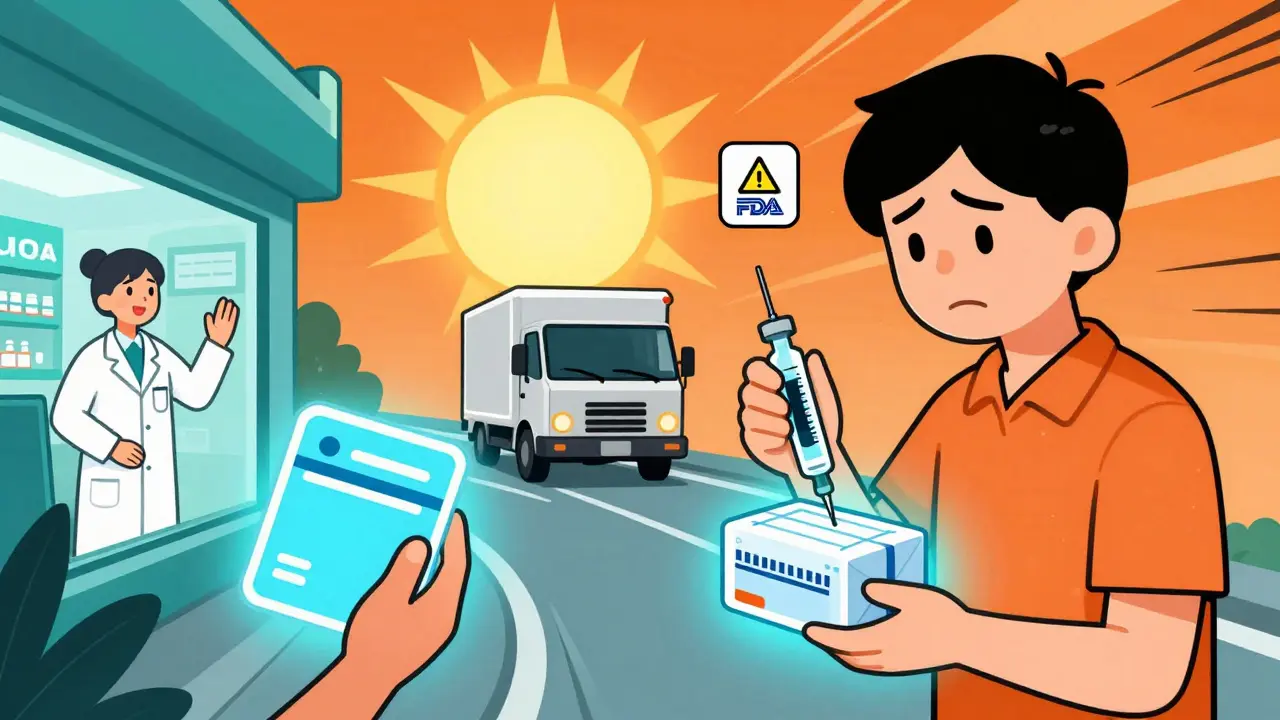
Mail-order usually takes 7-14 days to arrive. That sounds fine… until you run out on a Saturday night and your doctor just changed your dose. Or your insulin sits in a hot mailbox for three days and loses potency. The FDA says temperature-sensitive drugs like insulin, biologics, or epinephrine can degrade during shipping.That’s why keeping a 7-day supply on hand at your local pharmacy is smart. If your mail-order refill is delayed, you’ve got a backup. You don’t need to panic. You just need a plan.
Pro tip: Set a calendar reminder 10-14 days before your meds run out. That way, you order early, avoid late refills, and never miss a dose.
Local Pharmacists Are Your Secret Weapon
Most people think pharmacists just hand out pills. They’re wrong. Pharmacists are trained to spot drug interactions, check for duplicate prescriptions, and even help you switch to cheaper alternatives.Studies show 78% of patients who talk face-to-face with a pharmacist report better understanding of their meds. Mail-order? You get a phone call if there’s an issue-maybe.
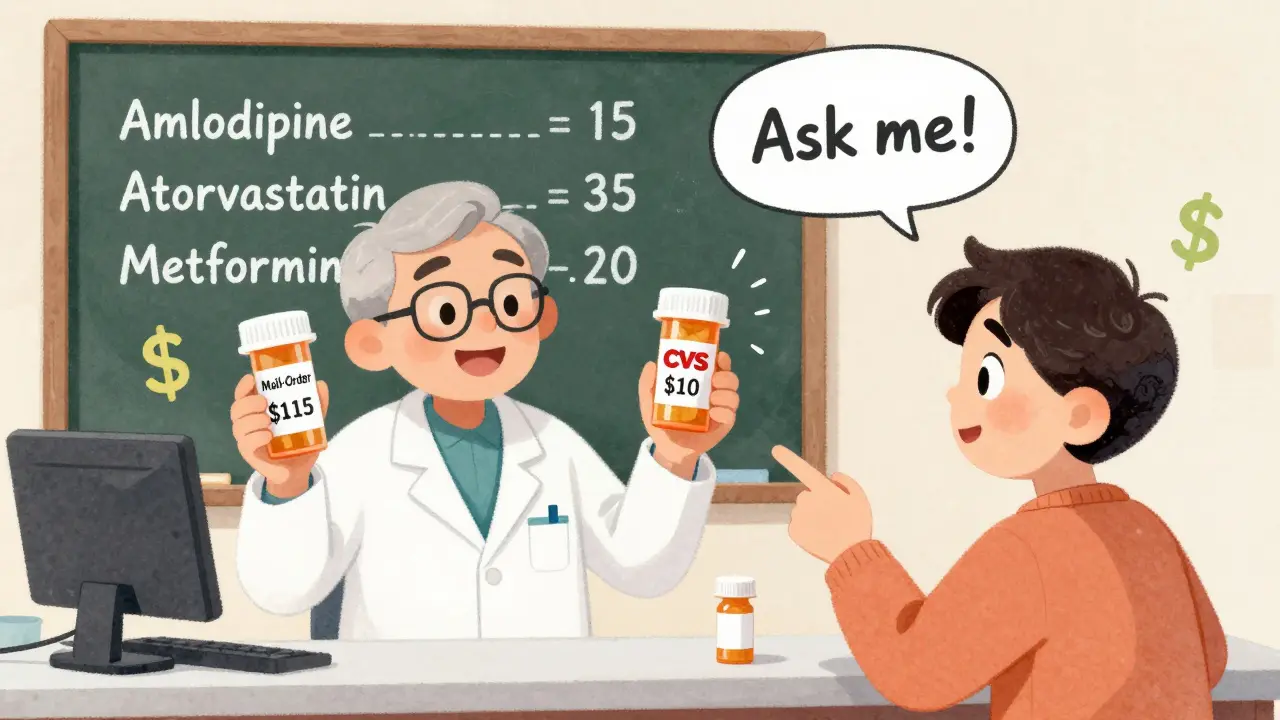
Build a relationship with one local pharmacy. Bring your full med list every 6 months. Ask: “Is there a cheaper way to get this?” Many pharmacists know about manufacturer coupons, state assistance programs, or bulk discounts you didn’t know existed.
One user on Reddit saved $320 a year just by asking his pharmacist if his cholesterol drug had a generic version. The answer? Yes-and it was $3 cheaper per month at retail than his mail-order brand.
Insurance Rules Are Messy-But You Can Navigate Them
Most plans treat mail-order and retail as two separate systems. That means:- You might need to enroll separately in mail-order.
- Your doctor might have to write a new prescription just for mail-order.
- Some plans won’t let you refill a mail-order script at a local pharmacy.
That’s frustrating. But here’s the fix:
- Call your insurance company and ask: “Can I get a 90-day supply of my maintenance meds at a retail pharmacy for the same price as mail-order?”
- If they say yes, you’ve just doubled your options.
- Ask if your plan uses Express Scripts, CVS Caremark, or Optum. These companies often let you pick your pharmacy-even if it’s not mail-order.
GoodRx reports that 71% of people don’t know local pharmacies can match mail-order pricing. You’re not alone. But now you do.
Real Savings: What It Looks Like in Practice
Let’s say you take three maintenance meds:- Amlodipine (blood pressure): $15 for 30-day retail → $115 for 90-day mail-order ($38/month savings)
- Atorvastatin (cholesterol): $12 for 30-day retail → $100 for 90-day mail-order ($33/month savings)
- Metformin (diabetes): $10 for 30-day retail → $85 for 90-day mail-order ($25/month savings)
That’s $96/month saved. $1,152 a year. Just by switching two of your three meds to 90-day fills.
And if you keep your albuterol inhaler (for asthma) at a local pharmacy? You pay $15 every 30 days. No delay. No risk. You’re covered.
One user, u/MedSaver87, reported saving $427 in one year using this exact method. They didn’t change their insurance. They didn’t switch doctors. They just coordinated.
What to Avoid
Don’t do these things:- Don’t let mail-order refill your new meds. If your doctor changed your dose, the system might send the old one. That’s how people end up taking the wrong amount for weeks.
- Don’t skip checking your plan’s formulary tiers. A Tier 3 drug might cost $50 at retail but $110 through mail-order. That’s a trap.
- Don’t wait until you’re out of meds to act. You’ll end up paying full price at the ER or urgent care.
Also, avoid using mail-order for medications that need refrigeration unless you’re sure the shipping process is temperature-controlled. Insulin, some biologics, and injectables are risky if shipped carelessly.
Start Small. Do This Next Week
You don’t need to overhaul everything at once. Start here:- Pick one maintenance med you’ve been on for over 6 months.
- Call your insurance and ask: “What’s my copay for a 90-day supply through mail-order vs. at a local pharmacy?”
- If mail-order is cheaper, ask your doctor for a 90-day script.
- Set a calendar reminder for 10 days before it runs out.
- Keep your other meds at your local pharmacy for now.
In 3 months, you’ll know if it works. If it does, repeat with your next med. Most people who try this save $200-$500 in the first year.
What’s Changing in 2026
By 2025, 65% of commercial insurance plans are expected to offer integrated pharmacy networks-meaning you’ll be able to switch between mail-order and retail with one refill system. Medicare’s 2024 Part D changes will also standardize 90-day pricing across channels.But here’s the catch: Many plans are reducing mail-order incentives. In 2023, 43% of Medicare Advantage plans cut back on discounts. That means the old rule of “mail-order always saves” is fading.
The future isn’t about choosing one channel. It’s about using both. The best users don’t just save money-they stay in control. They know when to use each system. And they check their options every time they refill.
Can I get a 90-day supply at my local pharmacy instead of mail-order?
Yes-many insurance plans let you get a 90-day supply at a retail pharmacy for the same price as mail-order. You just need to ask. Call your insurer and say: "Can I fill my maintenance medications as a 90-day supply at CVS or Walmart?" Some plans, like those using CVS Caremark or Optum, allow this. It’s not advertised, but it’s common. This gives you the savings without waiting for mail.
What if my mail-order refill is delayed?
Always keep a 7-day supply of your maintenance meds at your local pharmacy as a backup. If your mail-order is late, use that supply while you wait. You can also call your local pharmacy and ask if they can fill an early refill-some will if you explain it’s a mail-order delay. Don’t wait until you’re out. Plan ahead.
Is mail-order safe for insulin or other temperature-sensitive drugs?
It depends. The FDA warns that insulin and biologics can lose potency if exposed to extreme heat or cold during shipping. Some mail-order pharmacies use temperature-controlled packaging-but not all. If you take insulin, ask your mail-order provider how they ship it. If they don’t guarantee temperature control, keep a 30-day supply at your local pharmacy and refill there instead.
How often should I review my medication plan?
At least once a year, or whenever your doctor changes your meds. Insurance plans change their formularies and copays every year. A drug that was cheap last year might now cost more through mail-order. Talk to your pharmacist about your full list. About 40% of people can save $200+ annually just by reviewing their refill strategy.
Do I need to switch all my meds to mail-order to save?
No. In fact, it’s smarter to only use mail-order for stable, long-term medications. Keep new prescriptions, antibiotics, or meds with changing doses at your local pharmacy. That way, you avoid delays, get immediate help from a pharmacist, and stay safe. The goal isn’t to use mail-order for everything-it’s to use it where it saves money and makes sense.
Comments
Randy Harkins
Love this breakdown. I started doing this last year after my dad ran out of insulin during a storm and got stuck with a $200 ER bill. Now I keep 7 days of everything local, mail-order the stable stuff, and check prices every refill. Saved over $600 last year. Seriously, it's not rocket science-just common sense with a little legwork.
February 7, 2026 at 15:49
Camille Hall
This is such a needed guide. I used to just let mail-order handle everything until I missed a dose because the package got stuck in Texas weather. Now I rotate-mail-order for my statins and metformin, local for anything new or sensitive. Pharmacists are gold. I ask mine monthly if there’s a cheaper generic. She once hooked me up with a $3/month coupon I didn’t even know existed. You’d think this stuff was common knowledge, but nah.
February 8, 2026 at 01:37
Ritteka Goyal
Bro this is so true but u know what even better? In India we dont even have this problem because our local chemist just gives u 90 days for same price as 30 and no shipping wait. Why do Americans overcomplicate? I mean u pay more tax, more insurance, more delivery fees-why not just walk to the corner shop? I came here for work and thought my blood pressure med would cost 100x but it was cheaper than back home! Just ask. No one tells u. But u can do it. U got this.
February 8, 2026 at 03:38
THANGAVEL PARASAKTHI
Good info but lemme add-some places like Walmart and Costco do $10 for 90-day generics even if u got no insurance. I use that for my bp med. Also, dont forget to ask if ur doc can write a 90-day script for retail. Some pharmacies will fill it even if ur plan says mail-only. Just call and say 'I want to pick it up today.' They usually say yes. I saved $80 last month this way. Easy money.
February 9, 2026 at 15:42
Chelsea Deflyss
You’re all missing the point. Mail-order is a scam designed by insurers to make you wait until you’re sick. They delay shipments on purpose. I had my insulin delayed for 11 days last winter. I had to go to the ER. And now they want you to trust them with your life? Wake up. This isn’t saving money-it’s gambling with your health.
February 9, 2026 at 19:12
Scott Conner
Has anyone tried using GoodRx + local pharmacy for 90-day fills? I did it with my atorvastatin and paid $18 for 90 pills. Mail-order wanted $100. I didn’t even need insurance. Just showed the coupon at CVS. It’s wild how no one talks about this. Why is this not common knowledge?
February 10, 2026 at 00:47
Sam Dickison
As a pharmacy tech, I see this daily. People don’t realize retail pharmacies can legally fill 90-day scripts if the insurer allows it. Mail-order is just a middleman. Most plans have a 'retail 90' option buried in fine print. Call your insurer, say 'I want to use my retail pharmacy for 90-day maintenance fills'-they’ll either say yes or give you a code to use. We do it all the time. It’s not magic. It’s policy.
February 10, 2026 at 08:55
Karianne Jackson
I used to be the person who waited until I was out of meds and then cried in the pharmacy. Now I set calendar alerts 14 days out. I keep one med local. I check prices. I talk to my pharmacist. And guess what? I’m alive. No ER visits. No panic. No drama. Just… calm. It’s not hard. You just have to care enough to try.
February 10, 2026 at 12:56
Joseph Charles Colin
For temperature-sensitive meds, always verify shipping protocols. Mail-order providers like Express Scripts use cold-chain logistics for insulin and biologics-but not all do. Request their shipping whitepaper. If they don’t provide it, don’t risk it. Also, ask your provider if they partner with UPS or FedEx for temperature-controlled delivery. Most do. If they say 'we use standard ground,' walk away. Your meds aren’t a Amazon package.
February 12, 2026 at 07:58
John Sonnenberg
Let me be clear: This entire system is rigged. Insurance companies make you jump through hoops so they can profit from the delays. They want you to panic. They want you to pay full price at the ER. They don’t care if you die. They care about your premiums. And now they’re cutting mail-order discounts? That’s not innovation-that’s exploitation. Stop trusting them. Take control. Or die trying.
February 13, 2026 at 13:28
Jessica Klaar
I’m from Ghana, and I moved here five years ago. I was shocked at how complicated this is. Back home, you walk in, pay, leave. Here? You need a spreadsheet, three phone calls, and a calendar. But I’ve learned. I keep my insulin local. I mail-order my thyroid med. I ask my pharmacist every time if there’s a coupon. She even helped me find a nonprofit that gives free meds to low-income folks. It’s not perfect-but it’s better when you ask. And you’re not alone.
February 14, 2026 at 04:52
Tori Thenazi
Wait. Did you know that mail-order companies are owned by the same insurers that set your copays? And they track your refill habits to predict when you’ll miss a dose? That’s not a coincidence. That’s a business model. They delay your meds so you’ll eventually go to urgent care. Then they charge you $500. And you think you’re saving money? Think again. This isn’t healthcare. It’s a trap.
February 16, 2026 at 01:21
Elan Ricarte
Yeah, and while you’re all over here playing financial Tetris with your meds, the real scam is that drug manufacturers price the same pill at 3x the cost for mail-order vs. retail. Why? Because they know you’ll be too lazy to switch. They bank on your inertia. You think you’re saving? You’re being milked. Stop being passive. Ask your pharmacist for the manufacturer’s patient assistance program. They’ll give you a free 90-day supply if you’re low-income. But you gotta ask. No one’s gonna hand it to you.
February 17, 2026 at 03:03