
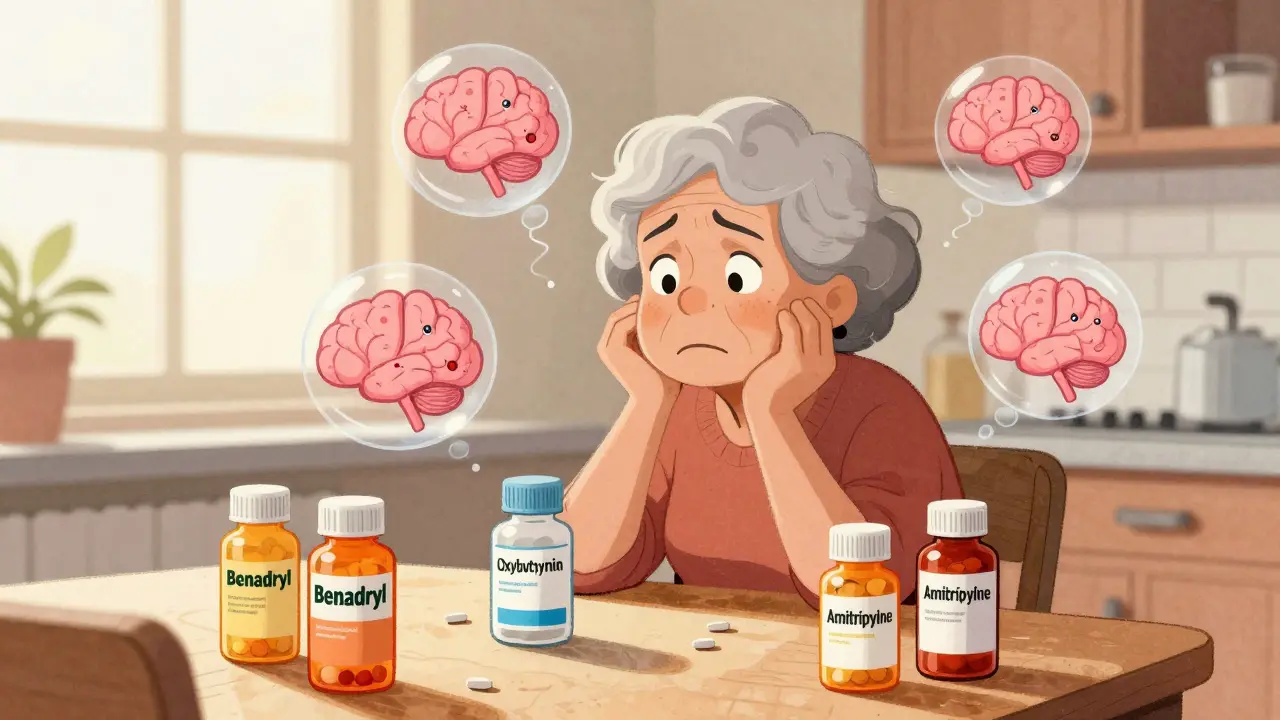
It’s easy to assume that memory lapses, confusion, or sluggishness in older adults are just part of getting older. But what if these signs aren’t aging at all? What if they’re caused by medications your loved one is taking - and could be reversed?
Every year, thousands of seniors are misdiagnosed with dementia or Alzheimer’s when the real culprit is a common prescription or over-the-counter drug. The symptoms look identical: forgetting names, getting lost in familiar places, struggling to follow conversations, or seeming unusually drowsy. But unlike true neurodegenerative disease, these changes often appear suddenly - and they can vanish if the right medication is stopped.
What Medications Are Behind These Symptoms?
The biggest offenders are drugs with anticholinergic properties. These medications block a brain chemical called acetylcholine, which helps with memory, attention, and muscle control. As we age, our bodies process these drugs differently - the liver and kidneys clear them slower, so they build up in the brain. Seniors get up to 50% more exposure than younger people, even at the same dose.
Common anticholinergic drugs include:
- Diphenhydramine (Benadryl) - used for allergies, sleep, or colds
- Oxybutynin (Ditropan) - for overactive bladder
- Hydroxyzine (Atarax) - for anxiety or itching
- Tricyclic antidepressants like amitriptyline
- Some antipsychotics like quetiapine (Seroquel)
- Promethazine - for nausea or motion sickness
These aren’t rare prescriptions. About 50-70% of older adults take at least one drug in this category. And many don’t even realize they’re taking an anticholinergic - Benadryl, for example, is in dozens of sleep aids and cold medicines sold without a prescription.
But it’s not just anticholinergics. Other drugs that commonly mimic aging include:
- Benzodiazepines like lorazepam (Ativan) or alprazolam (Xanax) - cause memory gaps and confusion
- Corticosteroids like prednisone - can trigger mood swings, paranoia, or hallucinations
- Opioids like oxycodone - lead to short-term memory loss and mental fog
How to Tell the Difference Between Aging and Medication Side Effects
True aging-related cognitive decline happens slowly - over months or years. Dementia doesn’t suddenly appear after starting a new pill. But medication-induced confusion? That’s often fast.
Here’s what to look for:
- Sudden onset: Did the symptoms start within 2 weeks of a new medication or dose change?
- Fluctuating symptoms: Does your loved one seem clearer in the morning and foggy at night? That’s a classic sign of drug buildup.
- Physical clues: Dry mouth, constipation, blurry vision, trouble urinating, or dizziness often come with brain fog from anticholinergics.
- No progressive decline: If their memory isn’t getting worse month after month, but just feels "off" since a doctor changed their meds, that’s a red flag.
One real case from Indiana University involved a 68-year-old woman who couldn’t remember her grandchildren’s names or how to use the phone. Her family assumed dementia. After a medication review, they found she was taking Benadryl nightly for sleep, oxybutynin for bladder control, and amitriptyline for nerve pain - all strong anticholinergics. Within six weeks of stopping them, her memory returned almost completely.
The Beers Criteria and the ACB Scale: Tools That Can Save Lives
Doctors have a checklist for this exact problem. It’s called the Beers Criteria, updated in 2019 by the American Geriatrics Society. It lists 30+ medications that should generally be avoided in seniors because they carry too high a risk of confusion, falls, or delirium.
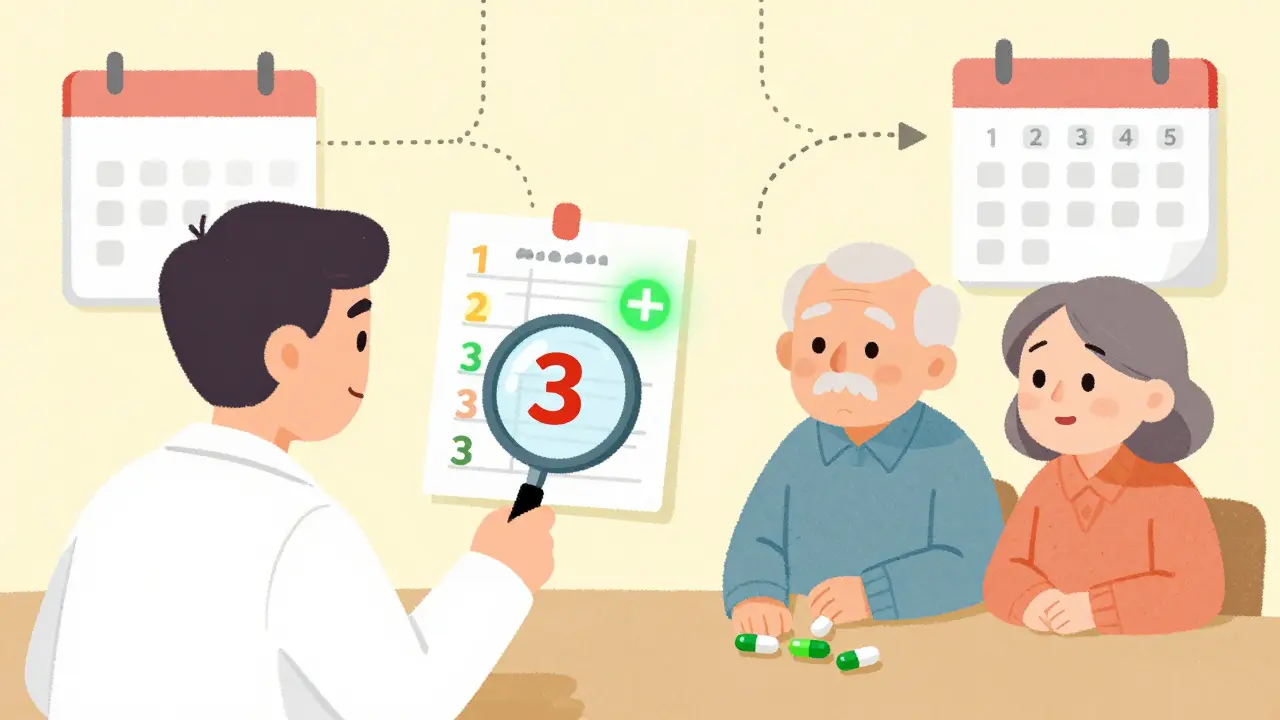
But even better is the Anticholinergic Cognitive Burden (ACB) scale. This tool assigns a score to each medication based on how strongly it blocks acetylcholine:
- Score of 1 = mild effect (e.g., some antihistamines)
- Score of 2 = moderate effect (e.g., oxybutynin, tricyclics)
- Score of 3 = strong effect (e.g., diphenhydramine, quetiapine)
If a senior’s total ACB score is 3 or higher - meaning they’re taking one strong drug or a combination of moderate ones - their risk of dementia-like symptoms jumps by 49% over three years. That’s not just a number. It’s a warning sign.
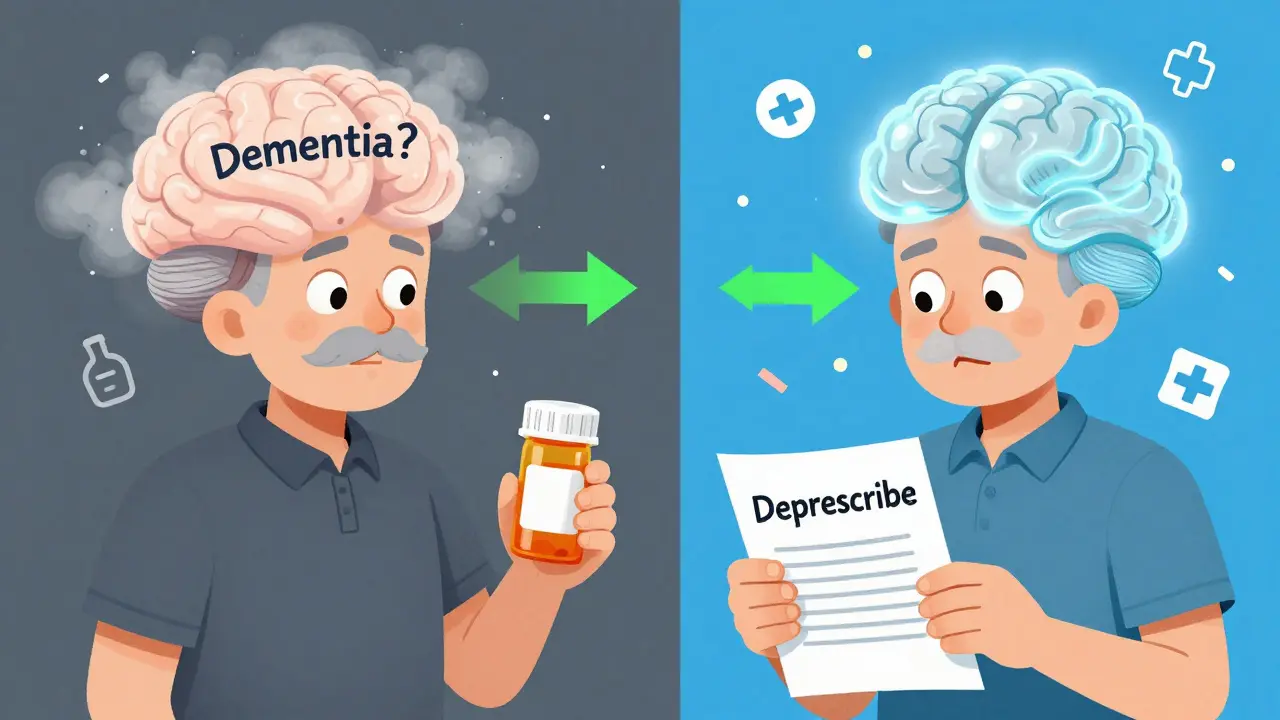
And here’s the good news: if you catch it early, reversing the damage is possible. Studies show 30-40% of people with medication-induced cognitive decline see significant improvement after stopping the drugs.
What to Do If You Suspect Medication Side Effects
You don’t need to be a doctor to take action. Here’s your step-by-step plan:
- Get a full medication list: Write down every pill, patch, cream, or supplement your loved one takes - including OTC drugs and herbal remedies. Don’t rely on memory. Bring the actual bottles.
- Check for Beers Criteria drugs: Look up the list online or ask a pharmacist. If you see diphenhydramine, oxybutynin, or amitriptyline, flag them.
- Calculate the ACB score: Use the ACB scale (easily found on geriatric medicine websites) to add up the scores. If it’s 3 or more, talk to the doctor.
- Ask about deprescribing: Say: "Could any of these meds be causing confusion or drowsiness? Is there a safer alternative?" Don’t ask if they should be stopped - ask how to stop them safely.
- Track symptoms: Keep a simple journal: "Day 1: Clear. Day 3: Slowed speech. Day 5: Forgot lunch." Note timing and changes after dose adjustments.
Never stop a medication cold turkey - especially benzodiazepines or antidepressants. Tapering over 4-12 weeks is usually needed to avoid withdrawal. A pharmacist or geriatrician can help design a safe plan.
Why This Is Still Overlooked - And What’s Changing
Most doctors don’t routinely check for medication-induced cognitive issues. Why? Because they’re trained to treat symptoms, not question the cause. If a senior forgets things, the default assumption is dementia. A 2023 study found that 10-20% of dementia diagnoses in older adults are actually drug reactions - and most never get corrected.
But things are shifting. Since 2023, Medicare’s Annual Wellness Visit now requires a medication review. The FDA has added stronger warning labels to 17 high-risk drugs. And researchers are testing blood tests that measure acetylcholine levels - a potential way to confirm anticholinergic burden without guesswork.
AI tools are also being developed to scan electronic health records and flag seniors on multiple high-risk drugs. In pilot programs, these systems predicted cognitive side effects with 85% accuracy.
The biggest barrier isn’t science - it’s awareness. Families need to ask. Pharmacists need to speak up. Doctors need to listen.
Real-Life Impact: It’s Not Just About Memory
These side effects don’t just cause confusion. They cause falls. Dizziness from anticholinergics increases fall risk by 200%. One fall can lead to a hip fracture, hospitalization, and a downward spiral. Weight loss? Unexplained loss of 5+ pounds in 30 days is another red flag - often tied to dry mouth, nausea, or loss of appetite from meds.
And then there’s the emotional toll. Families feel guilty. Seniors feel ashamed. They think they’re losing their mind. But when the right pill is stopped, they often return to themselves - laughing again, recognizing faces, remembering birthdays. One woman in Sydney, after stopping her nightly Benadryl and bladder med, told her daughter: "I feel like I’m back in my 50s. I finally remember why I used to love gardening."
That’s not magic. That’s medicine.
Can over-the-counter drugs like Benadryl really cause dementia-like symptoms?
Yes. Diphenhydramine (Benadryl) is one of the strongest anticholinergic drugs on the market, even though it’s sold without a prescription. Studies show it crosses the blood-brain barrier easily in seniors and causes confusion, memory loss, and drowsiness. Long-term use is linked to a 49% higher risk of dementia-like decline. It’s not just sleep aids - it’s in allergy pills, cold medicines, and even some pain relievers. Always check the active ingredients.
How long does it take for medication side effects to go away after stopping the drug?
It varies. Some people feel clearer within days, especially if the drug was taken for a short time. For others, especially those on multiple anticholinergics or long-term use, it can take 4 to 12 weeks for the brain to fully recover. Symptoms like dizziness and dry mouth fade faster than memory issues. Patience and careful monitoring are key - and never stop abruptly without medical guidance.
Are there safer alternatives to anticholinergic drugs for seniors?
Yes. For allergies, second-generation antihistamines like loratadine (Claritin) or cetirizine (Zyrtec) have little to no anticholinergic effect. For overactive bladder, mirabegron (Myrbetriq) is a non-anticholinergic option. For sleep, cognitive behavioral therapy (CBT-I) is more effective and safer than sleeping pills. For depression, SSRIs like sertraline are preferred over tricyclics. Always ask: "Is there a non-anticholinergic alternative?"
Should I stop my loved one’s medication if I suspect side effects?
No - not without talking to their doctor or pharmacist. Some drugs, like antidepressants or blood pressure meds, can cause dangerous withdrawal if stopped suddenly. Instead, gather the full medication list, note the symptoms and when they started, and schedule a medication review. Ask for a deprescribing plan. The goal isn’t to remove all meds - it’s to remove the ones causing harm.
Can a pharmacist help with this?
Absolutely. Pharmacists are medication experts and often know more about drug interactions than doctors do. Ask for a free medication review - many pharmacies offer this. Bring all bottles, including supplements. They can calculate the ACB score, flag Beers Criteria drugs, and suggest safer options. They can also help you taper off safely.
Is this problem getting worse?
Yes. With 92% of seniors taking at least one prescription and 55% taking five or more, the risk of harmful interactions is growing. The FDA has responded by adding stronger warnings to 17 drug classes since 2020. But awareness among the public and even some providers remains low. The good news? Tools like the Beers Criteria and ACB scale are now widely recognized, and Medicare now requires medication reviews - so change is happening, slowly but surely.
Comments
Allen Davidson
My grandma was on Benadryl for years thinking it was just helping her sleep. When we finally got her off it, she started remembering our birthdays again. It wasn't magic, it was just her brain finally getting a break from the chemical fog. So many families don't even know this is a thing.
January 17, 2026 at 15:04
john Mccoskey
The entire medical establishment is built on treating symptoms, not interrogating causality. You give someone a pill for a symptom, then another pill for the side effect of the first pill, then another for the side effect of the second. It's a cascade of iatrogenic decay disguised as care. The Beers Criteria exists because the system is fundamentally broken. And yet, 70% of geriatric patients are still on at least one of these drugs because no one has the courage to ask, 'What if we just stopped?' The answer is always, 'We can't.' But we can. We just won't.
January 17, 2026 at 17:38
Rob Deneke
My dad was on amitriptyline for nerve pain and kept forgetting where he put his keys. We switched him to gabapentin and within a month he was back to fixing the sink and telling stories from his youth. Nobody told us meds could do this. Just thought he was getting old
January 18, 2026 at 10:25
evelyn wellding
OMG this is SO important!! 🙌 I just got my mom off her nightly Benadryl and she’s been calling me every day to chat like she used to. I cried when she remembered my dog’s name. Please share this with everyone you know!! 💙
January 19, 2026 at 15:36
Isabella Reid
I work in a pharmacy and see this all the time. People come in with a list of 12 meds and say 'I just feel off lately.' We run the ACB score and boom - three score 3s. Half the time they didn’t even know Benadryl was in their cold medicine. It’s not that doctors are negligent, they’re just overwhelmed. But families can be the missing link.
January 21, 2026 at 00:07
Jody Fahrenkrug
My aunt had her whole personality change after starting Seroquel. She stopped laughing, stopped recognizing people. We thought it was dementia. Turned out it was the meds. She’s back to baking pies now. Just needed to stop the cocktail. Hard to believe something so simple can fix so much.
January 21, 2026 at 21:42
Kasey Summerer
So let me get this straight. We’ve got a whole generation of seniors being misdiagnosed with dementia because we’re too lazy to check if their meds are poisoning their brains? And the solution is… ask nicely? 🤦♂️ Meanwhile, Big Pharma keeps selling these drugs like they’re candy. I’m not mad, I’m just disappointed.
January 22, 2026 at 21:28
Corey Sawchuk
My uncle in Canada was on oxybutynin for years and kept falling. His doctor said it was balance issues from age. We switched to mirabegron and he hasn't had a fall since. No one ever mentioned the drug connection. It's scary how easy it is to miss
January 24, 2026 at 02:59
Chelsea Harton
benadryl is the worst. its in everything. why is it even still sold over the counter for sleep? its a neurotoxin for old people
January 25, 2026 at 08:33
Corey Chrisinger
It’s funny how we treat aging like it’s some inevitable cosmic decline, when in reality, half the ‘symptoms’ are just chemical noise from decades of pill-popping. We’ve outsourced our biology to Big Pharma and now we’re surprised when the system glitches. Maybe the real question isn’t ‘what’s wrong with them?’ but ‘what have we done to them?’ 🤔
January 26, 2026 at 10:41
Bianca Leonhardt
Anyone who still takes diphenhydramine after 65 deserves what they get. It’s not aging, it’s stupidity. You don’t put poison in your body and then cry when you forget your own name. This is basic. Why are we even having this conversation?
January 28, 2026 at 05:23
Travis Craw
my mom took ativan for 15 years and we thought she was just getting forgetful. turned out it was the meds. we tapered slowly with her doctor and now she’s reading books again. just wish someone had told us sooner
January 29, 2026 at 06:49
Christina Bilotti
Oh look, another article telling people to stop taking their meds. How original. The real problem is that people don’t take responsibility for their own health. If you’re on 10 pills and confused, maybe you should’ve asked questions in 2012 instead of waiting until now. Blame the system? No. Blame the person who never bothered to read the label.
January 30, 2026 at 04:03
Nick Cole
I’ve seen this firsthand. My neighbor’s wife was diagnosed with early Alzheimer’s. She was on three anticholinergics. After switching meds and cutting out the OTC stuff, she started gardening again. She cried and said she felt like herself for the first time in years. It’s not just memory - it’s dignity.
January 30, 2026 at 10:38
Riya Katyal
So you’re telling me I can fix my grandma’s memory by just stopping her sleep medicine? Wow. And here I was thinking she was just getting senile. Guess I should’ve Googled before assuming. Thanks for the wake-up call.
February 1, 2026 at 09:32