
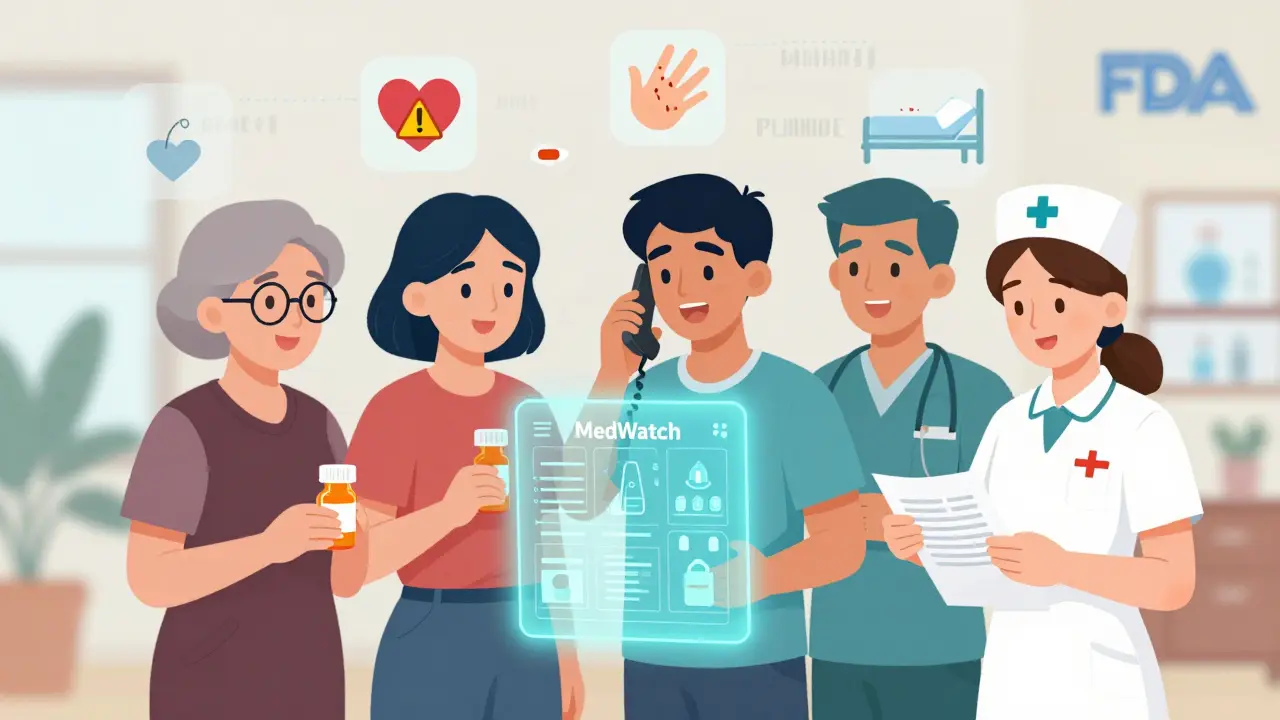
Every year, millions of people in the U.S. take prescription and over-the-counter drugs. Most of them work as expected. But sometimes, something goes wrong. A medication might cause a severe rash, a sudden drop in blood pressure, or even organ damage. These are called adverse drug reactions - and they’re more common than you think. The problem? Many of them go unreported. That means the FDA doesn’t see the full picture, and other people could end up hurt. If you’ve experienced a strange or serious side effect from a drug - whether it’s something you bought at the pharmacy or something your doctor prescribed - you have the power to help protect others. Reporting it to the FDA isn’t just a good idea. It’s one of the most important things you can do as a patient. The FDA’s system for collecting these reports is called FAERS - the Adverse Event Reporting System. It’s not a hotline for emergencies. It’s a safety net. And it only works if people like you use it. Here’s how to do it right.
What Counts as a Reportable Adverse Reaction?
Not every weird feeling after taking a pill needs a report. The FDA defines a serious adverse event as one that:- Causes death
- Is life-threatening
- Leads to permanent disability
- Requires hospitalization
- Causes a birth defect
- Needs medical intervention to prevent permanent harm
Who Can Report?
Anyone can report. You don’t need to be a doctor. You don’t need to prove it was the drug’s fault. You just need to suspect it.- Patients: If you took the drug and had a bad reaction, you can report it yourself.
- Family members or caregivers: If someone you care for had a reaction and can’t report it themselves, you can do it for them.
- Healthcare providers: Doctors, nurses, pharmacists - they’re required to report serious events, but many don’t. If you’re a provider, don’t assume someone else will do it.
How to Submit a Report
There are three ways to report. All of them are free. All of them are confidential.1. Online - Fastest and Recommended
Go to the FDA’s MedWatch portal: www.accessdata.fda.gov/scripts/medwatch Click on "Voluntary Reporting" and fill out Form 3500. It’s simple. You’ll need:- Patient info: Age, sex, weight (if known)
- Drug details: Brand name, generic name, dose, how often taken, how long you took it
- Reaction details: What happened, when it started, how long it lasted
- Outcome: Did you go to the hospital? Did you need treatment?
- Your contact info: So they can follow up if they need more details
2. Phone - For Help or Urgency
Call 1-800-FDA-1088 (1-800-332-1088). This is the FDA’s MedWatch Safety Information hotline. A trained operator will ask you the same questions as the online form. You don’t need to write anything. Just talk. They’ll file the report for you. This is especially helpful if you’re not comfortable using a computer, or if the reaction happened recently and you’re still dealing with it.3. Mail - If You Prefer Paper
Download Form 3500 from the MedWatch site, fill it out by hand, and mail it to: FDA MedWatch 5600 Fishers Lane Rockville, MD 20852-9787 It takes longer - usually 2-4 weeks for the report to be processed. But if you’re not tech-savvy, it works.What Happens After You Report?
Your report goes into FAERS - a database with over 2 million reports a year. It doesn’t mean the FDA will pull the drug off the market right away. But it does mean:- Other reports like yours get grouped together
- Statistical patterns start to show up
- If enough people report the same issue, the FDA investigates
Common Mistakes People Make
Most reports fail because they’re incomplete. Here’s what to avoid:- Not naming the drug: Just saying "the pill my doctor gave me" isn’t enough. Use the brand or generic name.
- Skipping dates: When did you start the drug? When did the reaction start? These details help link cause and effect.
- Assuming it’s "just a side effect": If it was unusual, severe, or unexpected - report it anyway. That’s how new risks are found.
- Waiting too long: If it’s serious, report it within 1-2 days. The sooner, the better.
Why This Matters - Even If You’re Not a Doctor
Clinical trials test drugs on a few thousand people. Real life? Millions take the same drug. Different ages. Different health conditions. Different combinations with other meds. That’s where hidden dangers show up. That’s why the FDA needs you. A drug that’s safe for 99% of people might be deadly for 1%. If no one reports it, that 1% keeps getting hurt. And the next person might be your sibling, your neighbor, your child. Reporting isn’t about blaming a company. It’s about making the system smarter.What If You’re a Healthcare Provider?
If you’re a doctor, pharmacist, or nurse, you’re legally required to report serious, unexpected reactions to the FDA or the drug manufacturer within 15 days. But many don’t. Why? Time. Bureaucracy. Uncertainty. Here’s the truth: You don’t need to be 100% sure it was the drug. You just need to suspect it. And if you’re unsure, report it anyway. The FDA will sort it out. Use the online form. It’s faster than filling out hospital paperwork. And it goes straight to the national system. Don’t assume the pharmacy or hospital is reporting it. They might not be.
What About Over-the-Counter Drugs and Supplements?
Yes. Report them too. The FDA’s system covers everything: prescription pills, OTC painkillers, herbal supplements, vitamins, even cosmetics. If it’s sold as a drug or has a drug claim on the label - it’s reportable. A 2023 study found that 37% of serious adverse events involving supplements went unreported. That’s a huge blind spot. If your aunt had a heart palpitation after taking a "natural" weight-loss pill - report it. It could be the key that unlocks a safety warning.What’s New in 2026?
The FDA is making changes to improve reporting:- FAERS Public Dashboard 2.0: You can now view real-time data on reported reactions (no login needed).
- Mobile-friendly form: The MedWatch site now works better on phones.
- AI-assisted analysis: The system now flags patterns faster - but only if reports are detailed.
- Integration with EHRs: By 2027, hospitals and clinics will be required to auto-submit reports from electronic records - but until then, you’re still the first line of defense.
Final Thoughts
You don’t need to be an expert. You don’t need to be a scientist. You just need to care. If you or someone you know had a bad reaction to a drug - report it. It takes less time than a coffee break. And it could save a life. The FDA doesn’t have magic powers. They can’t read your mind. They can’t guess what happened. But they can act - if you tell them. Don’t wait. Don’t assume. Don’t think someone else will do it. Do it yourself. And if you’re reading this after experiencing a reaction - you already know what to do. Go. Report. It matters.Do I need to prove the drug caused the reaction to report it?
No. The FDA doesn’t require proof. You only need to suspect the drug caused the reaction. Even if you’re unsure, reporting it helps the agency spot patterns. Many serious safety issues were first noticed because multiple people reported similar reactions - even when none were certain it was the drug.
Can I report an adverse reaction for someone else?
Yes. Family members, caregivers, or even friends can report on behalf of someone else - especially if the person is unable to report themselves due to illness, age, or mental capacity. You’ll need to provide basic information about the patient and the reaction, and your own contact details as the reporter.
What if I don’t know the exact name of the drug?
If you don’t know the name, provide as much detail as possible: the color, shape, markings on the pill, the pharmacy you filled it at, or the reason you took it (e.g., "for high blood pressure"). The FDA can often identify the drug from this information. If you’re still unsure, call 1-800-FDA-1088 - a trained operator can help you identify it.
How long does it take for the FDA to act on a report?
There’s no fixed timeline. A single report won’t trigger immediate action. But when multiple reports of the same issue come in, the FDA’s systems flag it for review. If a pattern emerges - like dozens of reports of liver damage linked to a specific drug - the agency may issue a safety alert, update the label, or even remove the drug from the market. It can take weeks or months, but every report adds to the evidence.
Is my report confidential?
Yes. The FDA keeps all personal information confidential. Your name, address, and contact details are not made public. In published reports, patient identities are removed, and drug names are only listed if the FDA confirms a safety concern. Your privacy is protected under federal law.
Can I report a reaction to a vaccine?
Yes. The FDA accepts reports for vaccines, but many vaccine-related reactions are also tracked by the CDC through the Vaccine Adverse Event Reporting System (VAERS). You can report to both systems. For non-vaccine drugs, use the FDA’s MedWatch system. For vaccines, you can report to VAERS at vaers.hhs.gov - or use the same MedWatch form and indicate it’s a vaccine.
What if I report and nothing happens?
Nothing happening doesn’t mean your report didn’t matter. The FDA receives millions of reports each year. Most don’t lead to immediate action - but they all contribute to the overall safety picture. One report might seem small, but if 50 other people report the same issue, it becomes a signal. Your report could be the missing piece that leads to a warning, a label change, or even a drug recall.
Comments
Susan Kwan
Let me get this straight - we’re asking patients to do the FDA’s job? I took a new statin, got a rash that looked like I’d been attacked by a hive of angry bees, and spent three days in bed. I reported it. Got an automated confirmation. Nothing since. Meanwhile, my doctor says, ‘It’s probably just a side effect.’ Yeah, right. Like we’re supposed to just shrug and pop another pill? This system is a joke. If it’s serious enough to land you in the ER, someone should be accountable. Not just ‘voluntary reporting’ like we’re donating blood or something.
February 8, 2026 at 23:53
Random Guy
so like… i took that ‘natural’ weight loss gummy that said ‘no stimulants!’ and then my heart started doing the cha-cha? yeah. i reported it. i didn’t even know where to go. just googled ‘fda report drug weirdness’ and boom. 15 mins later i was done. no one called. no one cared. but hey - at least i didn’t let it slide. next time? i’m posting a tiktok. #fdaignoreme
February 10, 2026 at 08:24
Tasha Lake
As a clinical pharmacist, I’ve seen this firsthand. The FAERS database is underutilized because most patients don’t realize that ‘unusual’ is the keyword. A mild headache? Probably not. But if you’re 72, on three meds, and suddenly develop aphasia 48 hours after starting a new OTC antihistamine? That’s a signal. And if you’re a provider, you’re legally obligated - but too many rely on pharmacy reports or assume someone else filed it. Spoiler: they didn’t. The AI-assisted pattern detection in FAERS 2.0 is promising, but garbage in = garbage out. Detailed, timely reports with exact dosing and temporal relationships are what turn anecdotal noise into actionable safety signals. Also - yes, report supplements. The 2023 JAMA study on supplement-related hepatotoxicity was eye-opening. 37% unreported. That’s not negligence. That’s systemic silence.
February 10, 2026 at 17:31
Sam Dickison
Just wanted to say - I reported my mom’s reaction to her blood pressure med last year. She had sudden syncope, ended up in ICU. We didn’t know what to do. Found the MedWatch form, filled it out while she was still in the hospital. Got a confirmation email. Two months later, the FDA issued a safety update for that exact combo - hypotension + renal impairment. My mom’s report was one of 12 that triggered it. I didn’t expect anything. But it mattered. If you’re unsure? Report it anyway. The system’s not perfect, but it’s the only one we’ve got. And yeah - even if you’re not a doc, your voice counts. More than you think.
February 11, 2026 at 06:43
Brett Pouser
As a Black man in rural America, I’ve seen how the system fails people who don’t speak ‘medical.’ My cousin took a new diabetes med and got dizzy, confused, almost passed out. He didn’t report it because he thought they’d think he was ‘complaining.’ He didn’t trust the system. I sat him down, helped him fill out the form on my phone. He didn’t even know the drug’s generic name - just said ‘the blue one with the red stripe.’ We called 1-800-FDA-1088. The operator helped us ID it. He’s alive today because he reported. No one told him he could. No one made it easy. This post? It’s a lifeline. Thank you.
February 12, 2026 at 10:43
Simon Critchley
LOL. ‘Report it!’ as if the FDA isn’t just a glorified paper-shuffler with a 3-year backlog. I’ve submitted 3 reports. One for a ‘natural’ testosterone booster that made my liver scream. One for a migraine med that gave me hallucinations. One for a topical cream that turned my forearm into a crime scene. All confirmed. All ignored. The system’s broken. They get 2 million reports a year. They can’t even triage them properly. AI? Please. It’s trained on garbage data because 94% of cases are unreported or underdescribed. The real fix? Mandatory reporting by prescribers - with penalties. Until then, we’re all just screaming into a void. 🤦♂️
February 12, 2026 at 15:34
Karianne Jackson
i took a vitamin d pill and my face swelled up like a balloon. i called my mom. she said ‘report it.’ i did. i didn’t even know how. just clicked the link. now i’m waiting for a call. i think i’m a hero.
February 13, 2026 at 03:37
Tom Forwood
Hey - just wanted to add a quick thing from my ER shift last week. We had a 23-year-old come in with rhabdomyolysis after taking a ‘bodybuilding stack’ from a gas station. She didn’t know the ingredients. Said she got it off Instagram. We got her stable. Then I helped her file the report. She cried. Said she thought it was ‘just supplements.’ Spoiler: it was a synthetic steroid. The FDA flagged it 3 days later. That report? It’s why 4 other people didn’t end up in our ER this month. You think it doesn’t matter? It does. Every. Single. Time. Don’t overthink it. Just report. Even if you’re not sure. Even if you’re tired. Even if you’re mad. Just do it. 🙌
February 13, 2026 at 16:33