
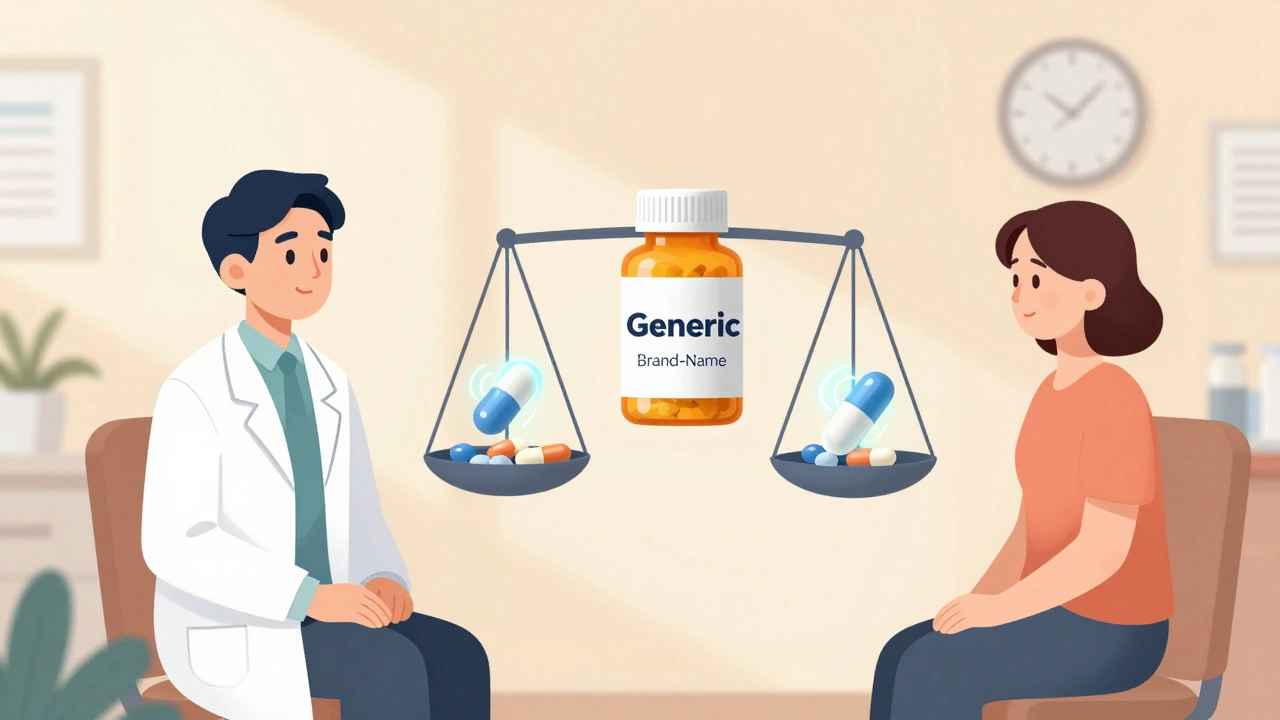
When your doctor hands you a prescription, you might not think twice about whether it’s the brand-name version or the generic. But here’s the thing: generic medications aren’t cheaper because they’re worse-they’re cheaper because they don’t carry the marketing and patent costs of the original. And yet, many people still worry. Is the generic going to work the same? Could it make me feel different? Should I ask for the brand name instead?
The short answer? For most people, generics work just as well. But that doesn’t mean you shouldn’t talk about it with your doctor. In fact, you should. Because the real issue isn’t science-it’s communication.
What’s the Difference Between Generic and Brand-Name Medications?
Let’s clear up a common myth: generic drugs are not "weaker" or "inferior." They’re exact copies of the active ingredient. If your brand-name pill contains 10 mg of lisinopril, so does the generic. The FDA requires them to deliver the same amount of medicine into your bloodstream at the same rate. That’s called bioequivalence. Studies show the average difference in absorption between brand and generic is just 3.5%-well within the 20% safety margin the FDA allows.
The differences? They’re all on the outside. Generics can’t look the same as brand-name pills because of trademark laws. So the shape, color, or even the little imprint on the tablet might change. The inactive ingredients-like fillers, dyes, or flavorings-might be different too. That’s why some people say, "This one doesn’t feel right." But it’s rarely the medicine itself. It’s the packaging, the size, or even the psychological shift of switching.
Brand-name drugs cost more because the company paid to develop them, run clinical trials, and market them. Once the patent expires-usually after 20 years-other companies can make the same drug without repeating those costs. That’s why generics are typically 80-85% cheaper. In the U.S., generics save the healthcare system billions every year. Between 2007 and 2016, they saved $1.67 trillion. That’s not just a number-it’s people who didn’t skip doses because they couldn’t afford their meds.
When Might You Need the Brand Name?
There are rare cases where your doctor might recommend sticking with the brand. These usually involve drugs with a narrow therapeutic index-meaning tiny changes in dosage can cause big problems. Think warfarin (a blood thinner), thyroid meds like levothyroxine, or certain seizure medications like phenytoin.
Even here, the FDA says approved generics are safe and effective. But some doctors, out of caution, prefer to keep patients on one version. If you’ve been stable on a brand-name drug for years and switching causes any change in how you feel-like increased side effects or a drop in effectiveness-it’s worth discussing. That’s not about the generic being bad. It’s about your body adapting to a new formulation, even if it’s chemically identical.
One study from Harvard found that a small number of patients on warfarin had slight fluctuations when switching between generic manufacturers. But these weren’t dangerous, and they weren’t consistent across all patients. Most experts agree: if you’re stable, stay put. If you’re switching and feel off, tell your doctor. Don’t assume it’s "all in your head."
Why Do Pharmacists Automatically Switch to Generics?
In the UK and most U.S. states, pharmacies are legally required to substitute a generic unless your doctor writes "dispense as written" or "no substitution" on the prescription. This isn’t a trick. It’s a cost-saving rule built into the system to keep prices down for everyone.
But that means you might get a different pill than you expected-without ever being asked. That’s why it’s important to know what you’re on. If you’ve had a bad reaction to a generic before, or if you’re sensitive to dyes or fillers, you need to make that clear. Don’t wait until you feel strange to speak up.
Pharmacists are your allies here. If you’re confused about a new pill, ask them. A 2022 study found that 78% of patient concerns about generics were resolved after a quick chat with the pharmacist. They can explain what changed, why, and whether it matters.
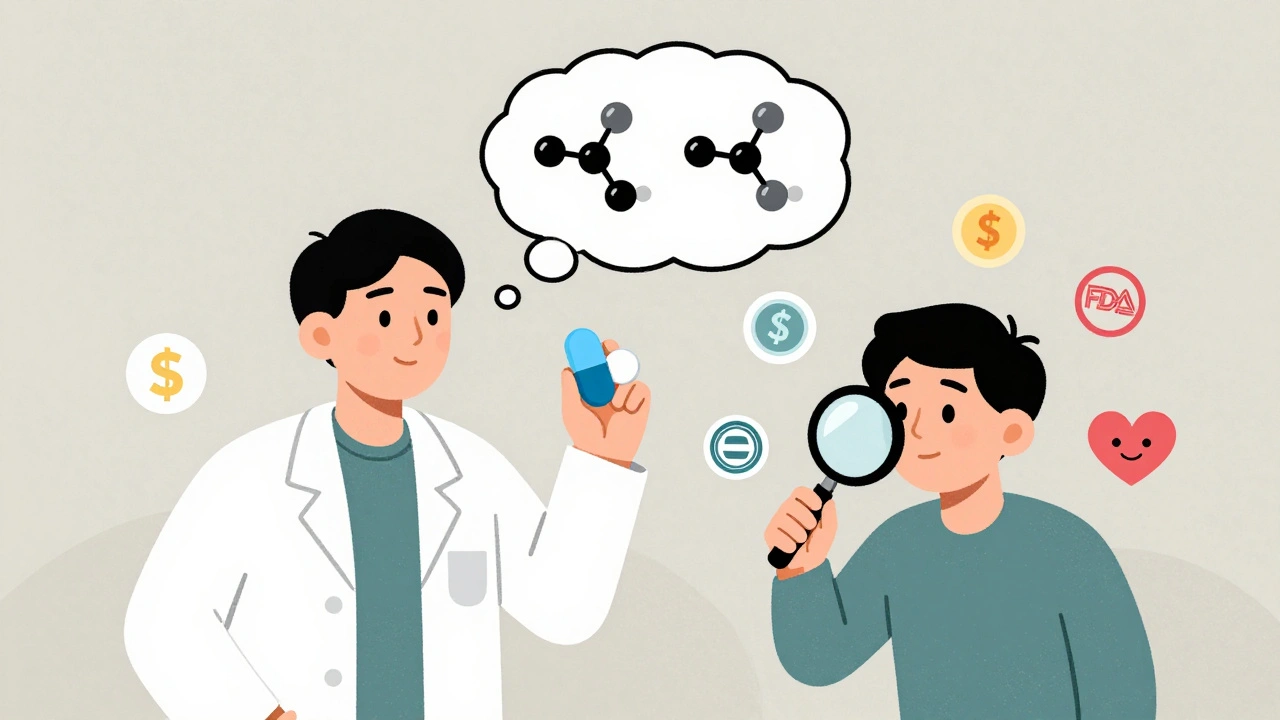
What Should You Say to Your Doctor?
Don’t wait for your doctor to bring it up. Most won’t. They’re busy. You need to lead the conversation. Here’s how to do it without sounding confrontational:
- Ask if there’s a generic version available. Simple. Direct. No judgment.
- If you’re already on a brand name, ask: "Is there a generic that works just as well?" This opens the door to cost-saving options.
- If you’ve switched before and felt different, say so. "I tried the generic last month and noticed I felt more tired. Could it be the filler?"
- If cost is a problem, say it. "I can’t afford this without insurance. Is there a cheaper option?"
- Ask about alternatives. "Are there other generics from different manufacturers?" Sometimes switching brands within generics helps.
Don’t be afraid to ask for a written note if you need to stay on brand. If your doctor agrees, they can write "DAW 1" or "dispense as written" on the script. That stops the pharmacy from switching it out.
What About Those Online Stories?
You’ve probably seen Reddit threads or Facebook groups where people say, "My generic made me sick," or "My seizures came back after the switch." It’s scary. And sometimes, it’s real.
But here’s what’s missing from those posts: context. Were they on a narrow therapeutic index drug? Did they switch manufacturers twice in one month? Were they already stressed, sleeping poorly, or on other meds? Often, what feels like a drug reaction is actually a nocebo effect-the opposite of a placebo. If you expect the generic to fail, your brain can make you feel like it did.
Consumer Reports found that 89% of people who switched from brand to generic reported no difference in effectiveness. Only 17% felt uneasy at first-until they talked to their pharmacist and understood why the pill looked different.
That’s the key: knowledge reduces fear. If you understand that the active ingredient is identical, and the FDA checks every batch, it’s easier to trust the process.
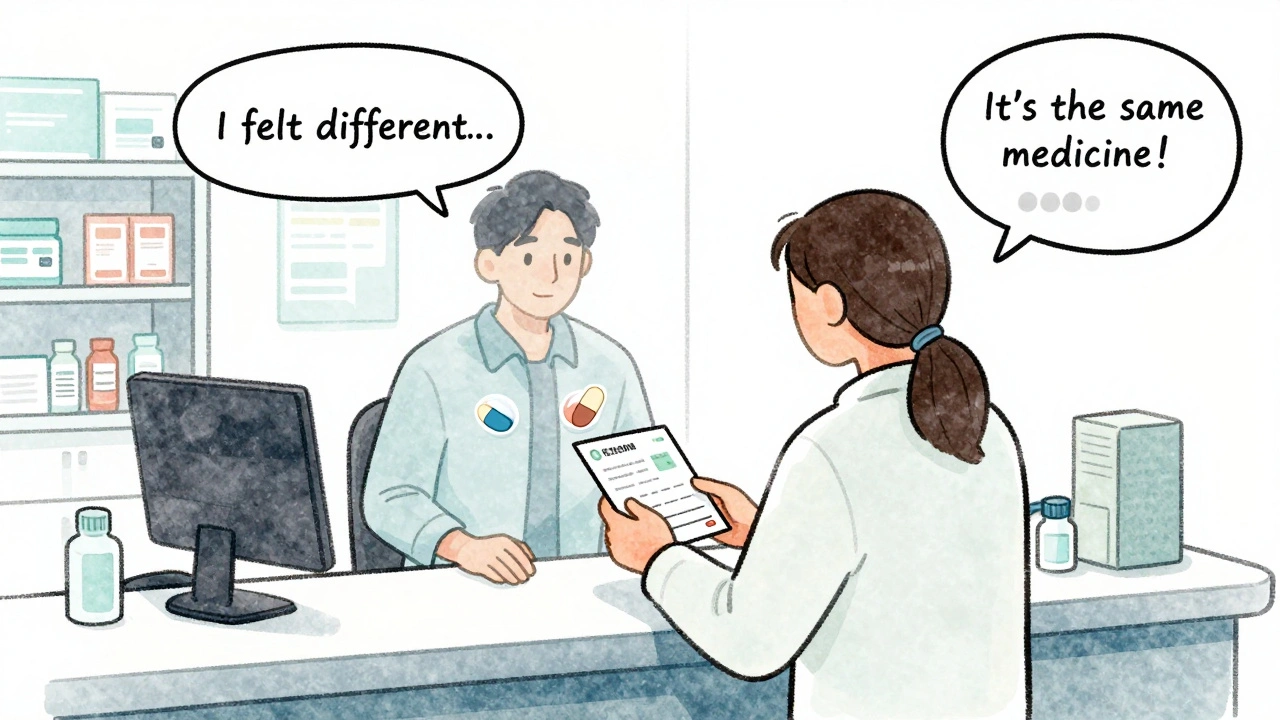
How to Spot a Generic on Your Prescription
When you get your script, look at the name. If it says "lisinopril," that’s the generic. If it says "Zestril," that’s the brand. Sometimes, your doctor will write the brand name by habit-even if they’re fine with the generic. That’s why you need to ask.
Check the label on your bottle. The manufacturer name will be different. The pill might be white instead of blue. The shape might be oval instead of round. None of that means it’s less effective. But if you’re unsure, take a picture and show your pharmacist. They’ll confirm it’s the right medicine.
What If You Can’t Afford Either?
Even generics can be expensive without insurance. In the UK, you pay a flat prescription charge unless you’re exempt. In the U.S., prices vary wildly. GoodRx and other price-comparison tools can help you find the lowest cash price at nearby pharmacies. Sometimes, a generic costs $4 at Walmart and $25 at your local pharmacy. That’s not a typo.
Ask your doctor about patient assistance programs. Many brand-name manufacturers offer free or discounted meds to low-income patients-even if you’re on a generic. Don’t assume you’re ineligible. Just ask.
Bottom Line: Your Voice Matters
Generic drugs are safe, effective, and save lives by making treatment affordable. But medicine isn’t just chemistry. It’s trust. It’s consistency. It’s how you feel when you take your pill every day.
If you’re happy on your brand-name drug and can afford it? Fine. Stay on it. But if cost is a burden, or you’re curious about switching, don’t stay silent. Ask your doctor. Ask your pharmacist. Ask questions until you feel confident.
The goal isn’t to pick the cheapest option. It’s to pick the one that works for you-physically, financially, and emotionally. And that’s a conversation you deserve to have.
Comments
Kenny Pakade
Generics are a socialist plot to make Americans weak. My grandpa took brand-name aspirin for 60 years and never needed a pacemaker. Now they give you chalk dust in a capsule and call it medicine. The FDA? Bought and paid for by Big Pharma’s cheaper cousins. I’d rather die than swallow a pill made in a basement in Bangalore.
December 6, 2025 at 15:48
Ashish Vazirani
Bro... I switched to generic metformin last year... and my sugar levels went haywire... I mean... seriously... I was sweating... trembling... felt like my soul was being vacuumed out... then I switched back... and boom... peace... the FDA doesn’t know what it’s doing... and the pharmacist? He just shrugs... like it’s normal... this isn’t science... this is a nightmare... I’m not crazy... I’m just... alive... and this system wants me dead...
December 7, 2025 at 09:23
pallavi khushwani
Honestly, I used to panic when my pills looked different too. But after talking to my pharmacist and reading up on bioequivalence, I realized it was mostly my brain playing tricks. I even tried switching between three different generic brands of levothyroxine-no difference. The real issue isn’t the drug. It’s how little we’re taught to trust our own bodies and the system that keeps us alive. Maybe we need more education, not more fear.
December 7, 2025 at 20:09
Katie O'Connell
While the empirical data supporting bioequivalence is statistically robust, one must acknowledge the phenomenological variance experienced by patients-particularly those with heightened pharmacokinetic sensitivity. The reductionist paradigm of equating chemical identity with therapeutic equivalence neglects the intricate interplay of excipient tolerability, circadian absorption rhythms, and the psychosomatic architecture of medication adherence. One cannot dismiss anecdotal reports as mere nocebo effects without first interrogating the epistemological foundations of clinical generalization.
December 9, 2025 at 06:52
Jackie Petersen
My cousin’s dog got the same generic heart med and started foaming at the mouth. Then I saw a video of a pharmacist in Ohio dumping generic pills into a dumpster labeled ‘US GOVT LEFTOVERS’. They’re testing them on poor people. You think your blood pressure’s fine? What if your pills are just sugar with food coloring? They don’t want you healthy. They want you dependent. And the doctors? They’re in on it.
December 10, 2025 at 17:53
Kumar Shubhranshu
Generic works. If you feel weird, it’s stress or sleep. Talk to your pharmacist. Done.
December 11, 2025 at 00:53
Geraldine Trainer-Cooper
Medicine is just chemistry pretending to be magic. We’re all just bodies with timers inside. The pill doesn’t care if you’re scared. It just does its job. The fear? That’s yours. And it’s cheaper than the brand name.
December 11, 2025 at 19:30
Nava Jothy
My doctor switched me to generic citalopram and I cried for three days. I felt like my soul had been replaced with a TikTok ad. 😭 The pills looked like they were made in a prison kitchen. I begged for my brand back. They said it was ‘the same’. But how can something that looks like a childhood crayon be the same? I’m not a lab rat. I’m a human being with feelings. And my mental health isn’t a cost-cutting spreadsheet. 🙏
December 11, 2025 at 20:52