
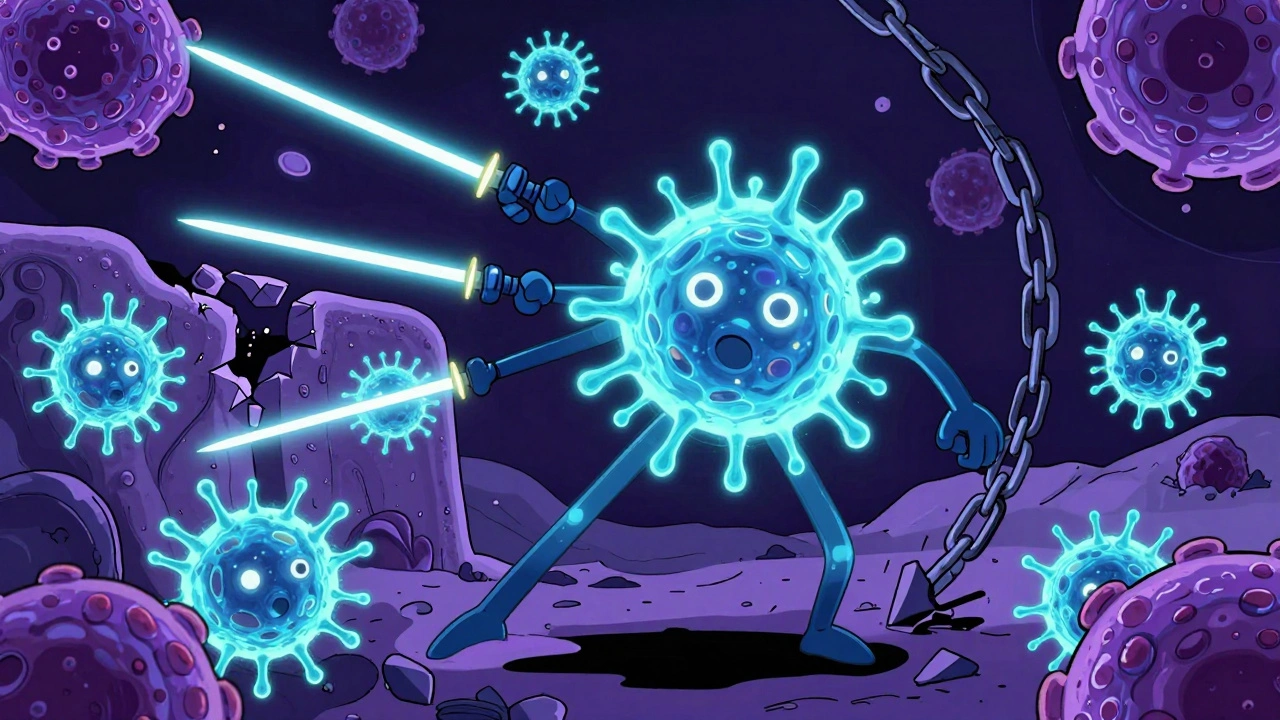
Checkpoint inhibitors and CAR-T cell therapy are two of the most powerful tools in modern cancer care. They don’t kill cancer cells directly. Instead, they help your own immune system find and destroy them. This shift-from poisoning tumors to empowering your body-has changed survival rates for some of the deadliest cancers. But these treatments aren’t magic bullets. They work brilliantly for some, barely at all for others, and come with serious risks.
How Checkpoint Inhibitors Unleash Your Immune System
Your immune system has built-in brakes. These are called checkpoint proteins. They stop T cells-the immune system’s soldiers-from attacking healthy tissue. Cancer cells exploit this. They turn on these brakes by expressing proteins like PD-L1, tricking your T cells into thinking the tumor is harmless.
Checkpoint inhibitors are monoclonal antibodies that block these signals. Drugs like pembrolizumab (Keytruda) and nivolumab (Opdivo) target PD-1. Ipilimumab (Yervoy) blocks CTLA-4. By cutting the brake lines, they let T cells see the cancer for what it is: a threat.
This approach works best in cancers with lots of mutations-like melanoma, lung cancer, and kidney cancer. In melanoma, about 40% of patients respond to anti-PD-1 drugs. Some see their tumors shrink dramatically, and a portion stay in remission for years. That’s unheard of with older treatments.
But not everyone responds. Only 20-40% of patients benefit, even in cancers where these drugs are approved. Why? Because the tumor might not have enough immune cells inside it to begin with. Or the environment around the tumor is so toxic that even activated T cells can’t survive.
CAR-T Therapy: Engineering Your Own Cancer-Fighting Cells
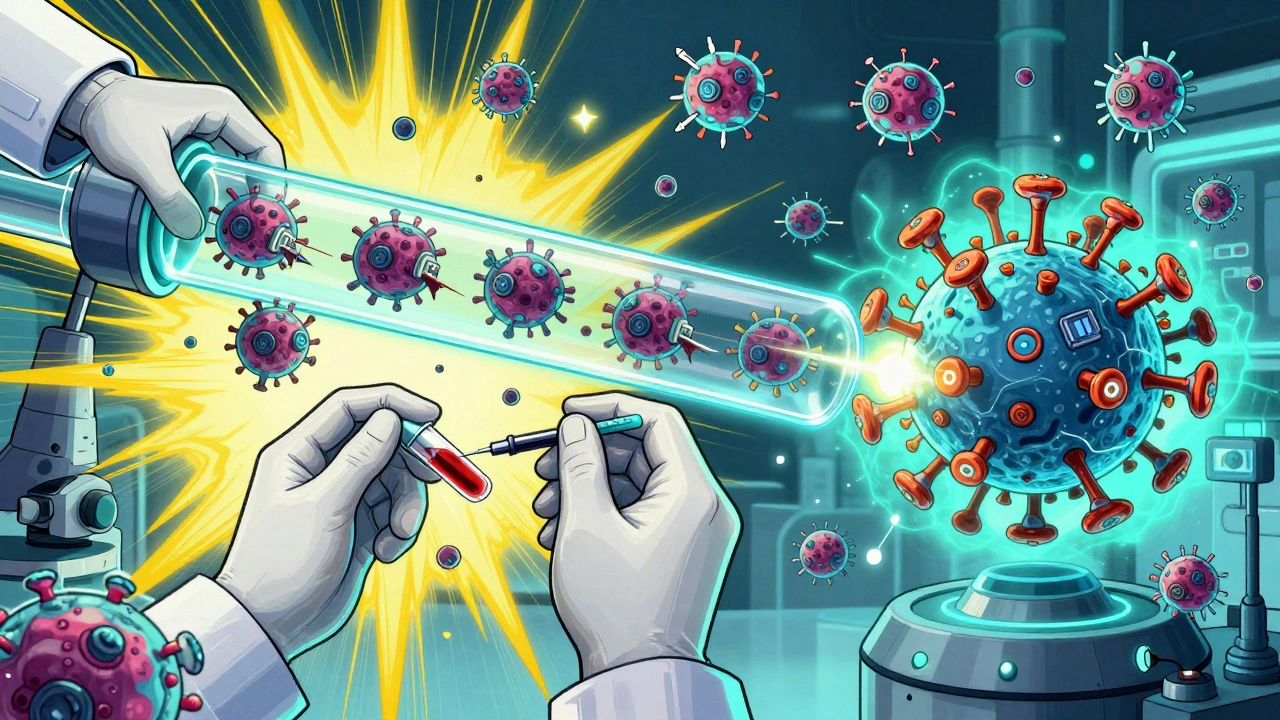
CAR-T therapy is like giving your immune system a GPS and a weapon. It starts with drawing blood from the patient. T cells are pulled out, then sent to a lab. There, scientists use a virus to insert a gene that codes for a chimeric antigen receptor (CAR). This receptor is designed to latch onto a specific protein on cancer cells-like CD19 on B-cell leukemias.
Once modified, these CAR-T cells are grown in huge numbers-billions of them. Then they’re infused back into the patient, after a round of chemotherapy to clear space in the immune system.
In children with relapsed acute lymphoblastic leukemia (ALL), CAR-T therapy achieves complete remission in 60-90% of cases. That’s staggering when you consider these kids had no other options left. The same is true for certain types of lymphoma.
But CAR-T only works well in blood cancers. For solid tumors-like lung, breast, or colon cancer-success rates are below 10%. Why? Solid tumors are harder to penetrate. They create a protective shield: low oxygen, acidic pH, immune-suppressing cells, and physical barriers. CAR-T cells get tired, stuck, or killed before they can do their job.
Side Effects: The Price of a Powerful Response
Both treatments can cause serious side effects, but they’re very different.
Checkpoint inhibitors trigger immune-related adverse events (irAEs). When the immune system is unleashed, it sometimes attacks healthy organs. Common issues include colitis (inflammation of the colon), skin rashes, thyroid problems, and lung inflammation. About 30-40% of patients get a rash. Around 10-15% develop colitis. These are manageable with steroids-if caught early.
CAR-T therapy brings its own dangers. Cytokine release syndrome (CRS) happens in 50-70% of patients. It’s like a storm inside your body: fever, low blood pressure, trouble breathing. In severe cases, it can be life-threatening. Then there’s ICANS-immune effector cell-associated neurotoxicity syndrome. Patients may get confused, have seizures, or lose the ability to speak. About 20-40% of CAR-T patients experience this.
Both treatments cause fatigue and fever. But CAR-T’s side effects come fast-usually within days of infusion. Checkpoint inhibitor side effects can appear weeks or even months later.
Combining Them: The Next Big Leap
Scientists are now trying to merge the two. Why? Because checkpoint inhibitors activate existing T cells, while CAR-T therapy brings in brand-new ones. Together, they might overcome the weaknesses of each.
Early trials show promise. In one study, patients with advanced melanoma who got both anti-PD-1 and CAR-T therapy saw better tumor shrinkage than either alone. But combining them also increases toxicity. Giving a patient a powerful drug and a living cell therapy at the same time can overwhelm the body.
So researchers are getting smarter. Instead of giving two separate drugs, they’re engineering CAR-T cells to make their own checkpoint blockers. These modified cells secrete anti-PD-1 antibodies right at the tumor site. In mouse studies, this cut immune side effects by 37% while boosting cancer killing. It’s like giving the CAR-T cells a built-in shield against the tumor’s defenses.
Another breakthrough? CAR-T cells that release IL-12 or block PTP1B-a protein that puts brakes on T cells. One study showed a 2.3-fold increase in tumor-fighting cells inside breast tumors when PTP1B was blocked.
Access and Cost: Who Gets These Treatments?
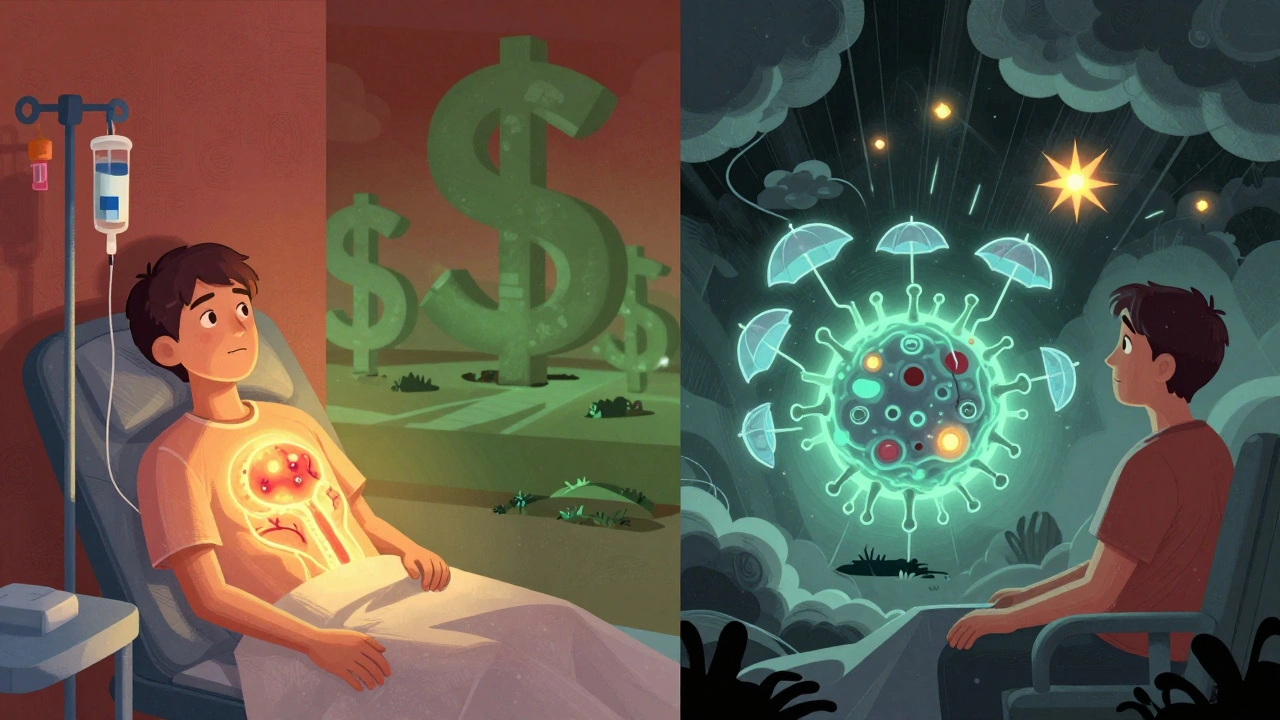
These therapies aren’t just complex-they’re expensive. A single CAR-T treatment costs between $373,000 and $475,000. Checkpoint inhibitors aren’t cheap either-up to $150,000 a year. Insurance often covers them, but not always equally.
Studies show Black patients are 31% less likely to get CAR-T therapy than White patients. Medicaid patients are 23% less likely. Why? CAR-T requires specialized centers. Only 15% of U.S. cancer centers offer it, but they handle 87% of all treatments. Most patients live too far, or their doctors don’t know how to refer them.
Manufacturing CAR-T takes 3-5 weeks. For someone with fast-growing cancer, that delay can be deadly. Checkpoint inhibitors? They’re ready-made. A doctor can prescribe them like any other drug.
Even in Australia, where healthcare is publicly funded, access varies. Patients in rural areas often wait months to be evaluated. Urban centers like Sydney and Melbourne have more expertise, but still struggle with capacity.
What’s Next?
The future is in smarter engineering. Scientists are working on "off-the-shelf" CAR-T cells-made from healthy donors, not the patient. That could cut wait times from weeks to days.
New targets are being explored. Instead of CD19, researchers are looking at BCMA for multiple myeloma, or GPC3 for liver cancer. They’re also building CAR-T cells that can switch on only when they reach the tumor, reducing damage to healthy tissue.
And the most exciting idea? Personalizing the combination. Not every patient needs both drugs. Some respond to CAR-T alone. Others need a checkpoint inhibitor first to wake up their immune system. The goal is to match the right treatment to the right tumor-based on its genetics, its immune environment, and the patient’s overall health.
Right now, we’re in the early days of this revolution. These therapies have saved lives. But they’re not perfect. The next decade will be about making them safer, cheaper, and available to everyone-not just those lucky enough to live near a top cancer center.
Are checkpoint inhibitors and CAR-T therapy the same thing?
No. Checkpoint inhibitors are drugs given through an IV that block signals cancer uses to hide from the immune system. CAR-T therapy is a personalized treatment where a patient’s own T cells are removed, genetically changed to attack cancer, and then reinfused. One is a drug; the other is a living cell therapy.
Which cancers respond best to CAR-T therapy?
CAR-T therapy works best in certain blood cancers: B-cell acute lymphoblastic leukemia (ALL) in children and young adults, diffuse large B-cell lymphoma, follicular lymphoma, and multiple myeloma. Response rates can be as high as 90% in some cases. It has limited success in solid tumors like lung, breast, or colon cancer.
Why don’t checkpoint inhibitors work for everyone?
Checkpoint inhibitors only help if your immune system already has T cells that can recognize the cancer. If the tumor has few mutations, no immune cells inside it, or a hostile environment that shuts down T cells, the drugs won’t work. That’s why response rates are only 20-40%, even in cancers where they’re approved.
Can you get CAR-T therapy more than once?
It’s possible, but rare. CAR-T cells can lose effectiveness over time, or the cancer may stop expressing the target protein. Some patients receive a second infusion if the first one worked but didn’t last. But the procedure is intense, and side effects can be worse the second time. Most doctors prefer to try other options first.
How long do the effects of CAR-T therapy last?
In many patients, especially those with leukemia or lymphoma, the effects last for years-sometimes over a decade. CAR-T cells can become long-lived memory cells, sticking around to fight cancer if it comes back. That’s why some patients are considered cured. But for others, the cells fade, or the cancer evolves to escape them.
Is immunotherapy better than chemotherapy?
It’s not a simple yes or no. Chemotherapy kills fast-growing cells, both cancerous and healthy, which causes side effects like hair loss and nausea. Immunotherapy works differently-it trains your body to fight cancer. It often has fewer short-term side effects, and responses can last much longer. But it doesn’t work for everyone, and when it does, the side effects can be severe. The best choice depends on the cancer type, stage, and individual health.
Comments
Yasmine Hajar
This is the future, folks. Not magic, not miracle - just science finally catching up to what we always knew: your body can fight cancer if you stop holding it back. I’ve seen it in my cousin. Stage 4 melanoma. Now? Zero signs. Five years clean. No chemo. No hair loss. Just a damn immune system that finally got a clue.
December 3, 2025 at 05:43
val kendra
Checkpoints are cool but CAR-T is where it’s at. I work in oncology nursing. Saw a 12-year-old girl walk out of the ICU after CAR-T like she’d just had a flu shot. Her parents cried for an hour. That’s not medicine. That’s resurrection.
December 4, 2025 at 01:14
Rudy Van den Boogaert
Yeah but let’s not pretend this is accessible. My uncle got diagnosed with lymphoma last year. His oncologist said CAR-T was an option. Then they told him the nearest center was 600 miles away. Insurance said ‘maybe.’ He died waiting. This isn’t progress if it’s only for the rich and lucky.
December 4, 2025 at 14:00
Ashley Elliott
Real talk: the side effects scare me more than the cancer sometimes. My aunt got checkpoint inhibitors. Got colitis so bad she had to be hospitalized. Then her thyroid went haywire. Then her lungs. It’s like her body turned on itself. She’s alive now, but she’s not the same person. These aren’t just drugs. They’re weapons that backfire.
December 6, 2025 at 10:26
Pavan Kankala
Wake up. This is all a pharmaceutical scam. They don’t want you cured. They want you on lifelong drugs. Checkpoint inhibitors? Made from lab-grown antibodies that cost $150K a year. CAR-T? A $500K ‘personalized’ treatment that only works on 1 in 3. Meanwhile, natural immune boosters like turmeric and mushrooms are banned in 14 countries. Coincidence? I think not.
December 7, 2025 at 18:59
Chad Handy
Let’s be real - this whole immunotherapy thing is just a glorified placebo with extra steps. The body doesn’t ‘fight cancer’ like some war movie. Cancer isn’t an enemy. It’s your own cells going rogue because your liver’s clogged, your gut’s dead, and your stress hormones are screaming. You think a lab-made antibody fixes that? Nah. You need fasting, sunlight, sleep, and real food. Not IVs full of corporate science.
December 8, 2025 at 10:52
Jessica Baydowicz
Y’all are missing the point. This isn’t about the science. It’s about the people behind it. The grad students pulling all-nighters in labs. The nurses who sit with patients during CRS. The families who drive 8 hours just to get a shot. This is hope. Not perfect. Not fair. But real. And it’s saving lives every damn day.
December 10, 2025 at 03:41
zac grant
TL;DR: CAR-T = living drug. Checkpoint = molecular leash release. Both require tumor-infiltrating lymphocytes (TILs) to be present. No TILs? No response. That’s why biomarkers like PD-L1, TMB, and CD8+ density are critical for patient stratification. We’re moving toward precision immuno-oncology - but we’re still in phase 1 of the playbook.
December 10, 2025 at 05:44
Gillian Watson
My mum had melanoma. Got Keytruda. Response was amazing - tumors vanished. Then, six months later, she got a weird rash. Turned out it was vitiligo. Her skin just… stopped making pigment. Doc said it was a sign her immune system was still on high alert. Kinda beautiful, in a scary way. She’s still here. No cancer. But she looks different now. And so do I.
December 10, 2025 at 20:20
Joe Lam
Oh please. You think this is revolutionary? I’ve seen this movie before. Remember the 90s? ‘Gene therapy will cure everything!’ Then it killed three people. Remember CAR-T’s first trials? 20% mortality. Now it’s a $500K spa day for billionaires. The real breakthrough? The PR team. The rest is just hype wrapped in a lab coat.
December 11, 2025 at 09:15
Benjamin Sedler
Immunotherapy is the new religion. People treat it like it’s holy. ‘My cousin got cured!’ ‘My aunt’s in remission!’ But no one talks about the 60% who die anyway. Or the ones who get auto-immune diabetes because their pancreas got mistaken for a tumor. We’re not curing cancer. We’re just trading one hell for another. And charging $500K for the upgrade.
December 12, 2025 at 13:24
Jordan Wall
As a biochemist (PhD, Cambridge), I must say: the real innovation isn’t the therapy - it’s the manufacturing pipeline. CAR-T takes 3-5 weeks because we’re still using retroviruses and batch bioreactors. CRISPR-based, allogeneic, off-the-shelf CAR-T? That’s the future. And it’s coming. By 2030, you’ll get it like a blood transfusion. No more ‘personalized’ nonsense. Just… fix it.
December 12, 2025 at 21:43
Gareth Storer
So let me get this straight… we spend $500K to reprogram someone’s T-cells… so they can… kill cancer? Meanwhile, we can’t afford to give people clean water or mental health care. Brilliant. Truly. The pinnacle of human ingenuity: making rich people live longer while the rest of us die waiting for a referral.
December 13, 2025 at 02:40
Martyn Stuart
For those asking ‘why not just use diet?’ - listen. I’ve been a nurse for 22 years. I’ve seen patients eat kale, juice, meditate, and still die. And I’ve seen others with terrible diets live years after CAR-T. This isn’t about ‘natural’ vs ‘synthetic.’ It’s about biology. And biology doesn’t care if you’re ‘pure.’ It cares if your T-cells can recognize the tumor. That’s it.
December 14, 2025 at 08:28
Jake Deeds
There’s a quiet tragedy here. The patients who respond? They’re the lucky ones. The ones who don’t? They’re the ones who get ghosted by the system. Their oncologists stop calling. Their insurance drops coverage. Their families stop visiting because ‘there’s nothing left to do.’ We celebrate the miracles. We ignore the silence. That’s the real cost of progress.
December 15, 2025 at 15:12
Elizabeth Crutchfield
my mom got car-t last year. it was rough. she was in the hosptial for 3 weeks. fever, confusin, couldnt talk for 2 days. but she’s here. no cancer. i just wanted to say… it’s worth it. even if it breaks you first.
December 16, 2025 at 07:33