

Kombucha Medication Interaction Checker
Check Your Kombucha Safety
Kombucha contains trace alcohol (0.5% ABV for commercial brands, up to 3.2% ABV for homemade). This tool helps determine if your kombucha may interact with your medications.
Many people drink kombucha for its probiotics, tangy flavor, and reputation as a healthy alternative to soda. But if you’re taking medication that reacts badly to alcohol, your daily kombucha could be risking your health-without you even realizing it.
Why Kombucha Has Alcohol in It
Kombucha isn’t brewed like beer or wine. It’s fermented. That means yeast eats sugar in sweetened tea and turns it into alcohol and carbon dioxide. This is natural. Every batch of kombucha, whether store-bought or homemade, contains some alcohol as a byproduct. The difference? Amount. Commercial brands are legally required to keep alcohol below 0.5% ABV (alcohol by volume) to be sold as a non-alcoholic beverage. That’s less than what you’d find in a ripe banana or a glass of orange juice left out overnight. But here’s the catch: that rule doesn’t apply to homemade kombucha. Homebrewed kombucha can easily hit 1.5% to 2.5% ABV-close to light beer. Temperature, fermentation time, and how much sugar you use all affect how much alcohol builds up. One batch might be safe. The next? Not so much. And most homebrewers never test it.Which Medications Are at Risk?
Even small amounts of alcohol can cause serious problems when mixed with certain drugs. The American Pharmacists Association lists 17 major medication classes that interact with alcohol, and kombucha can trigger those reactions.- Antibiotics like metronidazole and tinidazole: Mixing them with kombucha-even at 0.5% ABV-can cause severe nausea, vomiting, flushing, and rapid heartbeat. A 2023 case report in the Journal of Clinical Pharmacy and Therapeutics documented a patient hospitalized after drinking homemade kombucha while on metronidazole.
- Antidepressants like sertraline (Zoloft) and fluoxetine (Prozac): Alcohol can worsen side effects like dizziness, drowsiness, and mood swings. Reddit users and pharmacy records show multiple cases of people feeling lightheaded or worse after combining kombucha with SSRIs.
- Diabetes medications like metformin and chlorpropamide: Alcohol can lower blood sugar dangerously. One user on Diabetes Daily reported a 15-point blood sugar drop after drinking kombucha with metformin, requiring an ER visit.
- Benzodiazepines like Xanax or Valium: Even trace alcohol can amplify their sedative effects. Stanford neuroscientist Dr. Andrew Huberman warned that kombucha’s alcohol may boost GABA receptor activity, increasing drowsiness and impairing coordination.
- Nitrates for heart conditions: Alcohol can cause dangerous drops in blood pressure. When combined with nitrates, the risk of fainting or heart strain rises.
Commercial vs. Homemade: The Big Difference
Not all kombucha is the same. Commercial brands use pasteurization, filtration, or strict controls to cap alcohol at 0.5% ABV. GT’s Kombucha, for example, has used flash pasteurization since 2016 to lock in consistency. Most major brands now test every batch with HPLC equipment to meet TTB standards. But homemade kombucha? It’s a gamble. A 2022 study of 200 homebrew batches found alcohol levels varied by up to 300%. One batch might be 0.3% ABV. The next, made in a warmer kitchen, could be 1.9%. And most people don’t know how to test it. A 2024 Harvard study found 43% of homebrewed kombucha exceeded 0.5% ABV. Twelve percent hit 3.2% ABV-the level of a light beer. That’s not a splash. That’s enough to trigger reactions in people on sensitive medications.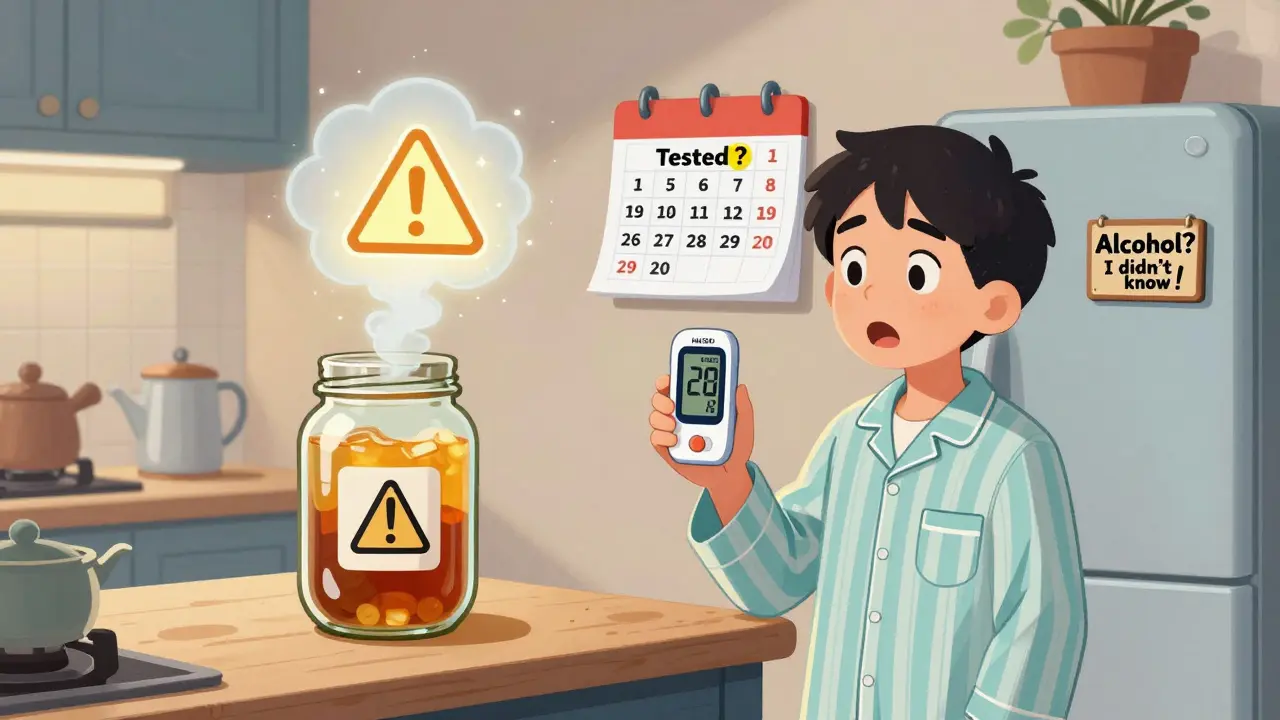
Labeling Is Still a Mess
You’d think if kombucha contains alcohol, it’d say so on the label. But until January 2024, it didn’t have to. Even now, with new FDA rules requiring “Contains Trace Alcohol” on every bottle, many brands still bury the warning in fine print. A 2023 FDA report showed only 63% of commercial kombucha products clearly disclosed alcohol content. On Trustpilot, customers complained: “No warning about my blood pressure meds.” “I had no idea this had alcohol.” “I drank it with my antibiotics and got sick.” Pharmacists aren’t always aware either. A 2023 survey by the American Pharmacists Association found only 32% of pharmacists correctly identified kombucha as a potential alcohol source. If your pharmacist doesn’t know, how are you supposed to?What Should You Do?
If you take any medication that warns against alcohol, here’s what to do:- Check your medication’s label or ask your pharmacist: Does it say “avoid alcohol” or “may interact with alcohol”?
- If you drink commercial kombucha: Look for the “Contains Trace Alcohol” label. Even then, consider skipping it if you’re on metronidazole, benzodiazepines, or diabetes meds.
- If you brew at home: Stop drinking it until you test it. Use an alcoholmeter like the HM Digital HA-520. It costs under $50 and gives readings accurate to ±0.1% ABV. Learn how to use it over 3-5 batches.
- Wait 48 hours after taking alcohol-sensitive meds before drinking kombucha. The Cleveland Clinic recommends this buffer to reduce interaction risk.
- Consider alternatives: Kefir, water kefir, or unsweetened herbal teas offer probiotics without alcohol.

The Bigger Picture
The kombucha market hit $3.2 billion in 2023, and it’s growing fast. But with more people drinking it daily comes more risk-especially for older adults. Nearly 38% of adults over 50 in the U.S. take four or more medications daily, and many of them drink kombucha without knowing the danger. New safety measures are starting. Health-Ade launched a blockchain traceability system in February 2024 that lets you scan a QR code to see the exact alcohol content of your bottle. The NIH just launched a $2.3 million study to better understand these interactions, with results expected in 2025. But until then, the safest choice is simple: if your medication says no alcohol, treat kombucha like alcohol. Even if it’s labeled “non-alcoholic.”What’s Next?
If you’re unsure whether your meds interact with kombucha, don’t guess. Call your pharmacist. Bring the bottle. Ask: “Does this contain alcohol? Could it affect my medication?” And if you brew your own? Test it. Write down the results. Share them with others. Because what seems like a healthy drink could quietly be putting your health at risk.Can I drink kombucha if I’m on antibiotics?
If you’re taking metronidazole or tinidazole, avoid kombucha completely. Even small amounts of alcohol can cause severe nausea, vomiting, and rapid heartbeat. For other antibiotics, check with your pharmacist-some have no interaction, but it’s not worth guessing.
Is 0.5% alcohol in kombucha really a problem?
For most people, no. But if you’re on medications that interact with alcohol-even trace amounts-it can be. That 0.5% adds up if you drink kombucha daily. Over a week, it equals 1.75 standard drinks. For someone on benzodiazepines or diabetes meds, that’s enough to cause dizziness, low blood sugar, or worse.
Does pasteurized kombucha have less alcohol?
Pasteurization stops fermentation, so it prevents more alcohol from forming. But it doesn’t remove alcohol already present. Pasteurized kombucha still contains the same alcohol level as before pasteurization-usually under 0.5% for commercial brands. The key is testing, not just pasteurization.
How do I test kombucha at home for alcohol?
Use a digital alcoholmeter like the HM Digital HA-520. It measures alcohol by volume directly and is accurate to ±0.1%. You’ll need to calibrate it with distilled water first. Test each batch after fermentation ends. It takes 3-5 batches to get consistent results, but it’s the only way to know if your kombucha is safe.
Are there kombucha brands that are completely alcohol-free?
No. All kombucha made through fermentation contains trace alcohol. Some brands use processes like vacuum distillation to remove alcohol after fermentation, but these are rare and expensive. If a brand claims “0% alcohol,” ask how they achieved it. Most are just staying under the legal 0.5% limit.
Can kombucha affect my blood sugar if I have diabetes?
Yes. Alcohol can lower blood sugar, especially when combined with metformin or sulfonylureas. A 2023 case report described a diabetic patient who had a dangerous 15-point drop in blood sugar after drinking kombucha. Always monitor your levels closely if you choose to drink it, and avoid it if your doctor advises against alcohol.
Is hard kombucha safer than regular kombucha?
No. Hard kombucha is intentionally brewed to have 3-8% ABV-similar to beer. If you’re on alcohol-sensitive medications, hard kombucha is far more dangerous than regular kombucha. It’s not a health drink-it’s an alcoholic beverage. Avoid it completely if your meds interact with alcohol.
Comments
Saylor Frye
Look, if you’re drinking kombucha and you’re on metronidazole, you’re already one step away from the ER. I mean, come on. The fact that people think 0.5% is ‘safe’ is why we have a healthcare crisis. That’s not a splash-it’s a slow drip into your liver while you scroll TikTok thinking you’re ‘wellness-ing.’
January 7, 2026 at 11:53
Wesley Pereira
Bro, I homebrewed 14 batches last year. One hit 2.8% ABV. I didn’t know until I used an HA-520. Now I label every jar like a lab rat. If you’re on SSRIs or nitrates, treat kombucha like a shot of tequila. The FDA’s ‘trace alcohol’ label is a loophole designed by lawyers who’ve never had a panic attack from a kombucha buzz.
January 7, 2026 at 17:35
Lily Lilyy
Hi everyone! 💕 I just wanted to say that taking care of your body is such a beautiful act of love. If you’re on medication, please, please talk to your pharmacist. They’re like health superheroes! And if you brew kombucha, maybe try kefir instead? It’s so creamy and kind to your gut. 🌿💖
January 8, 2026 at 18:48
Susan Arlene
so i drank kombucha with my zoloft for 8 months and didn’t die
but also didn’t feel like myself
maybe it’s the alcohol
maybe it’s the sugar
maybe i just need to sleep more
who knows
January 9, 2026 at 11:11
Joann Absi
AMERICA IS BEING POISONED BY CORPORATE KOMBUCHA LIES 🇺🇸🔥
THEY PUT ALCOHOL IN YOUR TEA AND CALL IT HEALTHY?!
THEY’RE STEALING OUR LIVER’S VIBES 😭
STOP BUYING BOTTLES WITH QR CODES THAT SAY ‘TRACE’
IT’S A TRAP. A SWEET, FERMENTED TRAP.
WE NEED A REVOLUTION. #KOMBUCHABAN
January 11, 2026 at 05:35
Mukesh Pareek
Typical Western ignorance. Fermentation is an ancient science, not a marketing gimmick. You don’t test alcohol content? Then you don’t deserve to drink it. In India, we ferment for months and know the ABV by smell and taste. Your ‘FDA standards’ are child’s play. If your body can’t handle trace ethanol, maybe your metabolism needs a reset, not a warning label.
January 12, 2026 at 19:11
Ashley S
why do people even drink this? it tastes like vinegar with bubbles
and now you’re telling me it’s secretly booze?
so i’ve been drinking alcohol and thinking i was healthy?
what a scam
no more kombucha. i’m switching to water.
and also i’m mad.
January 14, 2026 at 03:53
Jeane Hendrix
Just to clarify-does the 0.5% ABV threshold apply to total daily intake? Like, if I drink two 16oz bottles a day, that’s 1.0% ABV equivalent over 32oz. And if I’m on metformin, does that accumulate? I’ve been reading the TTB guidelines but they don’t specify cumulative exposure. Anyone have data on chronic low-dose alcohol exposure with diabetes meds?
January 14, 2026 at 11:45