
Lithium Thyroid Risk Calculator
Assess Your Thyroid Risk
This tool estimates your risk of developing thyroid issues while taking lithium based on the latest medical research. Results are for informational purposes only and should not replace professional medical advice.
Your Risk Assessment
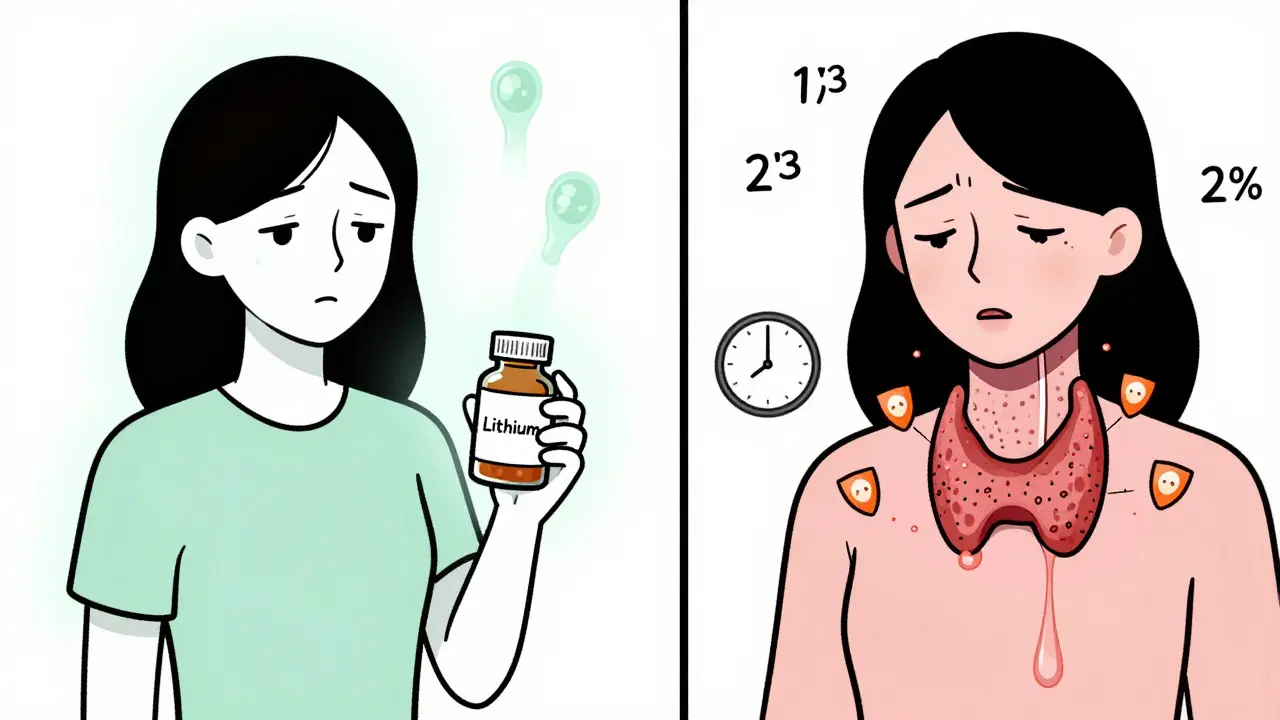
When lithium was first used to treat bipolar disorder in the late 1940s, doctors didn’t fully understand how deeply it could affect the thyroid. Today, we know better: lithium is one of the most effective mood stabilizers for preventing manic and depressive episodes, but it also disrupts thyroid function in a significant number of people. For many, this isn’t a minor side effect-it’s a lifelong management challenge. If you’re on lithium or considering it, understanding how it interacts with your thyroid isn’t optional. It’s essential.
How Lithium Disrupts Thyroid Function
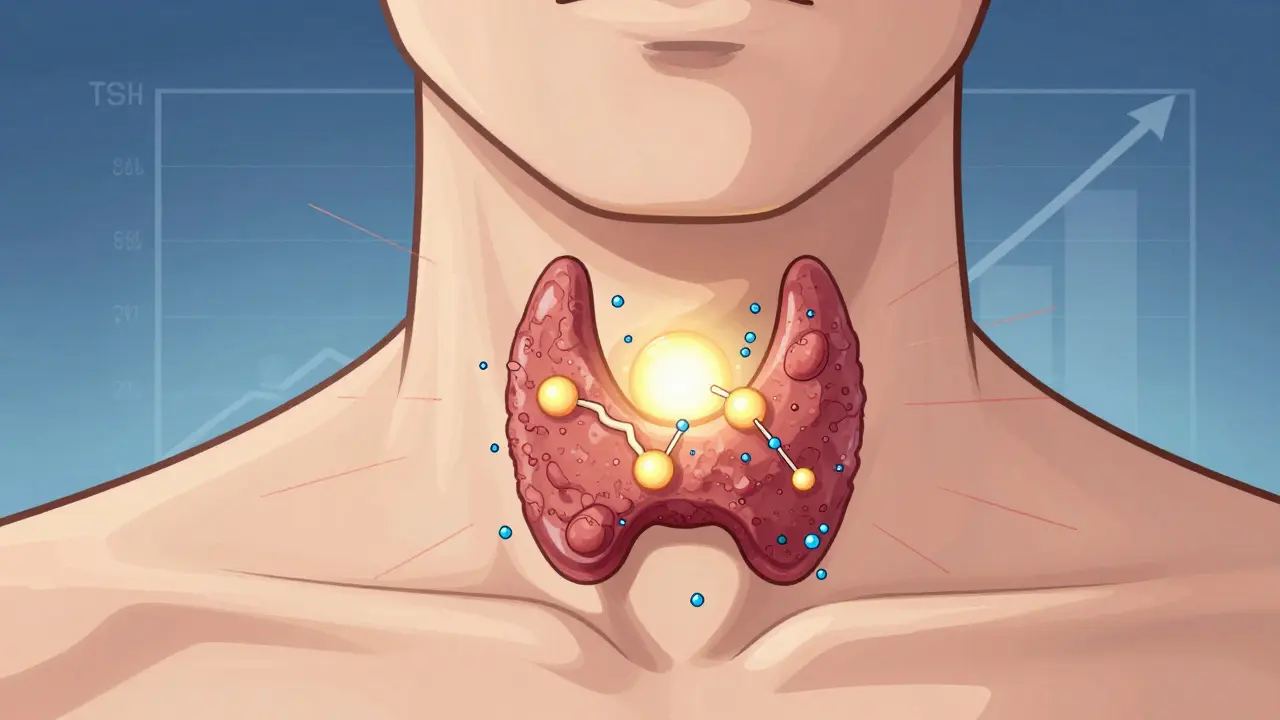
Lithium doesn’t just randomly mess with your thyroid. It attacks multiple points in the hormone production line. First, it blocks iodine from attaching to tyrosine, which is the first step in making T3 and T4. Then, it stops the thyroid from releasing those hormones into your bloodstream by interfering with the breakdown of thyroglobulin. It even reduces how much T4 gets converted into the more active T3 in your body. The result? Your thyroid can’t do its job properly.
On top of that, lithium changes the structure of thyroid cells. It messes with tubulin, a protein that helps cells maintain their shape and move hormones around. This leads to swelling of the thyroid gland-what doctors call a goiter. Studies show that between 30% and 59% of people on long-term lithium develop a goiter. Some people notice a lump in their neck; others never feel anything until a blood test shows trouble.
And then there’s the immune angle. About 20% of people on lithium develop antithyroid antibodies, which suggests their immune system starts attacking the thyroid. Not everyone with antibodies ends up with hypothyroidism, but it’s a red flag that the thyroid is under stress.
The Numbers Don’t Lie: How Common Is Thyroid Trouble?
Let’s cut through the noise. If you’re on lithium, here’s what you’re actually up against:
- 20% to 32% of patients develop hypothyroidism-meaning your thyroid stops making enough hormones.
- 3% to 5% develop hyperthyroidism, usually in the form of painless thyroiditis, not Graves’ disease.
- Goiter appears in up to half of long-term users.
- Women under 60 are 3.2 times more likely than men to develop hypothyroidism on lithium.
A 2023 study of 1,245 bipolar patients on lithium found that 79% of those with thyroid issues had hypothyroidism. That’s nearly one in three people. And here’s the kicker: many of them didn’t even know something was wrong until they started feeling exhausted, gaining weight, or struggling with depression despite stable mood control.
Dose Matters-More Lithium Doesn’t Mean Better Mood
It used to be thought that lithium-induced thyroid problems weren’t related to dose. That changed in 2024. A major study by Dr. Pardossi showed that for every 100 mg increase in daily lithium dose, the risk of worsening thyroid dysfunction went up by 27%. So if you’re on 900 mg and your TSH is creeping up, it’s not just coincidence.
But here’s the twist: the longer you’re on lithium, the more your thyroid might adapt. That same study found that after several years, the risk per milligram dropped slightly. Your body might be trying to compensate. Still, that doesn’t mean you can ignore rising TSH levels. It means you need to monitor more carefully over time, not less.
Lithium vs. Other Mood Stabilizers
Not all mood stabilizers treat your thyroid the same way.
| Mood Stabilizer | Thyroid Dysfunction Risk | Primary Effect |
|---|---|---|
| Lithium | 20-32% (hypothyroidism) | Inhibits hormone synthesis and release |
| Valproate | 5-10% | Mild TSH elevation, rarely permanent |
| Carbamazepine | 1-3% | Minimal impact |
| Amiodarone (not a mood stabilizer, but relevant) | 15-20% | Iodine overload, type 2 thyrotoxicosis |
Lithium stands out-not because it’s the worst, but because it’s the most effective. And that’s why so many people stay on it despite the thyroid risks. A 2017 meta-analysis in The Lancet showed lithium reduces mood episodes by 39% compared to placebo. That’s unmatched. Other drugs might be easier on the thyroid, but they don’t stop suicide attempts the way lithium does. One study found lithium cuts suicide attempt risk by 14% compared to alternatives.
What Does Thyroid Trouble Feel Like?
People on lithium often mistake thyroid symptoms for worsening bipolar symptoms. Fatigue? That’s just the illness, right? Weight gain? Just a side effect. But these might be your thyroid screaming for attention.
Common signs of lithium-induced hypothyroidism:
- Constant tiredness, even after sleeping
- Unexplained weight gain (5+ pounds without lifestyle changes)
- Feeling colder than usual
- Dry skin or hair loss
- Depression that won’t lift, even with stable lithium levels
- Constipation
For hyperthyroidism (less common):
- Sudden anxiety or nervousness
- Heart palpitations
- Unintentional weight loss
- Shaky hands
- Feeling hot all the time
One Reddit user wrote: “My TSH went from 1.8 to 8.7 in 18 months. I was told it was just stress. Then I started fainting. Turns out I needed levothyroxine.” That’s not rare. It’s predictable.
How to Monitor and Manage Thyroid Health on Lithium
The American Thyroid Association says this plainly: Test before you start, then every 6 to 12 months. That’s not a suggestion. It’s the standard.
Here’s what you need:
- Baseline test: TSH and free T4 before starting lithium. Don’t skip this.
- First year: Every 6 months. TSH can rise slowly-sometimes after 6 to 8 weeks. Don’t panic if it’s slightly elevated early on.
- After stabilization: Once a year, unless your doctor recommends more frequent checks.
- Watch for symptoms: If you feel off, get tested-even if it’s been 11 months.
If your TSH is high and your free T4 is low, you have hypothyroidism. Treatment? Levothyroxine. But here’s the catch: people on lithium often need 20-30% more levothyroxine than others to get their TSH back into the normal range. Your dose isn’t wrong-it’s just different.
For hyperthyroidism, most cases are painless thyroiditis. It usually clears up on its own in 3 to 6 months. No antithyroid drugs needed. But if it’s true Graves’ disease-which is rare-you’ll need carbimazole or methimazole.
What About Stopping Lithium?
You might think: “If lithium is wrecking my thyroid, why not quit?”
That sounds logical-but it’s risky. Abruptly stopping lithium can trigger a rebound hyperthyroid state. There’s one documented case of thyroid storm after a patient underwent hemodialysis to remove lithium. That’s life-threatening.
And even if your thyroid recovers after stopping lithium, your bipolar symptoms might not. Lithium’s ability to prevent suicide and stabilize mood is unmatched. For many, the trade-off is worth it. One patient said: “I’d rather have a thyroid issue and a stable mind than a perfect thyroid and another hospital stay.”
New Hope: What’s Changing in 2026
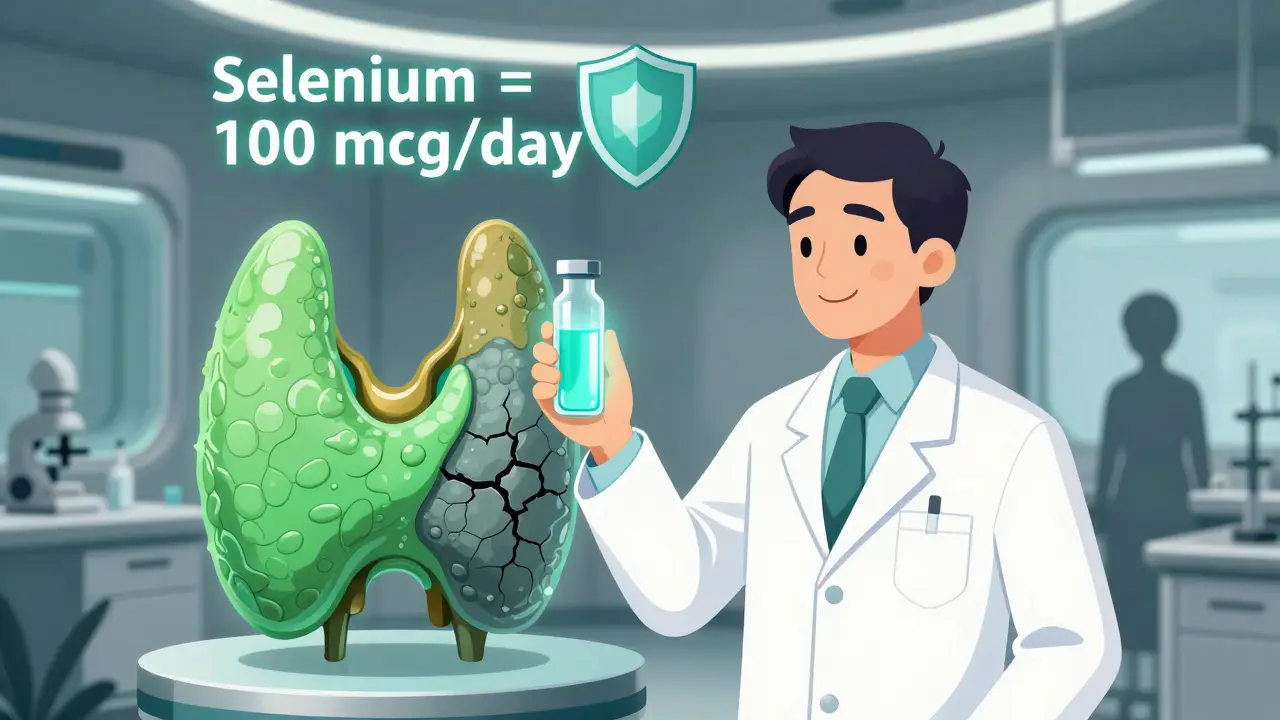
There’s progress. A 2023 clinical trial showed that taking 100 mcg of selenium daily cut the risk of hypothyroidism in lithium users from 24% to 14% over two years. Selenium helps protect the thyroid from oxidative stress. It’s not a cure, but it’s a simple, safe addition.
And then there’s RG101-a new lithium-like drug currently in Phase II trials. Early results show it stabilizes mood just as well as lithium but doesn’t raise TSH levels. If it passes, it could change everything.
For now, the best tools we have are awareness, testing, and smart management. Lithium isn’t going away. It’s too effective. But we’re getting better at managing its downsides.
What to Do Next
If you’re on lithium:
- Ask your doctor for your latest TSH and free T4 results. Don’t assume they’re fine.
- If you haven’t had a thyroid test in over a year, schedule one now.
- Track your energy, weight, and mood. Note changes.
- Ask about selenium supplementation-it’s low-risk and potentially helpful.
If you’re considering lithium:
- Get baseline thyroid tests before starting.
- Ask about your family history of thyroid disease.
- Understand that thyroid monitoring isn’t optional-it’s part of the treatment plan.
Lithium isn’t perfect. But for many, it’s the best tool they have. The key isn’t avoiding it-it’s managing it wisely.
Can lithium cause permanent thyroid damage?
In most cases, no. Hypothyroidism caused by lithium is usually reversible if you stop the medication. But many people stay on lithium because the benefits outweigh the risks. Even if you develop hypothyroidism, it can be managed with levothyroxine. Permanent damage is rare unless there’s an underlying autoimmune condition like Hashimoto’s that lithium triggers or worsens.
Do I need to stop lithium if my TSH is high?
Not necessarily. A slightly elevated TSH in the first few months of treatment is common and often temporary. Doctors typically wait until TSH is consistently above 10 mIU/L before making changes. If you’re feeling fine and your free T4 is normal, your doctor may just monitor you. Only if symptoms appear or TSH stays very high will they consider adjusting lithium or adding levothyroxine.
Can I take selenium while on lithium?
Yes, and it may help. A 2023 trial showed that 100 mcg of selenium daily reduced the risk of developing hypothyroidism by nearly half in lithium users. Selenium supports antioxidant enzymes in the thyroid and may reduce inflammation. Always check with your doctor first, especially if you’re on other supplements or have kidney issues.
Why do women on lithium have higher thyroid risks?
Women are more likely than men to develop autoimmune thyroid conditions like Hashimoto’s. Lithium appears to amplify this natural susceptibility. Hormonal differences, especially estrogen’s influence on immune function, may make the thyroid more reactive to lithium’s effects. This is why women under 60 are over three times more likely to develop hypothyroidism on lithium than men.
Is there a blood test that predicts who will develop thyroid issues?
Not yet for routine use, but research is moving fast. A 2024 study developed a predictive algorithm using baseline TSH, age at lithium start, gender, and whether the patient is taking gabapentin or antidepressants. It correctly identified high-risk patients 82% of the time. While not available in clinics yet, this points to a future where we can personalize lithium therapy based on individual risk-not guesswork.
Comments
Jimmy V
Lithium is a beast. I’ve been on it for 8 years. TSH hit 12. I was exhausted, gaining weight, and my doctor brushed it off as 'just bipolar fatigue.' Turned out I needed levothyroxine. Now I feel human again. Don’t ignore your labs.
March 13, 2026 at 05:39
Serena Petrie
So… just get tested. That’s it?
March 13, 2026 at 23:38
Stephanie Paluch
I’m on lithium and just got my TSH back - 5.4 😬 I started taking 100mcg selenium like the article said. Feels like a tiny win. 🙌 Also, my hair stopped falling out. 💇♀️
March 15, 2026 at 13:25
Sabrina Sanches
I had a goiter and didn’t even know it till I saw my reflection one morning and thought 'whoa who is that woman with the neck lump?' Turns out it was me. Lithium’s wild. But I’d rather have a neck lump than a suicide attempt. No regrets.
March 15, 2026 at 15:52
tynece roberts
so i been on lithium for 5 years and my doc says my thyroid is 'fine' but i feel like a zombie. i’m 32, female, and i gain weight just looking at food. i think they’re just ignoring it bc lithium works too well. i’m gonna push for a second opinion. anyone else feel like your doctor just wants you to shut up and take the pill?
March 16, 2026 at 08:32
Sally Lloyd
I’ve been wondering… who funded that selenium study? Big Pharma’s got a new supplement to sell. And what about the 'RG101' trial? Sounds like a name from a sci-fi novel. Coincidence? I think not. Lithium’s been around since the 50s. Now suddenly selenium and a magic new drug? Suspicious.
March 17, 2026 at 18:48
Kathy Leslie
I’m so glad someone wrote this. I was scared to say anything bc I thought 'maybe I’m just depressed again.' But nope - TSH was 11. Levothyroxine changed my life. I can finally wake up without crying. Thank you.
March 17, 2026 at 23:40
Amisha Patel
I’m from India and my psychiatrist here said 'thyroid issues are rare here.' I pushed for a test anyway. TSH was 9.2. He was shocked. Maybe it’s underdiagnosed globally? Just saying. We need more awareness outside the US/UK.
March 19, 2026 at 00:19
Elsa Rodriguez
I knew it. They don’t want you to know how dangerous lithium is. They want you dependent. You think your mood is stable? It’s because your thyroid is shut down. You’re not better - you’re chemically sedated. And now they’re selling you selenium to fix the damage they caused? Classic. I’m off lithium. I’d rather be unstable than poisoned.
March 20, 2026 at 01:53
Buddy Nataatmadja
I’m from Indonesia. We don’t have lithium here - too expensive. We use valproate. But I read this and thought - wow, this is the same everywhere. The body’s the same. The science’s the same. Just the access changes. Thanks for the clarity.
March 21, 2026 at 05:15
Hugh Breen
Lithium saved my life. I’ve tried everything - antipsychotics, SSRIs, even ECT. Nothing held me together. My thyroid? Yeah, I’m on levothyroxine. I take 100mcg selenium. I test every 6 months. I’m not 'damaged' - I’m managed. And I’m alive. That’s the win. 🙏
March 23, 2026 at 01:09
mir yasir
The empirical data presented herein is both statistically significant and methodologically rigorous. One must, however, interrogate the epistemological foundations of the selenium intervention. The 2023 trial, while promising, exhibits a small effect size (Cohen’s d = 0.41) and lacks longitudinal follow-up. Furthermore, the omission of TPO antibody titers as a covariate constitutes a critical oversight in thyroid autoimmune profiling. One would hope for more granular biomarker analysis in future iterations.
March 24, 2026 at 23:05