
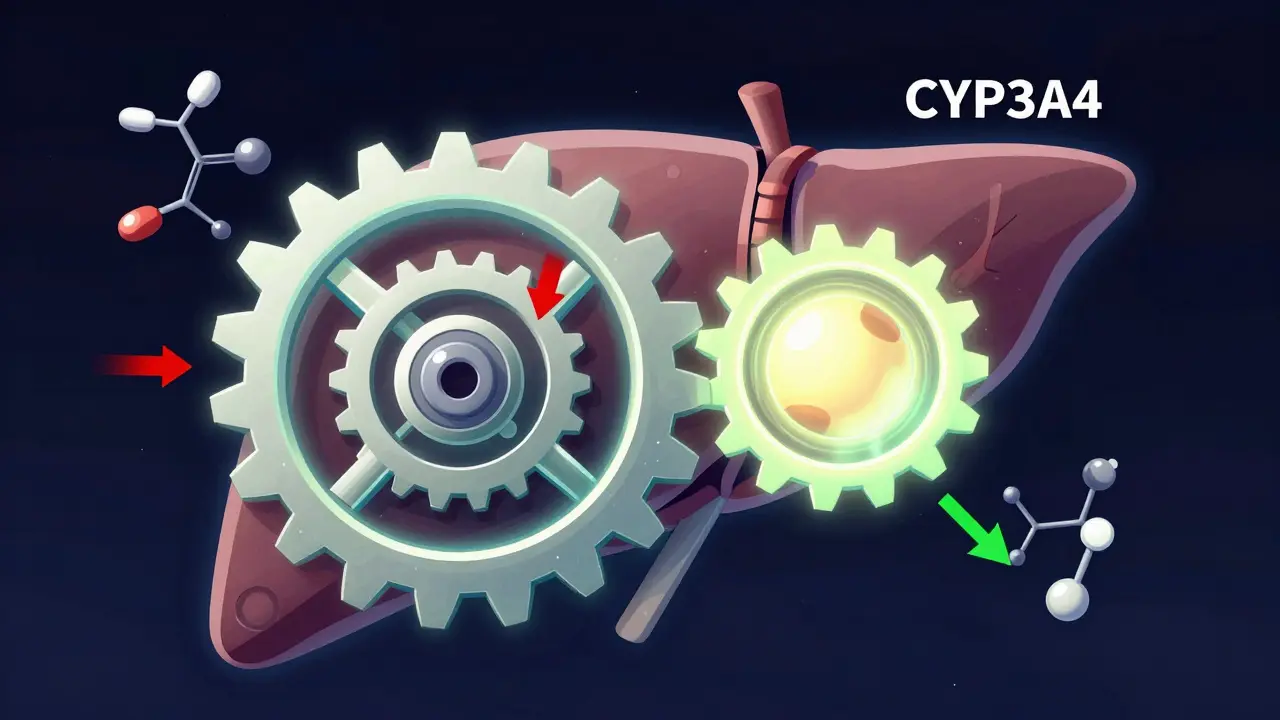
When you take Lopinavir/Ritonavir - often sold as Kaletra - you’re not just getting two drugs. You’re getting a carefully engineered system designed to make one drug work better by breaking down another. That system? A powerful, messy, and sometimes dangerous interaction with your body’s main drug-processing engine: the CYP3A4 enzyme. This isn’t a minor side effect. It’s the core mechanism behind how this HIV treatment works - and why it can cause serious, even life-threatening, problems when mixed with other medications.
How Ritonavir Makes Lopinavir Work
Lopinavir is an antiviral that fights HIV. But left on its own, it gets broken down too fast by your liver. Within hours, most of it vanishes. That’s where ritonavir comes in. At a tiny dose - just 100mg - ritonavir doesn’t fight HIV. Instead, it shuts down CYP3A4, the enzyme that normally destroys lopinavir. This isn’t just slowing things down. It’s nearly stopping it. Studies show ritonavir cuts lopinavir’s metabolism by more than 85%. That means lopinavir stays in your blood longer, at higher levels, with fewer daily doses. The result? Better control of the virus and better adherence.
But here’s the catch: ritonavir doesn’t just block CYP3A4. It does it in multiple ways - binding to the enzyme’s core, destroying its heme group, and even sticking permanently to its structure. This makes ritonavir the strongest CYP3A4 inhibitor used in human medicine. It’s so effective that it’s now used in Paxlovid to boost the COVID-19 drug nirmatrelvir. But that same power makes it a wild card in your drug regimen.
The Double-Edged Sword: Inhibition and Induction
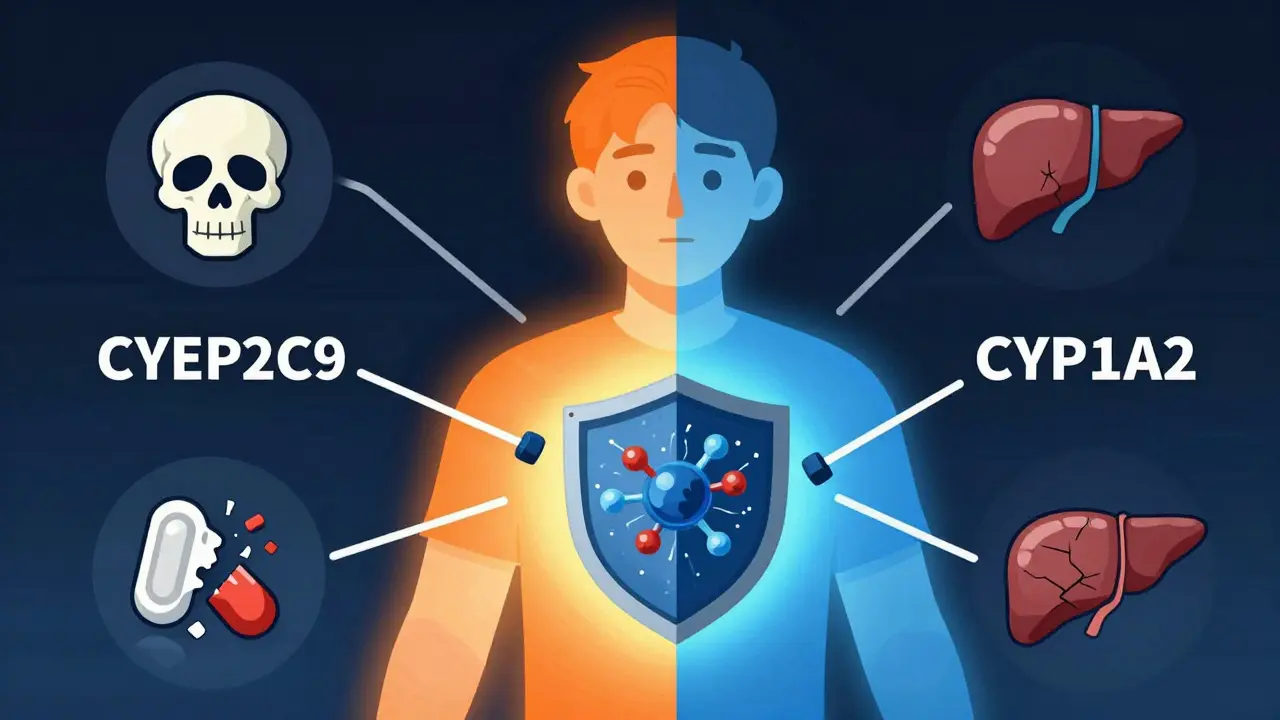
Most people think of ritonavir as just an inhibitor. That’s only half the story. While it shuts down CYP3A4, it also turns on other enzymes: CYP1A2, CYP2B6, CYP2C9, and CYP2C19. This isn’t a glitch. It’s built into the drug. The result? A tug-of-war inside your body.
Take warfarin, a blood thinner. Ritonavir induces CYP2C9, which breaks down warfarin faster. That means your INR drops. You’re at risk of clots. But at the same time, ritonavir inhibits CYP3A4, which can raise levels of drugs like midazolam (a sedative) by 500%. That’s enough to cause dangerous breathing problems. One drug. Two opposing effects. No wonder doctors need to check every pill you take.
The Liverpool HIV Interactions Database, updated in 2023, lists over 1,200 potential interactions with Lopinavir/Ritonavir. Compare that to newer regimens like darunavir/cobicistat, which have fewer than 900. The difference isn’t just numbers - it’s risk. A 2022 meta-analysis found patients on Lopinavir/Ritonavir were 37% more likely to stop their HIV treatment because of side effects.
Real-World Risks: What You Might Not Know
Imagine you’re on Lopinavir/Ritonavir and get surgery. Your anesthesiologist gives you fentanyl for pain. Normally, that’s fine. But with ritonavir in your system, your body can’t clear fentanyl. Exposure jumps 300%. You could stop breathing. Hospitals like the University of Michigan require a 60-80% dose reduction for opioids and sedatives in patients on this combo.
What about blood thinners? Rivaroxaban? Contraindicated. Too risky. Statins? You might need a lower dose - or switch to pravastatin, which doesn’t rely on CYP3A4. Birth control pills? Ritonavir cuts their effectiveness by half. You need backup contraception. Even then, it’s not foolproof.
And then there’s rifampicin - a TB drug. A 2008 study showed it dropped Lopinavir levels by 76%. That’s not just a dip. That’s treatment failure. Plus, liver damage jumped from 11% to 33% in those patients. This isn’t theoretical. It’s documented. Clinicians have seen it.
Who Still Uses It - And Why
In the U.S., Lopinavir/Ritonavir is rarely used anymore. Since 2015, guidelines have pushed doctors toward integrase inhibitors like dolutegravir. They’re safer, simpler, and have far fewer interactions. Today, less than 5% of U.S. HIV patients use this combo.
But globally, it’s still a workhorse. In low- and middle-income countries, it makes up 28% of first-line HIV regimens. Why? Cost. In PEPFAR programs, a year’s supply costs $68. Dolutegravir? $287. When you’re treating millions with limited budgets, that difference matters. The WHO still lists it as essential. It works. It’s just not clean.
Even in high-income countries, it’s not gone. Some patients can’t tolerate newer drugs. Some have resistance. Some are pregnant, and data on newer agents is still limited. For them, Lopinavir/Ritonavir remains a backup - but one that demands constant vigilance.

What You Need to Do
If you’re on this medication, here’s what you must do:
- Never start a new drug - even an OTC one - without checking with your HIV specialist. That includes painkillers, antibiotics, or herbal supplements.
- Use the Liverpool HIV Interactions Database (or a similar tool). It’s free, updated monthly, and used by clinics worldwide. Type in your meds. See what pops up.
- Know your liver function. Ritonavir can cause serious liver damage. Get your ALT and AST checked every 3 months.
- Don’t assume ‘natural’ means safe. St. John’s Wort? It induces CYP3A4. It’ll slash Lopinavir levels. Garlic supplements? They can interfere too.
- Keep a current list of every pill, patch, or injection you take. Bring it to every appointment.
There’s no room for guesswork. A single interaction can derail your HIV control - or kill you.
The Future: Why This Combo Is Fading
Lopinavir/Ritonavir is a relic of an earlier era. It saved lives when options were few. But today, we have better tools. Newer boosters like cobicistat are more selective. They don’t mess with CYP2C9 or CYP1A2. They don’t require constant monitoring. They’re safer.
Even the ritonavir in Paxlovid has its limits. The ‘Paxlovid rebound’ phenomenon - where symptoms return after treatment - is likely tied to how long ritonavir lingers, suppressing CYP3A4 long after nirmatrelvir clears. Researchers are now studying CYP3A5 gene variants to see why some people process Lopinavir faster. Early data shows 28% lower drug levels in those with certain genetic profiles. That’s personal medicine in action - but it’s not yet standard.
The global market for boosted protease inhibitors is shrinking. By 2028, it’s expected to drop 3.2% per year. Lopinavir/Ritonavir won’t disappear overnight. But its role is narrowing. It’s no longer the gold standard. It’s the fallback.
For patients who still need it - and they do - understanding its interactions isn’t optional. It’s survival.
Can I take ibuprofen with Lopinavir/Ritonavir?
Yes, ibuprofen is generally safe with Lopinavir/Ritonavir. It’s not metabolized by CYP3A4, so there’s no significant interaction. But long-term use can still stress the liver, and since ritonavir already increases liver toxicity risk, monitor for signs of liver damage like yellowing skin or dark urine. Always talk to your doctor before starting any new painkiller.
Why is ritonavir used in such a low dose?
Ritonavir at full dose (600mg) is an HIV drug itself - but it causes severe side effects like nausea and diarrhea. At 100mg, it’s too low to fight the virus, but high enough to block CYP3A4. This ‘boosting’ dose makes lopinavir work better without adding major side effects. It’s a clever trick: using one drug’s weakness (its toxicity) to fix another’s (its short half-life).
Does Lopinavir/Ritonavir affect birth control?
Yes. Ritonavir reduces the effectiveness of hormonal birth control - including pills, patches, and rings - by up to 50%. That means you could get pregnant even if you take it correctly. Backup methods like condoms or an IUD are strongly recommended. If you’re trying to conceive, talk to your provider - there are safer HIV regimens during pregnancy.
Can I take statins with Lopinavir/Ritonavir?
Some statins are dangerous. Simvastatin and lovastatin can build up to toxic levels - leading to muscle damage or kidney failure. Atorvastatin is safer but still needs a lower dose. Pravastatin and rosuvastatin are preferred because they don’t rely on CYP3A4. Always check with your doctor before taking any cholesterol medication.
What happens if I miss a dose of ritonavir?
Missing one dose might not cause immediate harm, but it can drop lopinavir levels enough to let HIV replicate - and that can lead to drug resistance. If you miss a dose, take it as soon as you remember, unless it’s almost time for the next one. Never double up. Consistency is critical. Ritonavir’s boosting effect is fragile. Even small drops in blood levels can undo its benefit.
Comments
David L. Thomas
Man, this post is a masterclass in pharmacokinetic warfare. Ritonavir’s not just a booster-it’s a biochemical siege engine. CYP3A4 gets nuked, then CYP2C9 gets a pep talk, and suddenly your warfarin’s useless and your fentanyl’s a time bomb. The fact that this is still used globally because $68 beats $287? That’s not just pragmatism-that’s global health triage in real time. We’re treating millions with a drug that requires a PhD to use safely. Wild.
And don’t even get me started on St. John’s Wort. People think herbal = harmless. Nah. It’s like inviting a saboteur to your drug party and handing them the keys to your liver.
March 10, 2026 at 08:24
Alexander Erb
Yessss this is why I always keep a printed med list in my wallet 🙌
Had a buddy on Kaletra who started taking turmeric ‘for inflammation’-ended up in the ER with elevated liver enzymes. Turns out curcumin’s a CYP3A4 inhibitor too. Not even a prescription drug and it still blew up his regimen. Always check the Liverpool DB. Free. Easy. Life-saving.
March 11, 2026 at 19:50
Donnie DeMarco
ritonavir is basically the drug world’s version of that one friend who shows up to every party and immediately turns the music up to 11, then shuts off the AC so no one can chill. it’s not helping anyone… but somehow it’s the only reason the party doesn’t collapse. 😅
also st john’s wort? bro that’s just a lil’ herbal gremlin with a vendetta against your meds.
March 13, 2026 at 19:22
Tom Bolt
Let me be clear: prescribing Lopinavir/Ritonavir today without a comprehensive interaction review is not just negligent-it’s criminally reckless. This isn’t ‘risk management.’ This is playing Russian roulette with a loaded chamber and a blindfold. The data is not ambiguous. The mortality risk is quantifiable. And yet, in some clinics, it’s still the default. That’s not clinical practice. That’s institutional inertia masquerading as care.
March 14, 2026 at 05:31
Adam Kleinberg
They say it's about cost but what they really mean is 'we don't care if you die as long as it's cheap.'
Did you know that ritonavir's heme destruction mechanism is structurally similar to how certain pesticides kill insects? That's not a coincidence. Big Pharma knew. They just didn't tell you. The liver damage spike from 11% to 33% with rifampicin? That's not a side effect. That's a calculated trade-off. They're not saving lives. They're optimizing profit margins.
And don't get me started on Paxlovid rebound. That's not a bug. It's a feature. They want you hooked. They want you coming back. Every. Single. Time.
March 15, 2026 at 10:38
Denise Jordan
Okay but like… why does this even exist? Why not just use the better drugs? It’s not like we’re in the 90s anymore. This feels like using a flip phone in 2024. I get the cost thing, but at what point do we say ‘this is too much hassle’? I’d rather pay more and not have to Google every Advil I take.
March 17, 2026 at 07:25
Gene Forte
Every life matters. Every dose counts. This isn’t just about chemistry-it’s about dignity. People deserve treatments that don’t turn their daily life into a minefield. We have better options. We must choose them. Not because they’re trendy, but because they’re right.
Let’s not confuse affordability with ethics. A life saved should never be measured in dollars alone.
March 18, 2026 at 00:30
Kenneth Zieden-Weber
So let me get this straight-you’re telling me the same molecule that saves lives by boosting lopinavir also makes fentanyl a silent killer and birth control a gamble?
That’s not a drug. That’s a Swiss Army knife with a chainsaw blade. And we’re still handing it out like it’s a band-aid?
Also, ‘natural’ doesn’t mean ‘safe.’ Garlic supplements? Yeah, they’re basically chemical saboteurs. Who knew your garlic bread could be a biohazard?
March 18, 2026 at 10:18
Chris Bird
This is why Africa can't progress. They give us old drugs because they don't care. We get the trash. You get the new stuff. Ritonavir? It's like giving someone a bicycle with no brakes and calling it transportation. This isn't medicine. This is colonialism with a stethoscope.
March 19, 2026 at 11:49
Bridgette Pulliam
It’s interesting how the same mechanism that makes this combo so effective also makes it so dangerous. The body doesn’t distinguish between ‘helpful inhibition’ and ‘toxic accumulation’-it just responds. And we’re asking patients to be pharmacologists. That’s not patient-centered care. That’s burden-shifting.
I’ve seen people skip doses because they couldn’t keep track. Not because they didn’t care. Because they were overwhelmed. We need systems-not checklists.
March 19, 2026 at 21:46
Mike Winter
I’ve always been fascinated by the dual nature of ritonavir-simultaneously inhibitor and inducer. It’s like a drug that speaks two languages and flips between them depending on the enzyme. Makes you wonder: is this evolution or engineering? And if we’re designing drugs this way, are we really treating disease-or just playing with biological feedback loops?
Also, typo: ‘cobicistat’ not ‘cobicistat.’
March 21, 2026 at 17:25
Randall Walker
so like… i just took ibuprofen and now i’m scared
wait no i didn’t but i’m still scared
why does everything have to be so complicated
can we just… not?
also i think my liver is judging me right now
March 23, 2026 at 02:25
Miranda Varn-Harper
It is imperative to underscore that the continued use of this regimen constitutes a profound failure of clinical stewardship. The data are unequivocal. The risks are documented. The alternatives are available. To persist in this paradigm is not merely an oversight-it is an ethical breach of the highest order. Patients are not experimental subjects. They are human beings deserving of evidence-based, optimized care. Period.
March 24, 2026 at 08:01
Shourya Tanay
From a pharmacogenomics standpoint, the CYP3A5 polymorphism angle is the next frontier. 28% lower lopinavir exposure in CYP3A5 expressors? That’s not noise-that’s a pharmacokinetic fault line. We’re still treating HIV with one-size-fits-all dosing in a world where genetic variability dictates drug fate. The future isn’t just ‘better drugs.’ It’s ‘right drug, right gene, right dose.’ We’re decades behind on this.
And yes, Liverpool DB is gold. But we need AI-driven real-time alerts integrated into EHRs. Not PDFs.
March 25, 2026 at 23:28