
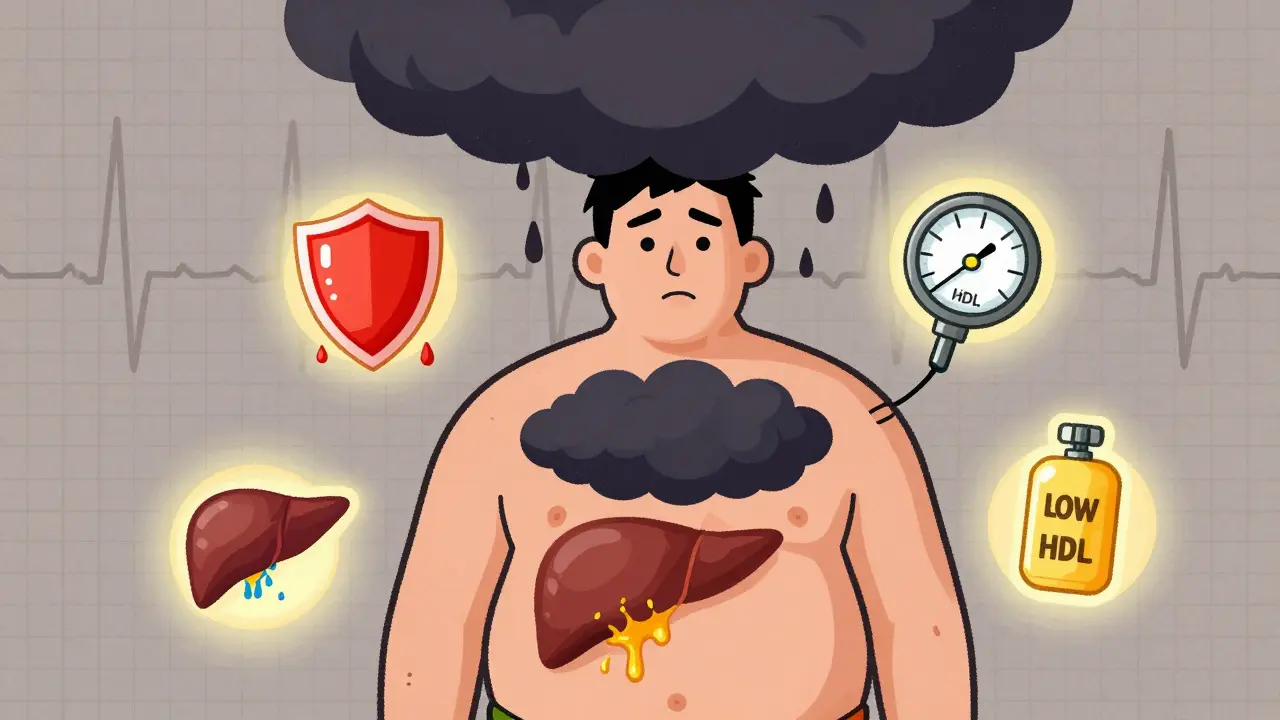
What Exactly Is Metabolic Syndrome?
Metabolic syndrome isn’t a single disease-it’s a group of five warning signs that show up together and dramatically raise your risk for heart disease, stroke, and type 2 diabetes. Think of it like a storm cloud with five different lightning strikes: if you have three or more, you’re in serious danger. The condition was first identified in the 1980s by Dr. Gerald Reaven, who noticed that people with high insulin levels often had high blood pressure, high triglycerides, low HDL cholesterol, and excess belly fat-all at once. Today, we know this isn’t coincidence. It’s a system failure.
According to the Cleveland Clinic, about 86.6 million American adults-roughly one in three-have metabolic syndrome. That number jumps to nearly half of all adults over 60. And here’s the scary part: most people don’t even know they have it. They might see their doctor for high blood pressure or high cholesterol, get a prescription, and walk out thinking they’re fixed. But if the other four risk factors are still lurking, the real problem is still growing.
The Five Diagnostic Criteria (And What They Mean)
To be diagnosed with metabolic syndrome, you need at least three of these five measurable factors:
- Abdominal obesity: Waist size over 40 inches for men, or 35 inches for women. For Asian Americans, the thresholds are lower: 35 inches for men and 31 inches for women. This isn’t just about looking bigger-it’s about fat deep inside your belly, wrapping around your liver and organs. That’s visceral fat, the kind that releases inflammatory chemicals and directly interferes with insulin.
- Elevated triglycerides: 150 mg/dL or higher. Triglycerides are a type of fat in your blood. When they’re high, it means your body isn’t processing sugar and fat properly-often because insulin isn’t working right.
- Low HDL cholesterol: Below 40 mg/dL for men, below 50 mg/dL for women. HDL is the "good" cholesterol that helps clean out arteries. When it’s low, plaque builds up faster.
- High blood pressure: 130/85 mmHg or higher. Even if your pressure is only slightly above normal, it’s a red flag when paired with other factors.
- Elevated fasting blood sugar: 100 mg/dL or higher. This isn’t diabetes yet, but it’s the first major warning that your body is struggling to handle glucose.
These aren’t arbitrary numbers. They come from decades of research, including the Framingham Heart Study, which showed that having three or more of these factors doubles your risk of heart disease and makes you five times more likely to develop type 2 diabetes. The American Heart Association and the National Heart, Lung, and Blood Institute set these standards for a reason: they work.
Why Insulin Resistance Is the Core Problem
At the heart of metabolic syndrome is insulin resistance. This isn’t just about sugar-it’s about your body’s cells ignoring insulin’s signal to absorb glucose from your bloodstream. Your pancreas responds by pumping out more insulin, trying to force the cells to listen. But over time, the system breaks down.
Dr. Scott M. Grundy, who led the team that first defined metabolic syndrome’s diagnostic criteria, called insulin resistance the "common soil" from which all these risk factors grow. Here’s how it plays out: excess belly fat releases fatty acids into your liver, which makes it harder for insulin to do its job. Your liver starts making more triglycerides. Your kidneys hold onto more sodium, raising your blood pressure. Your HDL drops because your body can’t process fats efficiently. And your blood sugar creeps up because glucose stays in your bloodstream instead of being absorbed.
This isn’t just a slow decline-it’s a cascade. One problem fuels the next. That’s why treating just one factor, like popping a pill for high blood pressure, doesn’t fix the root issue. You’re treating symptoms, not the storm.

Why Most People Miss the Diagnosis
Many patients don’t realize they have metabolic syndrome because doctors often treat each symptom in isolation. A patient comes in with high blood pressure-prescribed a beta-blocker. Another has high cholesterol-given a statin. A third has prediabetes-told to eat less sugar. But rarely are these symptoms connected in a conversation.
On HealthUnlocked, 68% of users said their metabolic syndrome went undiagnosed for years, even though they had multiple risk factors. Reddit users in r/MetabolicSyndrome shared similar stories: 76% said they only learned they had the syndrome after doing their own research or seeing a specialist who connected the dots. The problem? Fragmented care. One doctor handles your heart, another your blood sugar, and your primary care provider doesn’t have the time-or the tools-to see the full picture.
And here’s another issue: waist measurement isn’t always taken. Many doctors still rely on BMI, which doesn’t distinguish between muscle and belly fat. Two people can have the same BMI, but one has fat piled around their organs, and the other carries it on their hips. Only one is at high risk. That’s why measuring waist circumference is critical-and often skipped.
How to Reverse It-Without Medication
The good news? Metabolic syndrome is reversible. And the most powerful tool isn’t a pill-it’s lifestyle change.
The Diabetes Prevention Program (DPP), a landmark NIH study, showed that people who lost just 7% of their body weight through diet and 150 minutes of moderate exercise per week reduced their risk of developing type 2 diabetes by 58%. That same intervention reduced metabolic syndrome by 41% over 10 years. You don’t need to run marathons. Brisk walking, cycling, swimming-anything that gets your heart rate up-counts.
Diet matters just as much. Cutting back on processed carbs, sugary drinks, and refined grains helps more than any fad diet. Focus on whole foods: vegetables, lean proteins, healthy fats (like olive oil and nuts), and fiber-rich grains. The DPP recommended 1,200-1,500 calories per day for women and 1,500-1,800 for men, with less than 25% of calories from fat. That’s not starvation-it’s smart eating.
And it works fast. People in the Mayo Clinic’s Integrated Metabolic Syndrome Program saw 1-2 risk factors disappear within six months. One user lost 11 pounds, dropped his waist from 44 to 37 inches, and brought his fasting glucose down from 118 to 92-all without medication.
What About Drugs?
There’s no single drug approved to treat metabolic syndrome as a whole. That’s because it’s not a disease-it’s a cluster. But doctors can treat the individual pieces.
Statins might be prescribed for high cholesterol. Blood pressure meds like ACE inhibitors or diuretics can help. Metformin, a diabetes drug, is often used off-label to improve insulin sensitivity, especially in people with prediabetes. But these are band-aids. They don’t fix the underlying insulin resistance unless paired with lifestyle changes.
And here’s the catch: many of these drugs come with side effects. Statins can cause muscle pain. Blood pressure meds can make you dizzy. Metformin often causes stomach upset. That’s why lifestyle intervention remains the gold standard-it works better, lasts longer, and has no side effects.

Real People, Real Results
Reddit users in r/MetabolicSyndrome shared hundreds of stories. One man, 54, lost 32 pounds in eight months by switching to home-cooked meals and walking 45 minutes daily. His triglycerides dropped from 280 to 110. His blood pressure normalized. His waist went from 46 to 36 inches. He no longer qualifies for metabolic syndrome.
Another woman, 48, with PCOS, struggled for years with weight gain and insulin resistance. After joining a structured program with a dietitian and exercise physiologist, she lost 14% of her body weight in a year. Her fasting glucose dropped from 112 to 87. Her periods became regular. She stopped taking metformin.
But it’s not easy. 63% of users on MyHealthTeams said they regained weight after initial success. Hormonal issues, stress, lack of sleep, and social pressure make consistency hard. That’s why support matters. Programs with coaches, group meetings, or accountability partners have much higher success rates.
What’s New in 2026?
The field is evolving fast. In January 2023, the FDA approved the first digital therapeutic for metabolic syndrome: DarioHealth’s Metabolic+ app. It combines continuous glucose monitoring with daily behavioral coaching. In a clinical trial, users saw their HbA1c drop by 0.6% and their waist shrink by 3.2 cm in just six months.
The NHLBI is now funding research into genetic markers like PNPLA3 and TM6SF2 to predict who responds best to diet versus exercise. One person might lose fat with walking; another needs weight training to improve insulin sensitivity. Personalized plans are the future.
The American College of Cardiology now classifies metabolic syndrome as a "risk enhancer"-meaning if you have it, you should start statin therapy earlier than usual, even if your cholesterol isn’t sky-high. That’s a big shift. It means doctors are finally treating the whole picture, not just numbers.
What You Can Do Today
You don’t need to wait for a diagnosis. If you’re overweight, especially around the middle, and you’re over 40, start measuring your waist. Write it down. Get your blood pressure checked. Ask for a fasting glucose and lipid panel. Don’t assume your doctor will connect the dots-ask: "Do I have any signs of metabolic syndrome?"
Start small. Swap soda for water. Take a 20-minute walk after dinner. Cook one more meal at home this week. These aren’t drastic changes-they’re habits that add up.
And remember: metabolic syndrome isn’t a life sentence. It’s a signal. A chance to turn things around before your heart, your pancreas, or your arteries pay the price.
Can metabolic syndrome be reversed?
Yes, metabolic syndrome can be reversed in most cases through sustained lifestyle changes. Losing just 5-7% of body weight, getting 150 minutes of moderate exercise per week, and improving diet quality can eliminate three or more of the five diagnostic criteria. Studies like the Diabetes Prevention Program show that 41% of people reverse the syndrome within 10 years using these methods. Some patients even stop all medications after making these changes.
Is metabolic syndrome the same as prediabetes?
No, but they’re closely linked. Prediabetes means your blood sugar is higher than normal but not yet diabetic. Metabolic syndrome includes prediabetes as one of its five components-but also adds abdominal obesity, high triglycerides, low HDL, and high blood pressure. Someone can have prediabetes without metabolic syndrome, but most people with metabolic syndrome have prediabetes. The presence of multiple risk factors makes metabolic syndrome a stronger predictor of heart disease.
Does everyone with belly fat have metabolic syndrome?
No. Having excess belly fat is one of the five criteria, but you need at least three of the five factors to be diagnosed. Someone could have a large waist but normal blood pressure, cholesterol, and blood sugar-and wouldn’t meet the criteria. However, abdominal fat is the strongest driver of insulin resistance, so even without a full diagnosis, it’s a serious warning sign that needs attention.
Can children get metabolic syndrome?
Yes, and it’s becoming more common. With rising childhood obesity rates, pediatricians now screen teens for metabolic syndrome using modified criteria. A 16-year-old with a waist over 37 inches, high triglycerides, and elevated blood pressure could qualify. Early intervention with diet and activity can prevent lifelong complications. The American Academy of Pediatrics recommends screening children with obesity starting at age 10.
Why don’t doctors test for metabolic syndrome more often?
Many doctors don’t routinely measure waist circumference or connect the dots between separate lab results. Insurance reimbursement for comprehensive lifestyle counseling is limited, and visits are often too short to cover everything. Also, there’s no specific drug to prescribe for metabolic syndrome, so some providers focus on treating individual numbers instead of the whole pattern. But awareness is growing, especially since the American College of Cardiology now lists it as a risk enhancer.
Is metabolic syndrome genetic?
Genetics can increase your risk, but they don’t determine your outcome. Variants in genes like PNPLA3 and TM6SF2 make some people more prone to storing fat in the liver or developing insulin resistance. But even with these genes, lifestyle choices control whether metabolic syndrome develops. Studies show people with high genetic risk can still avoid it through diet, exercise, and weight management. Your genes load the gun-but your habits pull the trigger.
Comments
Ed Mackey
I never knew my belly fat was so dangerous. Just got my waist measured at the clinic-42 inches. 😳 Guess I need to start walking more. Thanks for the wake-up call.
February 4, 2026 at 06:47
Katherine Urbahn
This article is fundamentally flawed. The notion that lifestyle changes can reverse metabolic syndrome ignores the systemic failures of industrial food policy, pharmaceutical lobbying, and the deliberate obfuscation of insulin resistance by the ADA. You're being sold a lie if you think walking will fix this.
February 5, 2026 at 22:59
Meenal Khurana
Waist measurement matters. Most doctors skip it. Start there.
February 6, 2026 at 19:43
Joy Johnston
I'm a registered dietitian, and I can confirm: the DPP results are rock solid. Losing 5-7% of body weight isn't about aesthetics-it's about cellular function. Insulin sensitivity improves within weeks. Small changes, massive impact. You've got this.
February 7, 2026 at 23:07
Jesse Naidoo
So you're telling me the government doesn't want us to know this? Why? Because Big Pharma makes billions off statins and metformin. They don't want you healing yourself.
February 9, 2026 at 22:42
rahulkumar maurya
Let me be blunt: if you're reading this and haven't optimized your circadian rhythm and ketone levels, you're already behind. Real metabolic health requires fasting windows, cold exposure, and magnesium glycinate. The average person doesn't even know what insulin does.
February 11, 2026 at 13:24
Alec Stewart Stewart
I was diagnosed last year. Started walking after dinner, swapped soda for sparkling water, and cooked more. Lost 18 lbs in 5 months. My doc was shocked. It’s not magic. It’s just not giving up. 🙌
February 12, 2026 at 02:56
Demetria Morris
I tried the DPP program. Lost 10 pounds. Gained it back. Felt like a failure. Now I just... don't talk about it. No one understands.
February 13, 2026 at 12:58
Caleb Sutton
They’re hiding the truth. The real cause is glyphosate in your food. It wrecks your mitochondria. No amount of walking fixes that. You need to grow your own vegetables and filter your water with reverse osmosis.
February 15, 2026 at 11:30
pradnya paramita
The pathophysiology is unequivocal: visceral adiposity induces ectopic lipid deposition in hepatocytes, triggering hepatic insulin resistance via diacylglycerol-PKCε axis activation, which subsequently impairs IRS-1 phosphorylation. Lifestyle modification remains first-line, but pharmacologic adjuncts targeting AMPK activation may augment efficacy.
February 16, 2026 at 10:44
Coy Huffman
i read this and thought… maybe i dont need to be so hard on myself. i’ve been eating better and walking with my dog. it’s not perfect, but it’s something. thanks for not making me feel like trash for being 40 and tired 😅
February 17, 2026 at 08:22
Harriot Rockey
This is the most hopeful thing I’ve read all year 🌱 I’m 52 and just started cooking again. My husband says I’m obsessed with broccoli now. I say I’m obsessed with living. Thank you for sharing the science AND the heart.
February 18, 2026 at 09:24
Shelby Price
I didn't know my blood pressure was high until I got a free check at the pharmacy. Then I checked everything else. Three out of five. Scary. But also… doable.
February 20, 2026 at 06:31
Sherman Lee
The real problem? They don't test your gut microbiome. Without the right bacteria, nothing else matters. The FDA knows this. They just don't want you to know. Your microbiome is being poisoned by Roundup and antibiotics. Wake up.
February 22, 2026 at 02:02