
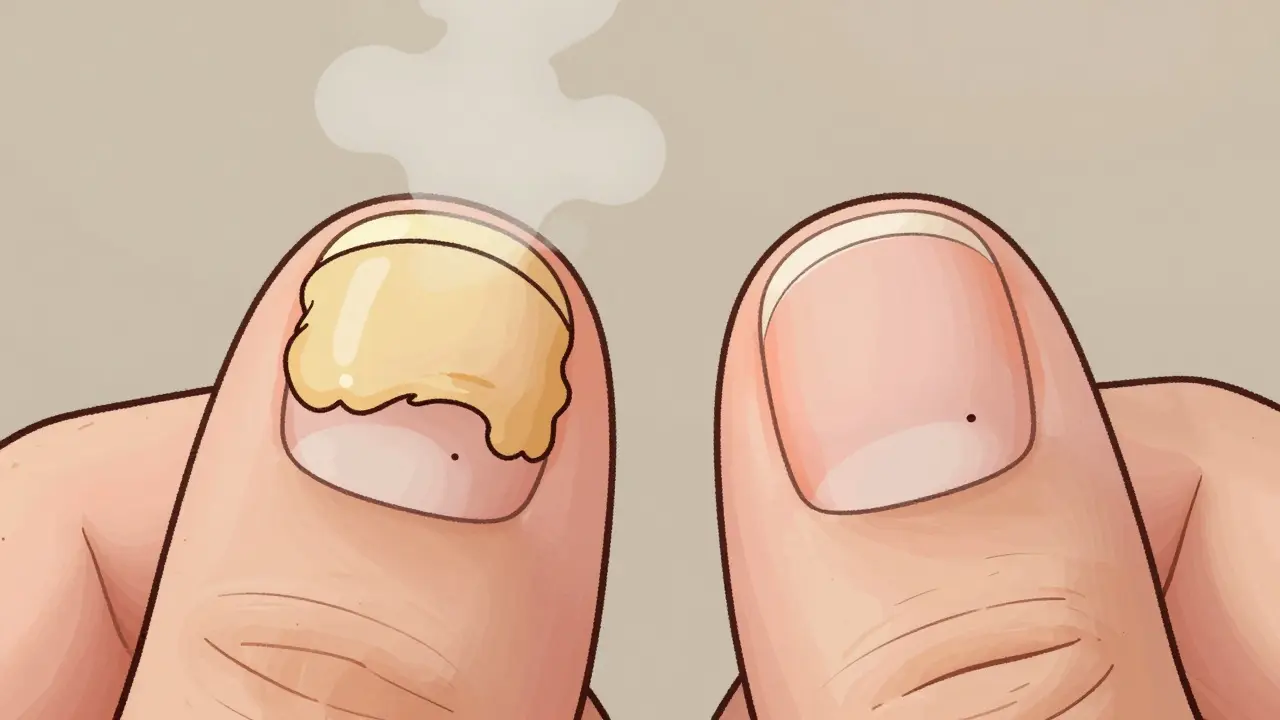
Have you noticed your nails turning yellow, thickening, or peeling away from the skin? You’re not alone. About fungal nail infection and nail psoriasis affect 1 in 10 people worldwide, and they look almost identical at first glance. But treating them the same way can make things worse. A fungal infection needs antifungals. Nail psoriasis needs immune-targeted therapy. Mix them up, and you could waste months - and money - on treatments that don’t work.
What Does a Fungal Nail Infection Actually Look Like?
Fungal nail infections, or onychomycosis, start quietly. You might spot a tiny white or yellow spot under the tip of your big toe or index finger. Over time, it spreads. The nail gets thicker - sometimes 3 to 5 millimeters - and turns brown or black. The edges curl. It may even smell bad. That odor? It’s a red flag. Around 40% of fungal cases have it. Psoriasis doesn’t.
Most fungal infections begin at the side or tip of the nail and creep inward. They’re caused mostly by a fungus called Trichophyton rubrum, which thrives in warm, damp places. Think sweaty shoes, public showers, or shared towels. Older adults are more at risk - nearly 1 in 5 people over 60 have it. It’s not just about hygiene. As we age, nails grow slower and blood flow drops, making it easier for fungi to take hold.
What About Nail Psoriasis? It’s Not a Fungus
Nail psoriasis is an autoimmune condition. Your immune system mistakenly attacks your nail matrix - the tissue under your cuticle that makes new nail cells. Instead of growing normally every 28 to 30 days, cells rush out every 3 to 4 days. That’s why the nail gets messy.
The telltale signs? Tiny pits, like pinpricks, on the surface. That happens in 7 out of 10 cases. Then there’s the salmon patch - a translucent red-yellow stain under the nail. Or oil-drop lesions: dark brown or yellow spots that look like you dripped cooking oil on your nail. Nail separation (onycholysis) is common too, affecting more than half of patients. Unlike fungal infections, psoriasis often hits multiple nails at once, especially fingernails. And it almost always shows up in people who already have skin psoriasis - usually 10 to 15 years after the skin symptoms start.
Why People Keep Mistaking One for the Other
Here’s the problem: both conditions cause yellowing, thickening, and crumbling. About 68% of nail psoriasis cases look like fungal infections to the untrained eye. That’s why so many people get it wrong.
On Reddit’s skincare forums, 63% of users thought their nail psoriasis was fungal. They bought antifungal creams, soaked their feet, used laser devices - and nothing changed. Some even got worse. One person wrote: “I used antifungals for 8 months. My nails got more brittle, and then they started lifting off completely.”
On the flip side, fungal patients are sometimes told they have psoriasis. They’re given steroid injections or topical creams meant to calm the immune system. Instead of improving, their nails become more fragile. “My dermatologist said it was psoriasis,” one user posted on FootHealthForum. “Then my nail started crumbling. Turns out it was fungus the whole time.”
How Doctors Actually Diagnose This
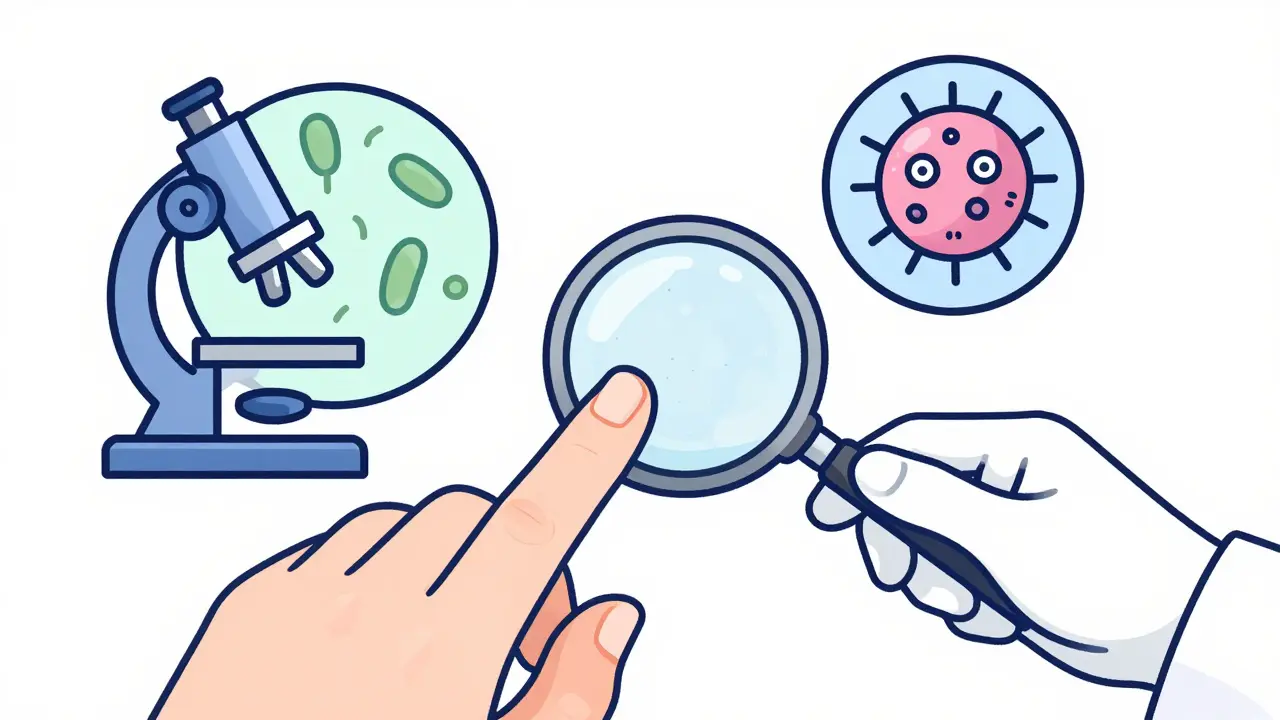
Visual inspection alone gets it wrong 30 to 40% of the time. That’s why experts use a three-step process:
- Clinical exam: Look for pitting, oil spots, or salmon patches - signs almost exclusive to psoriasis.
- KOH test: A quick scrape of nail debris is mixed with potassium hydroxide and looked at under a microscope. It catches fungal elements in 70-80% of cases.
- Fungal culture or PAS staining: If the KOH is negative but suspicion remains, a sample is sent to a lab. Culture takes weeks but is 95% specific. PAS staining is faster and catches 90% of fungal cases.
Psoriasis doesn’t show up on these tests. If you have pitting and a negative KOH, it’s likely psoriasis. If you have thick, smelly nails and the KOH is positive - it’s fungus. Nail thickness matters too: psoriasis thickens nails to 2-3 mm. Fungal infections push it to 3-5 mm.
What Works for Each Condition
Treatment isn’t one-size-fits-all. And timing is everything.
For fungal infections: Oral terbinafine is the gold standard. Taken daily for 12 weeks, it clears the infection in 78% of cases. Topical treatments like efinaconazole (Jublia) work too, but they take 9 to 12 months because toenails grow just 0.1 mm per day. You need patience. Keep nails dry. Wear open shoes. Avoid nail polish - it traps moisture.
For nail psoriasis: Topical steroids or vitamin D analogs can help mild cases. But for moderate to severe, biologics like secukinumab (Cosentyx) are game-changers. In clinical trials, 65% of patients saw major improvement after 24 weeks. Injections into the nail bed can also reduce swelling and lifting. Avoid trauma - don’t pick at your nails. Use moisturizers daily. Stress and injury can trigger flare-ups through the Koebner phenomenon.
What Happens If You Ignore It?
Left untreated, fungal infections can spread to other nails or even skin. In diabetics or people with poor circulation, it can lead to serious foot ulcers. Nail psoriasis doesn’t spread like that, but it can be painful. Separated nails trap dirt and bacteria. In 4.6% to 30% of psoriasis patients, a fungal infection sneaks in on top - making things much worse.
And the emotional toll? Real. People avoid showing their hands. They stop wearing sandals. They feel embarrassed. A 2023 Healthline survey found that 78% of psoriasis patients waited over six months for the right diagnosis. That’s half a year of self-doubt, failed treatments, and unnecessary expense.
What’s New in Diagnosis and Treatment
Technology is helping. In 2023, Mayo Clinic tested reflectance confocal microscopy - a non-invasive imaging tool that shows nail structure in real time. It correctly identified psoriasis vs. fungus in 92% of cases. That’s better than most dermatologists.
And in March 2024, the FDA approved Xepi (difloxacin) for bacterial superinfections that sometimes follow nail psoriasis. That’s a big deal because infected psoriatic nails are harder to treat.
Future tools? AI-powered apps that analyze photos of your nails. Early studies show they could cut misdiagnosis rates by 22% by 2027. Researchers are also looking at the nail microbiome - the bacteria and fungi living under your nail. Psoriasis nails have more Staphylococcus, less Cutibacterium. Fungal nails? Loaded with Trichophyton DNA. That could lead to a simple swab test that tells you exactly what you’re dealing with.
What You Can Do Right Now
If you’re unsure what’s going on with your nails:
- Take monthly photos under the same lighting. Compare them. Is it spreading slowly? Is there pitting? A smell?
- Don’t self-treat with antifungals unless you’ve been tested.
- See a dermatologist - not just your GP. Primary care doctors get it right only 52% of the time. Dermatologists hit 85%.
- Keep nails trimmed, dry, and clean. Avoid biting or picking.
- If you have skin psoriasis, check your nails every month. Early detection helps.
It’s not about being perfect. It’s about being informed. Nail problems aren’t just cosmetic. They’re a signal. And getting the right diagnosis means you stop wasting time - and start healing.
Can nail psoriasis turn into a fungal infection?
Yes. Nail psoriasis damages the nail structure, creating gaps where fungi can enter. Between 4.6% and 30% of people with nail psoriasis develop a secondary fungal infection. That’s why it’s important to treat psoriasis early and keep nails clean and dry.
Is nail psoriasis contagious?
No. Nail psoriasis is an autoimmune condition, not an infection. You can’t catch it from someone else. Fungal nail infections, however, are contagious - especially in shared spaces like gyms or pools.
How long does it take to treat a fungal nail infection?
Oral antifungals like terbinafine usually take 12 weeks. But because nails grow slowly - about 0.1 mm per day - it can take 6 to 12 months for the new, healthy nail to fully replace the infected one. Topical treatments take even longer, often 9 to 12 months.
Can I treat nail psoriasis at home?
Mild cases can be managed with over-the-counter emollients and avoiding trauma. But for noticeable pitting, thickening, or separation, you need medical treatment. Topical steroids or biologics are the most effective. Home remedies like tea tree oil won’t fix the immune response behind psoriasis.
Why do some nail treatments make my condition worse?
If you have nail psoriasis and use antifungal creams or steroids meant for fungus, you might irritate your skin further. Steroids can thin the nail and make it more brittle. Antifungals won’t touch the autoimmune process. That’s why misdiagnosis leads to worsening symptoms. Always get tested before starting treatment.
Comments
Kiran Plaha
Had this happen to me last year. Thought it was fungus, bought all those creams. Nothing changed. Then my dermatologist did a KOH test and said it was psoriasis. Mind blown. Took me 8 months to get right diagnosis. Don't self-diagnose.
January 5, 2026 at 19:17
Matt Beck
So... 🤔 if your nail looks like it’s been dipped in old motor oil 🛢️ but no smell? Probably not fungus. Probably your immune system just being dramatic again. 🙄 We’re all just walking biological experiments anyway.
January 6, 2026 at 21:40
Beth Templeton
Antifungals don’t work on psoriasis. Duh.
January 7, 2026 at 14:51
Tiffany Adjei - Opong
Actually, the whole ‘fungal vs psoriasis’ thing is a scam designed by Big Pharma to sell more biologics. I read on a forum that nail changes are just your body detoxing from glyphosate. Also, your dermatologist is probably on their payroll. 🤫
January 9, 2026 at 06:35
Ryan Barr
Terbinafine is the gold standard. Anything else is amateur hour.
January 10, 2026 at 03:32
Cam Jane
Hey, if you're reading this and you've been struggling with your nails - you're not alone. I've been there. Took me two years, three dermatologists, and a lot of tears. But once I got the right test? Life changed. Don't give up. Keep track of photos. Talk to a specialist. You deserve to feel confident again. 💪✨
January 12, 2026 at 02:38
Dana Termini
That Mayo Clinic imaging thing sounds promising. I hope it becomes standard. Too many people get misdiagnosed. I had a cousin who lost three nails because they were told it was fungus and given steroids. It was psoriasis. It broke my heart.
January 12, 2026 at 23:36
Amy Le
Why are we letting American doctors diagnose nail conditions? In Russia, they just look and know. No tests needed. Also, why are we using English terms for everything? We need a global standard. And why is everyone obsessed with biologics? Natural remedies work better. Just sayin’.
January 13, 2026 at 02:25
Stuart Shield
I used to work in a podiatry clinic back in Glasgow. Saw hundreds of these cases. The smell? Oh yeah, you know it when you smell it - like old socks left in a gym bag for a month. Fungus. Psoriasis? More like a sad little storm under the nail. No stink. Just chaos. I miss those days. Good people. Bad nails.
January 15, 2026 at 01:06
Lily Lilyy
Dear friend, please remember that your nails are a reflection of your inner health. With gentle care, consistent monitoring, and professional guidance, you can restore not only your nails but your confidence. Always consult a qualified dermatologist. You are worthy of healing.
January 16, 2026 at 11:52
Katelyn Slack
i had this for years and never knew… i thought it was just old age. then i saw this post and went to the doc. turns out fungus AND psoriasis. so i got treated for both. my nails are way better now. thanks for sharing!!
January 16, 2026 at 13:56
Jeane Hendrix
Interesting. The nail microbiome angle is fascinating. If psoriatic nails show increased Staphylococcus and decreased Cutibacterium, could that be a biomarker for early detection? We might be able to develop a rapid PCR-based point-of-care test within the next 5 years. Also, the Koebner phenomenon is underappreciated in clinical practice.
January 16, 2026 at 20:05
Melanie Clark
They don’t want you to know this but the FDA approved Xepi because the pharmaceutical companies knew people would keep misdiagnosing. It’s a trap. They profit from confusion. Your doctor is part of the system. Don’t trust them. Test your own nails with a UV light. I did. Saw the fungus glow. They never told me that.
January 18, 2026 at 12:33
Harshit Kansal
Bro I thought I had fungus too. Bought 3 bottles of tea tree oil. My nails looked worse. Then my cousin said ‘dude you got psoriasis like your dad’ - turned out he was right. Now I use moisturizer daily and don’t pick. Best advice I ever got. Also, stop wearing tight shoes. Your feet will thank you.
January 19, 2026 at 09:52