

When you or someone you care for has asthma or COPD, getting the right medication into the lungs quickly and effectively can make all the difference. But here’s the real question: should you use a nebulizer or an inhaler? Many people assume the machine that makes a foggy mist - the nebulizer - must be better. But the truth is more complicated. In fact, for most adults and older children, the simple handheld inhaler paired with a spacer is not just as effective - it’s often better.
How Nebulizers Work - And When They Really Shine
A nebulizer turns liquid medicine into a fine mist you breathe in through a mouthpiece or mask. It’s powered by a small air compressor that pushes air through a chamber, turning the liquid into tiny droplets. These droplets are sized between 1 and 5 microns - just right to reach deep into the lungs. Treatment usually takes 5 to 15 minutes. You sit still, breathe normally, and let the machine do the work.
This makes nebulizers ideal for people who can’t coordinate breathing with a spray. That includes infants, toddlers, elderly patients with shaky hands or memory issues, and anyone having a severe flare-up where they’re too breathless to time their inhale. Hospitals and ERs often use nebulizers for acute attacks because they’re easy to administer and don’t require patient input. Parents love them because they can see the mist, and their child is calm during treatment. In fact, a 2022 study found that 60.6% of patients believed nebulizers worked better - not because of science, but because they felt more tangible.
But here’s the catch: nebulizers waste a lot of medication. Older models lose 60-70% of the dose during exhalation. Even newer breath-actuated models still waste 30-40%. That means you’re using more medicine to get the same result. And if you don’t clean it properly? Mold can grow in the cup. For someone with a weak immune system, inhaling mold spores isn’t just unpleasant - it’s dangerous.
The Real Power of Inhalers - With a Spacer
Most people think of inhalers as those small metal canisters you shake and spray. But here’s what most don’t know: if you use one without a spacer, you’re probably getting less than 20% of the medicine into your lungs. The rest sticks to your throat or gets swallowed. That’s why you get a sore throat or oral thrush - it’s not the drug, it’s the delivery.
Enter the spacer. It’s a plastic tube with a chamber that holds the puff of medicine after you press the inhaler. You breathe in slowly from the spacer, no timing needed. This simple addition boosts lung delivery to 70-80%. That’s better than most nebulizers. And it cuts treatment time from 15 minutes down to under 5.
A 2002 study by the American Academy of Family Physicians showed something surprising: patients using an inhaler with a spacer had better peak flow improvements (180 L/min vs. 145 L/min), spent less time in the ER (147 minutes vs. 197), and needed less total medication (8.4 mg vs. 12.6 mg of albuterol). Their blood oxygen levels improved more, and relapse rates were nearly half at two weeks. The study concluded: more medicine doesn’t mean better results.
And it’s not just adults. Children’s Minnesota’s 2023 guidelines say almost anyone - from babies to grandparents - can use an inhaler with a spacer. Even kids as young as 2 or 3 can manage it with a mask attachment. Dry powder inhalers (DPIs) are another option for older children and adults who can take a quick, deep breath - and they’re growing fast in popularity.

Cost, Portability, and Daily Life
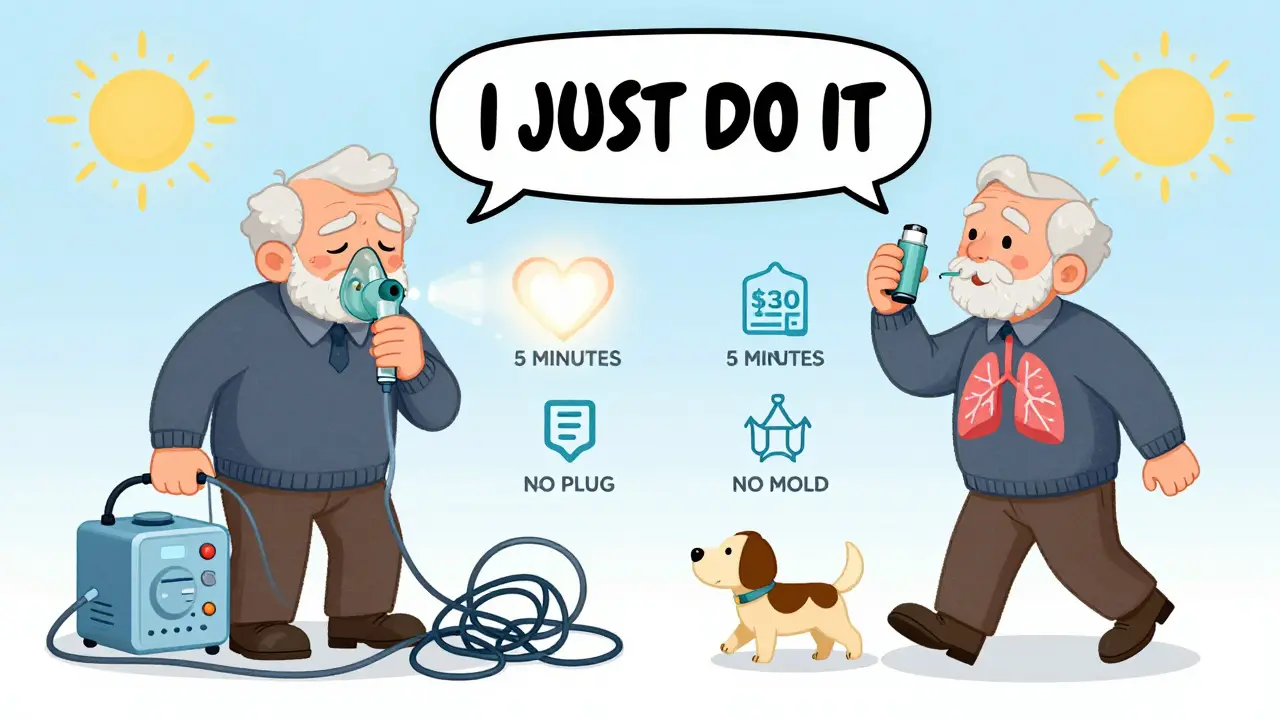
Let’s talk practical stuff. A basic nebulizer system - compressor, cup, tubing - costs $100 to $200. You need to plug it in. You can’t take it on the bus, to work, or on vacation without hauling a box. And you have to clean it daily. Weekly vinegar soaks. No shortcuts.
An inhaler with a spacer? Under $30. Fits in a pocket. Works anywhere. No power needed. You rinse the spacer once a week. That’s it. For people who travel, work, or live far from clinics, this isn’t a convenience - it’s a lifeline.
And here’s something most don’t realize: the global market for respiratory devices is growing fast. Inhalers - including MDIs and DPIs - make up 65% of sales. Nebulizers? Just 25%. Why? Because the evidence keeps piling up: for most people, the spacer is the better tool.
Why the Misconception Persists
So why do so many people - even some doctors and nurses - still think nebulizers are superior? Partly because they’re familiar. Partly because they’re visible. You see the mist. You hear the machine hum. It feels like something powerful is happening.
But perception isn’t proof. The same 2022 survey showed that while 60% of patients preferred nebulizers, only 34.5% of nurses did. And 49% of doctors preferred the spacer. Nurses, who see the daily grind of treatment, know the truth: nebulizers take longer, cost more, and increase infection risk. They’re not wrong to use them in emergencies. But for daily management? The spacer wins.
One Reddit user put it simply: “I used to use a nebulizer at home. Switched to inhaler with spacer. Cut my treatment time from 15 minutes to 2. I can take it anywhere.”
Which One Should You Choose?
There’s no single answer - but there is a clear path:
- If you’re under 5 years old - or have severe cognitive or physical limitations - a nebulizer is still the best choice.
- If you’re a child over 5 - or an adult who struggles to coordinate breathing with a spray - start with an inhaler and spacer. It’s easier than you think.
- If you’re healthy, active, and mobile - the inhaler with spacer is your go-to. It’s faster, cheaper, safer, and just as effective.
- If you’re having a serious attack - go to the ER. They’ll use whatever works fastest. But for routine care? Don’t default to the machine.
And if you’re unsure? Ask your doctor to watch you use your inhaler. Most people think they’re doing it right - but studies show 70-80% of adults use them incorrectly. With a spacer? That drops to 5-10%. That’s the power of simple tools.
What About New Tech?
Smart inhalers are changing the game. Devices like Propeller Health track when and how often you use your inhaler. In a 2022 study, users cut their rescue inhaler use by 58% just by seeing their usage patterns. That’s not magic - it’s awareness. But even these smart devices are inhalers - they still need a spacer for best results.
The future isn’t bigger machines. It’s smarter, simpler, and more personalized delivery. The NHLBI’s 2023 roadmap calls for “device-agnostic” systems - meaning the medicine matters more than the container. And that’s the real lesson here: the best delivery method is the one you’ll use correctly - every time.
Are nebulizers more effective than inhalers for asthma?
No, not for most people. Studies show that inhalers with spacers deliver just as much medication to the lungs as nebulizers - and often do it faster and with less total drug. The American Thoracic Society and Global Initiative for Asthma both recommend inhalers with spacers as first-line treatment because they reduce treatment time, cost, and infection risk. Nebulizers are only more effective in specific cases - like for infants or during severe attacks when coordination is impossible.
Can I use an inhaler without a spacer?
You can, but you’re probably not getting the full benefit. Without a spacer, up to 80% of the medication sticks in your mouth and throat instead of reaching your lungs. This increases side effects like thrush and hoarseness. Using a spacer improves lung delivery from 10-20% to 70-80%. It’s one of the simplest, cheapest upgrades in asthma care.
How often should I clean my nebulizer or spacer?
Clean your nebulizer cup and mouthpiece after every use with warm, soapy water. Disinfect it once a week using a 1:3 mixture of white vinegar and water. Rinse well and air-dry. For spacers, rinse with warm water once a week - no soap needed unless they look dirty. Never put them in the dishwasher. Mold in a nebulizer can cause serious lung infections, especially in people with weakened immunity.
Why did inhalers switch from CFCs to HFA propellants?
CFCs (chlorofluorocarbons) were phased out by the FDA by the end of 2008 because they damage the ozone layer. HFA (hydrofluoroalkane) propellants replaced them. The switch didn’t change how well the medicine works - just how it’s pushed out. All inhalers sold today in the U.S. and EU use HFA. Some patients initially worried about effectiveness, but studies confirmed HFA inhalers are just as effective - and better for the environment.
Is a dry powder inhaler better than a metered-dose inhaler?
It depends. Dry powder inhalers (DPIs) don’t need a spacer and don’t use propellants - you inhale quickly and deeply to draw the powder in. They’re great for adults and older children who can manage a strong, fast breath. But they don’t work well for young kids or people with very weak lung capacity. Metered-dose inhalers with spacers are easier for most people, especially those with limited strength or coordination. DPIs are growing in use, but spacers still win for broad accessibility.
If you’re managing asthma or COPD, don’t assume the noisiest device is the best. The best one is the one you’ll use correctly - every single time. For most people, that’s the inhaler and spacer.
Comments
Sophia Rafiq
I've been using an inhaler with a spacer for my COPD for 5 years now. No more throat irritation, no more messy cleaning routines. Just pop the spacer in, press, breathe slow. Done in under a minute. My pulmonologist was skeptical at first but now she hands out spacers like candy.
February 27, 2026 at 05:15
Noah Cline
Let me break this down in real terms. Nebulizers are 30-40% inefficient by design. That's not a flaw-it's a business model. Pharma companies profit from wasted doses. Spacers don't generate recurring revenue. The data is clear: inhaler + spacer = 70-80% lung deposition. The system is rigged to keep you dependent on expensive, high-maintenance hardware.
March 1, 2026 at 04:16
Angel Wolfe
They don't want you to know this but the FDA approved HFA propellants because Big Pharma bought off the regulators. Nebulizers are still sold in hospitals because they're profitable. I saw a nurse get fired for telling a patient to switch to a spacer. They're scared of transparency. The government is hiding the truth. Wake up.
March 2, 2026 at 09:12
Katherine Farmer
The author's argument is statistically sound but fundamentally naive. You assume compliance is the primary variable, yet you ignore socioeconomic determinants. A $30 spacer is meaningless if you're living paycheck to paycheck without transportation to refill prescriptions. The real issue isn't device efficacy-it's healthcare access. This reads like a Silicon Valley pitch disguised as medical advice.
March 2, 2026 at 20:21
Justin Ransburg
This is one of the most important pieces I've read this year. I work in a clinic and see patients struggle daily with nebulizers-especially seniors who forget to clean them or can't afford replacement parts. The spacer is a game-changer. I've personally helped over 200 patients switch. The reduction in ER visits is undeniable. Please share this with your doctor.
March 3, 2026 at 19:49
Miranda Anderson
I used to think nebulizers were the gold standard until my mom got a spacer after her last ER visit. She's 78, has arthritis, and thought she couldn't use it. We practiced for five minutes. Now she does it in 90 seconds. She says it feels more like she's in control. That's the real win-not just the numbers, but the dignity. The machine made her feel helpless. The spacer made her feel capable.
March 5, 2026 at 14:06
Gigi Valdez
The data presented here aligns with the 2023 Global Initiative for Chronic Obstructive Lung Disease guidelines. Inhaler with spacer consistently demonstrates non-inferiority in FEV1 improvement, reduced exacerbation frequency, and lower systemic corticosteroid exposure. The perception gap is largely attributable to heuristic bias-people equate complexity with efficacy. This is a classic case of cognitive dissonance in clinical practice.
March 6, 2026 at 19:52
Lisa Fremder
I used to use a nebulizer because I was told it was 'better.' Then I found out my insurance covered spacers for free. I switched. My throat stopped hurting. My refills went from every 2 weeks to every 2 months. Now I'm being told I'm 'not using the right device' because I didn't follow the hospital's protocol? Screw that. I'm not a lab rat. I'm a person who saved money and time. Stop gaslighting us.
March 8, 2026 at 19:07
Sumit Mohan Saxena
In India, nebulizers are often the only option due to lack of access to inhalers and spacers in rural clinics. While the data is compelling for urban, well-resourced settings, we must not universalize this recommendation. For millions, the nebulizer remains the only viable delivery system. Innovation must include equity, not just efficiency.
March 9, 2026 at 22:12
Full Scale Webmaster
You think this is about medicine? It's about control. The medical-industrial complex doesn't want you to be independent. They need you dependent on machines, on visits, on cleaning protocols, on replacement parts. A $30 spacer doesn't generate recurring revenue. A $150 nebulizer does. They'll tell you it's for safety. But ask yourself-why are they so afraid of you managing your own care? The answer is in the profit margin.
March 10, 2026 at 03:14
Brandie Bradshaw
I’ve been a respiratory therapist for 22 years. I’ve seen patients die because they didn’t clean their nebulizer. I’ve seen them recover because they used a spacer. I’ve watched families cry because they couldn’t afford the next nebulizer cup. The science is settled. The ethics are clear. The only thing left is the will to change. And if you’re still using a nebulizer at home without a compelling clinical reason-you’re not being careful. You’re being manipulated.
March 11, 2026 at 19:36
Ajay Krishna
For those of us in developing countries, this conversation is vital. I’ve distributed over 500 spacer kits in rural clinics. The difference isn’t just clinical-it’s emotional. A child who can breathe without a loud machine, without a mask, without crying-that’s peace. We don’t need fancy tech. We need simple, accessible tools. This post is a gift.
March 12, 2026 at 09:16
Sneha Mahapatra
The real question isn't which device works better-it's which one lets you live better. I used to spend 20 minutes every morning and night with a nebulizer, feeling like a sick person. With the spacer? I do it while making coffee. I don't feel like a patient anymore. I feel like myself. That’s the invisible benefit no study measures. It’s not just about lungs. It’s about identity.
March 12, 2026 at 12:31