
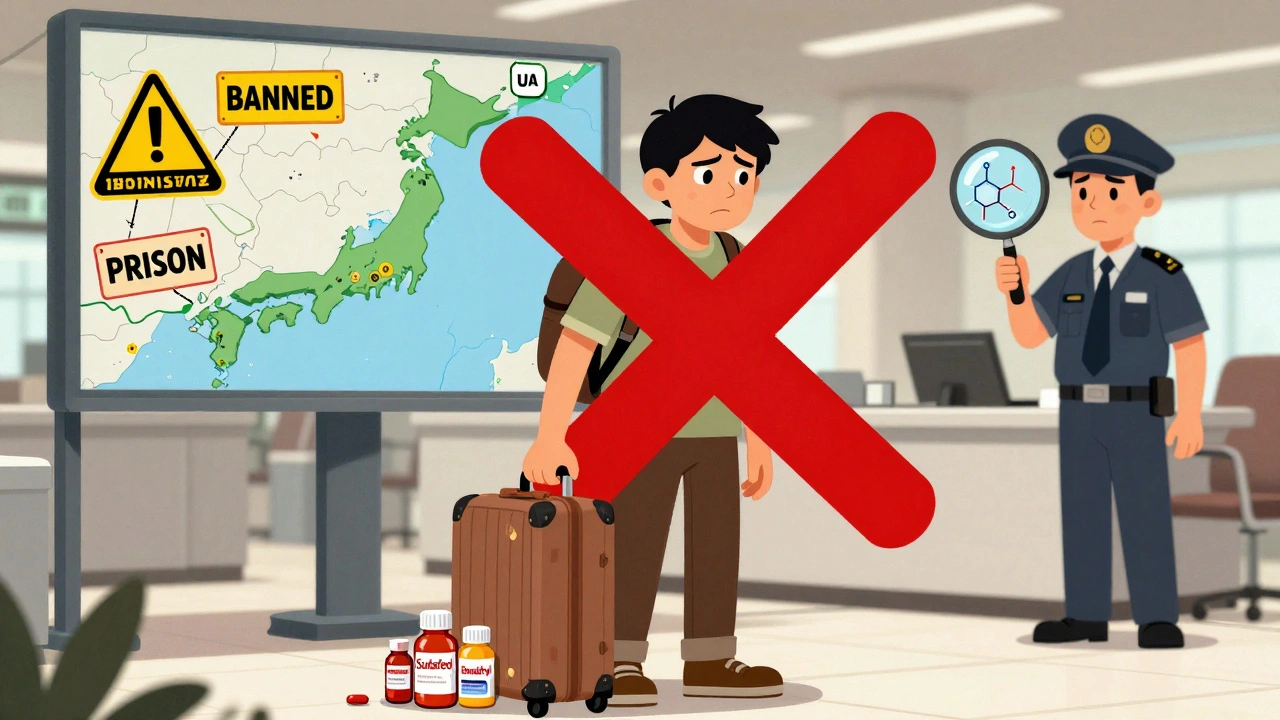
It’s easy to assume that if a medication is sold over the counter at your local pharmacy, it’s fine to pack in your suitcase. But that’s a dangerous assumption. Every year, travelers get detained, fined, or even jailed for carrying common OTC drugs that are completely legal at home - but illegal abroad. You might be carrying Sudafed, Benadryl, or even sleep aids like Ambien thinking they’re harmless. In countries like Japan, the UAE, or Mexico, those same pills could land you in serious trouble.
Why Some OTC Drugs Are Banned Overseas
Different countries have different rules about what counts as a medicine versus a controlled substance. In the U.S., pseudoephedrine (the active ingredient in Sudafed) is available behind the counter with no prescription. But in Japan, it’s classified as a stimulant under their Pharmaceutical Affairs Law - and possession without a special permit can mean up to five years in prison. Same with diphenhydramine (Benadryl). In Japan and Zambia, you need a doctor’s note even if you’re carrying just a few pills. The reason? Many countries treat ingredients like pseudoephedrine or codeine as potential drug precursors or narcotics, regardless of how they’re used at home.Top 5 OTC Medications That Will Get You in Trouble
- Pseudoephedrine - Found in Sudafed, Claritin-D, and many cold meds. Banned in Japan, Mexico, Singapore, and Thailand. Even small amounts can trigger customs alerts.
- Diphenhydramine - The sleep aid and allergy pill in Benadryl. Requires documentation in Japan, Zambia, and Australia. Japan confiscated over 1,800 Benadryl products from travelers in 2022 alone.
- Codeine - Present in Tylenol with Codeine, some cough syrups, and combination painkillers. Illegal without a permit in the UAE, Japan, Greece, Indonesia, and Saudi Arabia. In the UAE, possession can mean 1-3 years in prison.
- Zolpidem (Ambien) - A sleep medication. Banned in Egypt, Saudi Arabia, and the UAE. In France, you need advance approval - 83 travelers were detained for carrying it in 2022.
- Amphetamine-based ADHD meds - Adderall, Ritalin, Vyvanse. Prohibited in 22 countries including Japan, Sweden, and Switzerland. Sweden detained 147 travelers for these in 2021.
Japan: The Strictest Country for Travelers
If you’re flying to Japan, treat your medicine cabinet like a security checkpoint. Japan bans 26 common U.S. medications - including lidocaine patches over 4%, herbal supplements with ephedra, and even some antihistamines. The country doesn’t recognize U.S. prescriptions. Even if you have a doctor’s note, it’s not enough unless you’ve applied for a Yunyu Kakunin-sho - an import certificate from Japan’s Ministry of Health, Labour and Welfare. The process takes 4-6 weeks, and approval rates for first-timers are only around 68%. If you show up without it, your meds will be seized, and you could face questioning or detention. In 2022, 94% of all medication-related cases involving U.S. travelers in Japan were for Sudafed or Benadryl.The UAE: Zero Tolerance for Sedatives and Painkillers
The United Arab Emirates treats medications like narcotics - even if they’re legal elsewhere. Codeine, diazepam (Valium), alprazolam (Xanax), and zolpidem (Ambien) are all classified as controlled substances. Possessing any of them without a permit can lead to mandatory prison sentences of 2-4 years. There’s no gray area. A traveler carrying a single bottle of Xanax for anxiety was sentenced to two years in 2023. The UAE doesn’t care if you have a U.S. prescription. They don’t recognize it. The only safe way to bring these is to apply for an official permit through the UAE Ministry of Health - a process that requires a letter from your doctor, a copy of your passport, and proof of diagnosis. Most travelers don’t realize this until they’re at immigration.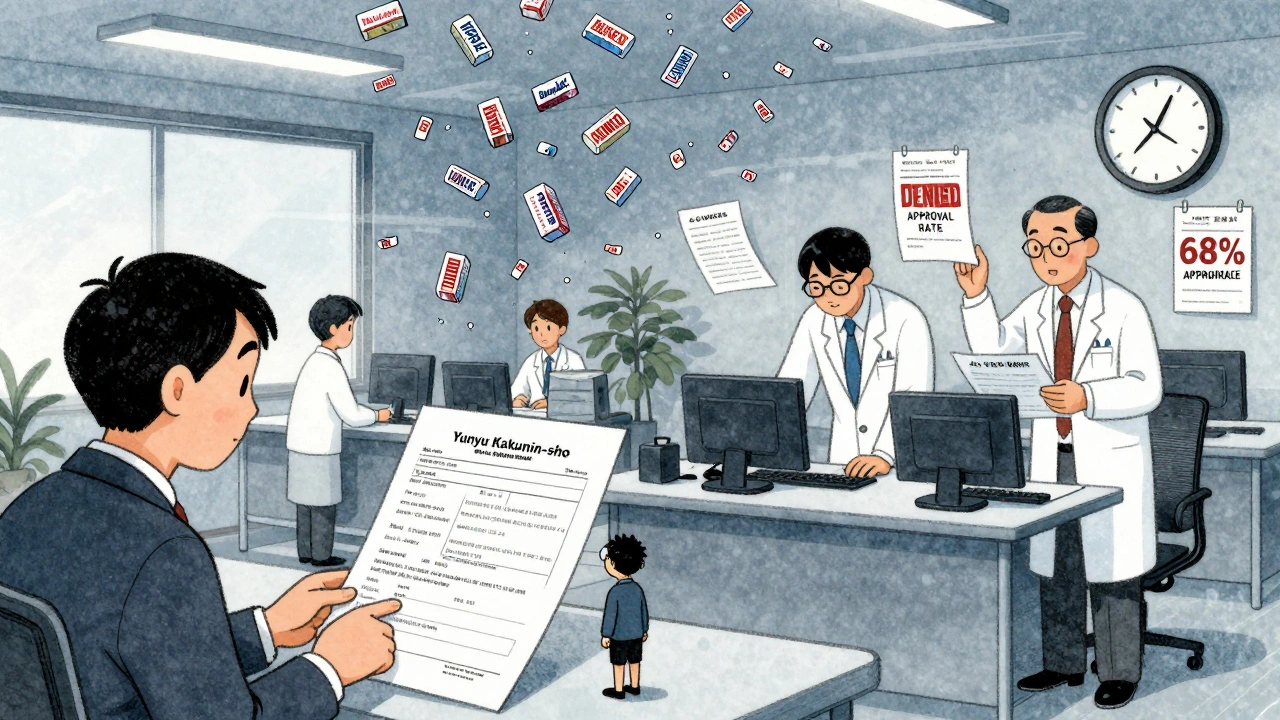
What You Should Do Before You Travel
- Check the INCB database - The International Narcotics Control Board maintains a free online tool listing medication rules for over 70 countries. Search by active ingredient, not brand name.
- Contact the embassy - Don’t rely on websites or travel blogs. Email the embassy of your destination country directly. Japan’s MHLW replies to inquiries at [email protected] within 72 hours.
- Carry meds in original containers - Pharmacy labels with your name, the drug’s generic name, dosage, and prescribing doctor’s info are critical. Customs officers don’t care if it’s in a pill organizer.
- Get a doctor’s letter - Ask your doctor to write a letter on official letterhead listing your medications, their generic names (INN), dosage, and medical necessity. This reduces legal issues by 89%, according to CDC data.
- Don’t exceed the allowed quantity - Japan allows up to two months’ supply without a permit. The UAE allows only a 30-day supply for controlled substances - even with a permit.
What Not to Do
- Don’t assume OTC = okay - 67% of all medication-related incidents happen because travelers thought, “It’s just a cold pill.”
- Don’t use brand names only - 78% of confusion at customs comes from mismatched brand names. “Benadryl” isn’t on Japanese forms - “diphenhydramine” is.
- Don’t pack meds in checked luggage - If your bag gets lost, you’re stuck. Carry everything in your hand luggage with your documents.
- Don’t rely on travel agencies - Only 28% of agencies check medication rules, according to a 2023 audit. You’re on your own.
What About Emergency Contraception?
Mifepristone (the pill used for medical abortion) is legal in the U.S. but banned in 12 countries including the UAE, Saudi Arabia, and Indonesia. In 2022, 32 travelers were detained for carrying it. Even if you’re taking it for non-abortion reasons (like regulating periods), some countries still classify it as an abortifacient. If you need it, research the destination’s stance well in advance. Some countries allow it only with a local prescription - and you can’t get one as a tourist.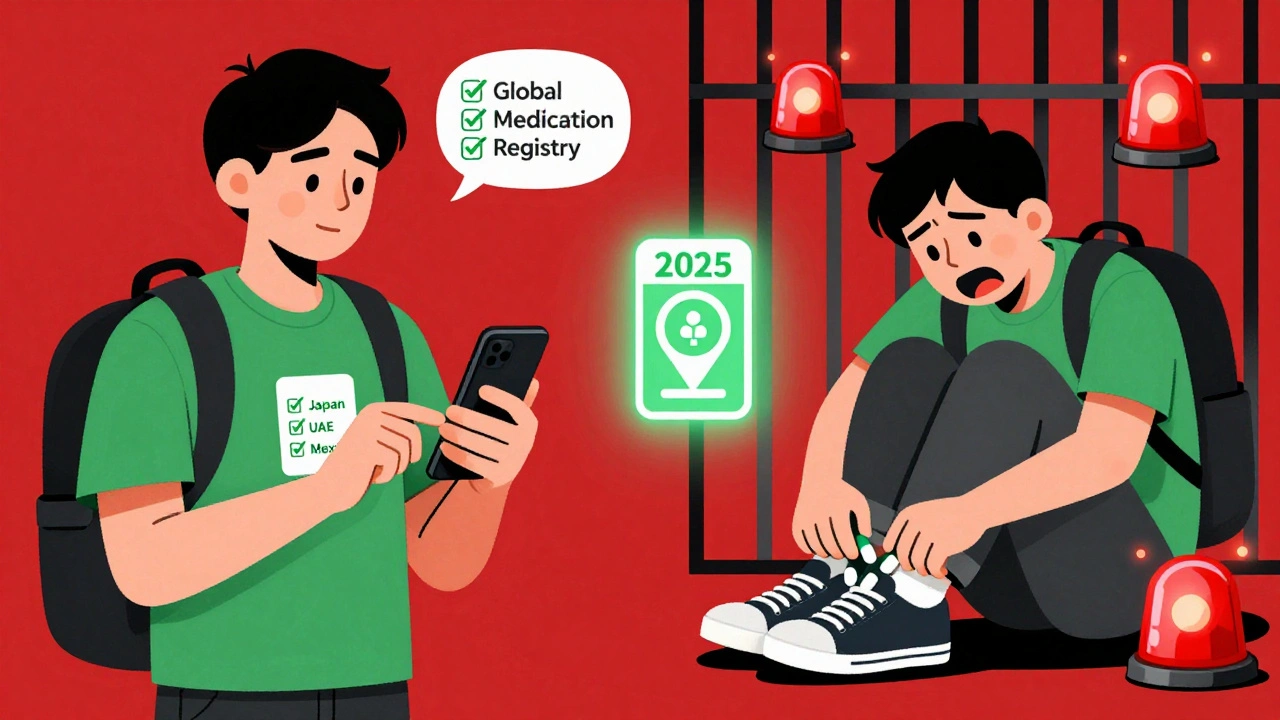
What’s Changing in 2025?
The INCB is launching a Global Medication Travel Registry in 2025, which will standardize how countries share medication rules. It’s a big step forward. But until then, 42 countries - including Indonesia, India, and Pakistan - still haven’t published any official guidelines. That means even if a drug isn’t listed anywhere, it could still be banned. In 2022, 89 travelers were detained in Indonesia for carrying codeine - despite no public warning. Always assume the worst.Travel Apps and Digital Tools
New tools are making this easier. The IATA Travel Pass now includes a medication module that checks rules for 65 destinations. Japan’s own “MediSafe Japan” app lets you verify if your meds are allowed and even start your import application. Download them before you fly. They’re free and updated in real time.What If You’re Already Caught?
If customs seizes your medication, stay calm. Don’t argue. Don’t lie. Ask for a lawyer. Contact the nearest U.S. embassy immediately. They can’t get your meds back, but they can help you navigate the legal system. In many cases, first-time offenders are released after paying a fine - but repeat offenses or possession of large quantities can lead to jail. Your U.S. passport won’t protect you. Foreign laws don’t care where you’re from.Can I bring Benadryl to Japan?
You can bring Benadryl to Japan only if you have a doctor’s letter explaining why you need it and the active ingredient is listed as diphenhydramine. Even then, you’re limited to a one-month supply. Customs officials confiscated over 1,800 Benadryl products from travelers in 2022. Without documentation, it’s considered illegal.
Is Sudafed illegal in Mexico?
Yes. Pseudoephedrine, the main ingredient in Sudafed, is completely banned in Mexico. Even a single tablet can be confiscated, and you may be questioned by authorities. Many travelers are surprised because it’s sold over the counter in the U.S. - but Mexico treats it as a controlled substance due to its use in making methamphetamine.
Do I need a prescription for codeine in Dubai?
You don’t need a prescription - you need a special government permit. Codeine is a controlled narcotic in the UAE. Even if you have a U.S. prescription, it’s not valid. You must apply for an import permit through the UAE Ministry of Health before traveling. Without it, you risk a 1-3 year prison sentence.
Can I bring Adderall to Europe?
It depends. Adderall is banned in Japan, Sweden, and Switzerland. In most other European countries, you can bring it with a doctor’s letter and your original prescription. But you must carry it in the original bottle with your name on it. Sweden detained 147 travelers for ADHD meds in 2021. Don’t assume it’s okay just because it’s legal in the U.S.
What if my medication isn’t listed anywhere?
If a country hasn’t published official rules (like Indonesia or India), assume it’s banned. In 2022, 89 travelers were detained in Indonesia for carrying codeine - even though no public warning existed. Always contact the embassy directly. Never assume safety based on lack of information.
Comments
Michael Robinson
It’s wild how we think our medicine cabinet is universal. I packed Sudafed for a trip to Thailand last year and got grilled at customs like I was smuggling cocaine. Turned out they just wanted to know if I was making meth. I wasn’t even sick. Just had a cold. Now I check every pill like it’s a visa application.
Turns out, the world doesn’t care if it’s ‘just OTC’ where you live.
December 10, 2025 at 21:58
Kathy Haverly
Oh please. This whole post is fearmongering. You’re telling people not to bring Benadryl like it’s heroin. It’s an antihistamine. Not a weapon. Japan’s laws are archaic, not enlightened. And the UAE? They’re still living in the 1970s. If you can’t handle a little common medicine, maybe don’t leave your house, let alone your country.
December 12, 2025 at 08:04
Evelyn Pastrana
LOL at the idea that you need a PhD to travel with allergy pills. I brought Benadryl to Japan in 2021 - no letter, no permit, just the bottle. They looked at it, shrugged, and waved me through. Maybe it’s different now? Or maybe some of us just got lucky?
Also, ‘89% of cases involved Sudafed’? That’s not a warning, that’s a marketing stat. People panic over pills because they don’t know what’s actually banned. Just carry the generic name. Easy.
And yes, I’m still alive. No jail. No fine. Just a confused customs officer wondering why I was so nervous about my cold medicine.
December 13, 2025 at 19:34
Nikhil Pattni
As an Indian who has traveled to 17 countries, let me tell you something - this is not even half the story. In Dubai, they once detained a guy for carrying paracetamol because it had ‘codeine’ in the ingredients list - even though it was just 2mg! And in Indonesia, they confiscated my multivitamins because they contained ‘vitamin B6’ - claimed it was a ‘precursor’ for something illegal. Honestly, the real issue is not the meds, it’s the lack of global standardization.
Why does every country have its own weird list? Why can’t we have a single global database? I mean, we have passports, we have vaccines, we have flight tracking - but not for medicine? This is 2025, not 1925. The INCB registry is a start, but it’s too slow. I’ve been begging my embassy for 3 months just to get a letter approved for my ADHD meds. It’s ridiculous.
And don’t get me started on how they ask for ‘original prescription’ but you can’t get a prescription in the U.S. for OTC drugs. That’s a loop hole. They want proof you’re not lying, but the system doesn’t give you proof to give them. It’s broken.
Also, if you’re carrying Ambien, just don’t. I’ve seen people cry at immigration because they thought it was ‘sleep aid’ like melatonin. It’s not. It’s a sedative. And in Saudi Arabia? They treat it like cocaine. Even if you’re diabetic and need it for insomnia from nerve pain. Doesn’t matter. Zero tolerance. No mercy. No exceptions. So just don’t bring it. Save yourself the trauma.
December 14, 2025 at 19:51
Arun Kumar Raut
Hey, I get it - this stuff is scary. But don’t let fear stop you from traveling. I took my dad’s blood pressure meds to Thailand last year and spent 45 minutes at customs explaining what each pill was. I had the bottle, the doctor’s note, the generic names written out. They asked a few questions, smiled, and said ‘welcome to Thailand.’
It’s not about avoiding meds. It’s about being prepared. Carry your info. Know the names. Call the embassy. It’s not hard. And if you’re worried, just buy what you need there. Most countries sell common meds, even if they’re restricted for import.
Traveling isn’t about bringing your whole pharmacy. It’s about adapting. And honestly? Most people who get caught didn’t even try to learn. They just assumed. That’s the real problem.
December 15, 2025 at 03:55
precious amzy
How quaint. You treat pharmaceutical regulation like a cultural faux pas, as if it’s merely a matter of etiquette rather than sovereign biosecurity. The notion that ‘it’s just OTC’ reveals a profound epistemological arrogance - one that assumes the moral and pharmacological frameworks of the Global North are universally applicable. The UAE, Japan, and others are not ‘backward’; they are exercising epistemic autonomy. To dismiss their legal regimes as ‘archaic’ is to replicate colonial epistemic violence under the guise of ‘common sense.’
One might also reflect on the commodification of bodily autonomy - how the Western pharmaceutical industry has normalized the medicalization of everyday discomforts, then exported them as cultural artifacts. Benadryl is not a right. It is a product of a specific pharmacological ideology. To carry it abroad without permission is not ‘innocent’ - it is a symbolic act of pharmacological imperialism.
December 16, 2025 at 15:57
William Umstattd
People still get caught with Benadryl? Seriously? This isn’t a thriller movie. It’s 2025. We have apps, QR codes, digital prescriptions, and AI customs bots. If a country can’t scan a pill bottle and recognize diphenhydramine in under 3 seconds, they’re not protecting public health - they’re just being bureaucratic idiots.
And the fact that you need a 6-week permit to bring a sleep aid? That’s not safety. That’s performance art. I’m not going to waste my vacation time filling out forms for something I bought at CVS. I’ll just buy it there. If they don’t sell it? Then I’ll sleep on the floor. Problem solved.
December 18, 2025 at 12:50
Elliot Barrett
Why are we even talking about this? Just don’t bring anything. Buy it there. It’s that simple. I went to Japan last year and didn’t bring a single pill. Got a cold? Bought some cold medicine at a pharmacy. No paperwork. No stress. No chance of jail.
Stop treating your medicine cabinet like a passport. It’s not.
December 20, 2025 at 06:01
Tejas Bubane
Wow. So the whole point of this post is: ‘Don’t be dumb.’ You’re telling people not to bring Sudafed to Japan because it’s illegal? Newsflash: EVERY country has weird drug laws. Why is this even a story? It’s like saying ‘don’t bring beef to India’ or ‘don’t bring pork to Saudi Arabia.’ It’s basic travel常识. If you don’t know the rules, you’re the problem.
And yes, I’ve been to 12 countries. Never brought anything but ibuprofen and it’s always in the original bottle. No drama. No letters. No ‘Yunyu Kakunin-sho’ nonsense. Just common sense.
Also, the fact that you need a doctor’s letter for Benadryl? That’s not a law - that’s a joke. Someone’s making money off this fear.
December 20, 2025 at 12:26