
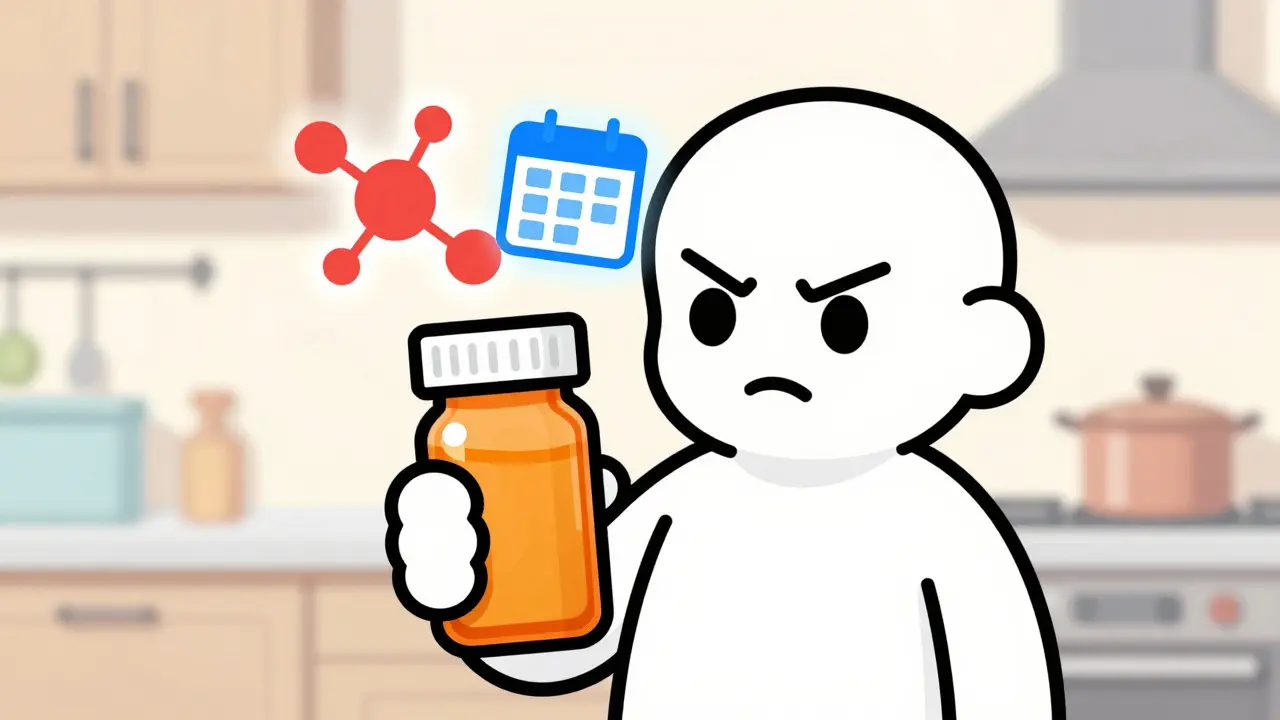
The Two Dates That Keep Your Meds Safe
You grab your pill bottle after refilling at the pharmacy. There are usually two dates staring back at you. One looks like the end of the road for the medicine itself. The other feels like a deadline for paperwork. Most of us glance at them, toss the bottle in the bag, and move on. But here is the scary part: mixing these up can leave you without life-saving medicine or lead you to throw away perfectly good drugs. A study showed that nearly half of patients couldn't tell the difference between them, and some threw out unexpired insulin because they confused an administrative deadline with a safety warning.
We need to stop treating these dates as just more bureaucracy. They serve completely different masters. One is rooted in chemistry and biology; the other is rooted in law and insurance. Today, we're going to strip away the jargon and figure out exactly what those numbers mean, why they matter, and how you can manage them so you never face a surprise gap in your treatment again.
What Is an Expiration Date?
Expiration Date A scientifically determined limit indicating when medication potency and safety cannot be guaranteed.Let's tackle the heavy hitter first. The expiration date isn't a guess. It's a hard line drawn in the sand based on rigorous testing. When manufacturers like Pfizer or Johnson & Johnson develop a drug, they run stability tests under controlled conditions. These tests answer one vital question: "How long does the molecule stay stable in this container under these temperatures?" According to the Food and Drug Administration (FDA), this date represents the point where the medication's strength and safety are no longer guaranteed.
This matters immensely for your health. Think of antibiotics. If a penicillin loses 10% of its potency before you take it, your infection might not clear up. Worse, you could build resistance. In most cases, the expiration date reflects the manufacturer's guarantee. However, when a pharmacist dispenses the drug, they apply their own "beyond-use" date. This is typically one year from the fill date for solid pills, or sometimes just 30 days for things stored in a fridge, like certain eye drops or reconstituted liquids. This ensures that even if the original package was sealed a few years ago, once opened and repackaged into your bottle, it still remains safe.
Data from the American Pharmacists Association shows that 98.7% of pharmacies now display this clearly. The rule is simple: Do not take the medication past this date. While scientific studies suggest some dry pills remain potent for years past the label, relying on this is risky. We don't know how humidity, heat, or light affected your specific bottle. For high-stakes drugs like heart medications or seizure controls, adhering strictly to the expiration date is non-negotiable for your safety.
Understanding the Refill-By Date
Refill-By Date An administrative deadline indicating when the remaining refills on a prescription must be processed.If the expiration date is about chemistry, the refill-by date is about permission. This is the date after which your doctor stops being authorized to provide new doses through the existing prescription slip. Sometimes called the "Refill-Through Date," it is a variable set by the prescribing authority. In many standard cases, this window opens up to one year from the day your medication was first filled. However, this changes significantly depending on the type of drug.
Take controlled substances, for example. Drugs that carry abuse potential, like certain painkillers or ADHD medications, often have much stricter limits. Under DEA Schedule II regulations, the window can close as quickly as six months. This prevents hoarding or diversion. Insurance companies also play a role here; plans might only cover refills within a specific window before requiring a new prior authorization. If you walk into the pharmacy on the day after your refill-by date passes, the system locks. The pharmacy cannot touch the bottle until the doctor sends a new order.
A survey by Consumer Reports found that 28.7% of people admitted to discarding meds prematurely because they thought the refill date meant the drug went bad. That is a waste of money, yes, but it's also dangerous if that drug was essential for blood pressure management. Understanding this distinction saves cash and keeps the medication flowing. The refill date answers: "When do I need a new doctor's note?" The expiration date answers: "When does the chemical composition fail?"
The Consequences of Mixing Them Up
Confusion isn't just annoying; it leads to tangible problems. Let's look at the impact. If you mistake the refill date for an expiration date, you might throw away a full bottle of vitamins or antihistamines that were perfectly fine to use. While that hurts your wallet, the reverse scenario is riskier. Imagine thinking you have three months left to take your pills because there are refills left, but ignoring the expiration date. You continue using the bottle for four months. By then, the tablets might have degraded. Inadequate dosing is a silent killer for chronic conditions.
There is a documented case on Reddit where a patient threw away $300 worth of insulin because they misread the refill date. Insulin is notoriously sensitive to temperature and age. In this specific instance, the pharmacist confirmed the drug was actually expired, but the patient learned it too late-their supply chain had broken down entirely. Another analysis from the University of Washington highlighted that 68.3% of medication access issues stem specifically from confusion between these two dates. When you mix them up, you lose trust in your medication management. You hesitate to pick up refills. You delay seeing your doctor because you think you aren't 'due' yet.
Regulatory Standards Driving These Labels
Food and Drug Administration (FDA) Federal agency responsible for protecting public health including food, drugs, and medical devices.Why do we have these dual dates at all? It didn't happen by accident. Regulations like the Omnibus Budget Reconciliation Act of 1990 (OBRA '90) set the foundation for standardized documentation. Later, the National Association of Boards of Pharmacy (NABP) updated their Model State Pharmacy Act in 2022 to mandate both dates on every dispensed label. The goal was transparency. By forcing pharmacies to print both, regulators hoped to align expectations between the patient, the doctor, and the insurer.
The FDA estimates that standardized labeling conventions reduce medication administration errors by 37.2%. That's a massive drop in preventable mistakes. When labels are ambiguous, pharmacists spend extra time verifying. A study in the Journal of Pharmacy Technology noted that pharmacists average 7.2 minutes per prescription just checking date accuracy. While that protects you, it means the process is complex. Standardized placement-often distinguishing administrative dates (sometimes printed in blue ink historically) from safety-critical dates (red ink)-is becoming the norm to help consumers spot the difference instantly.
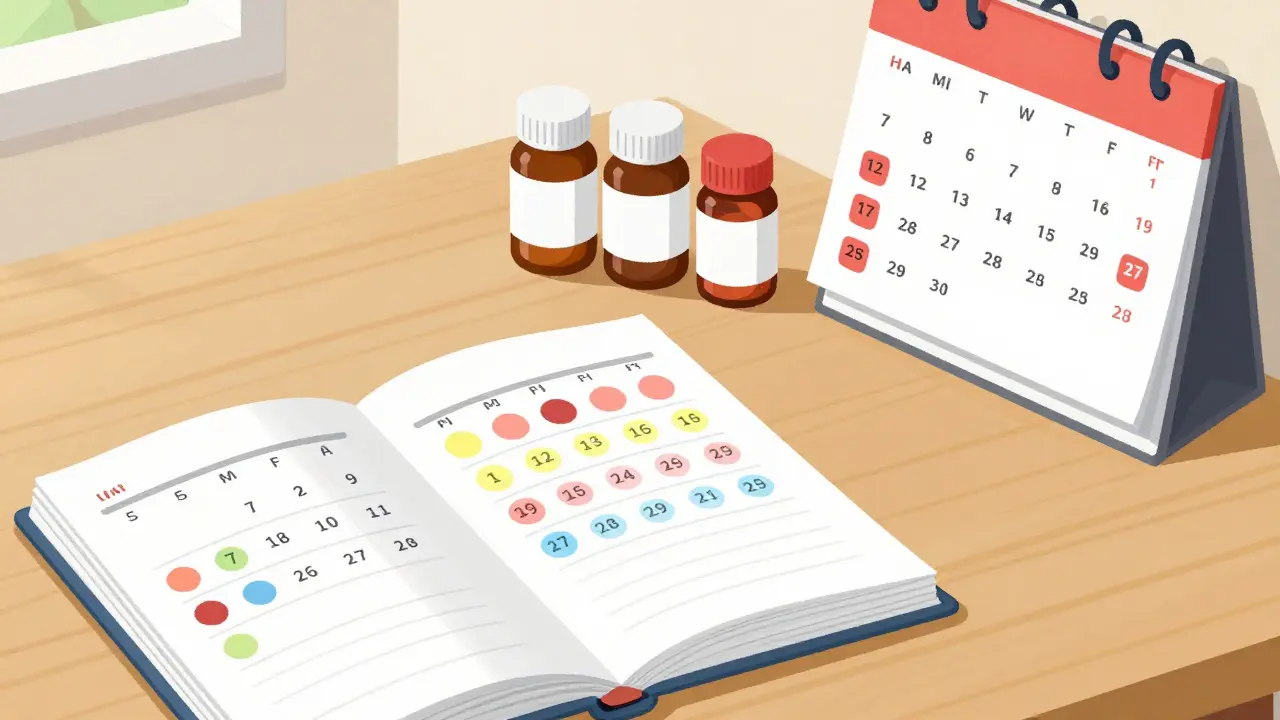
Managing Your Medication Log
So, how do you handle this practically? Relying on memory doesn't work, especially with complex schedules. The best approach is maintaining a dedicated medication log. Don't rely on the phone app alone, as digital summaries often lack the specific nuance of the physical bottle label. Create a system that tracks:
- Medication Name: Brand and generic names.
- Expiry Date: Mark this prominently with a highlighter.
- Refill Status: Number of refills remaining.
- Refill-By Deadline: Set a reminder alarm.
The American Pharmacists Association reports that setting reminders seven days before the Refill-Through Date expires reduces access issues by 63.4%. That's a huge win. Many pharmacies now offer automated alerts for this exact purpose. If your pharmacy doesn't, ask them. Some forward-thinking chains like CVS and Walgreens have started implementing QR codes on labels that link to video explanations. Scanning the code gives you instant clarity on which date does what. It's technology working for you, reducing the friction of reading small print.
| Feature | Expiration Date | Refill-By Date |
|---|---|---|
| Purpose | Ensures chemical stability and safety | Ensures prescription authorization validity |
| Determination | Scientific testing and pharmacy calculation | Prescriber decision and legal limits |
| Typical Duration | Usually 1 year from fill (or earlier) | Varies: 1 year standard, 6 months for controlled substances |
| Mixing Up Consequence | Taking ineffective/unsafe medication | Being unable to get new refills |
Navigating Insurance Coverage Gaps
There is one more layer to consider: insurance. Often, your insurance plan dictates coverage cycles that might conflict with your refill-by date. For example, Medicare Part D data reveals that nearly 31% of beneficiaries experience coverage gaps due to misalignment between the insurance plan's refill cycle and the medication expiration timeline. This can happen if your plan requires a new prescription for the next calendar year, but your previous one hasn't technically expired yet.
To avoid being stuck, check with your insurer during open enrollment or before your refill runs out. Ask specifically: "Does my coverage require a new doctor visit at the start of the year even if I have refills left?" Knowledge is power here. Knowing that your plan might cut off coverage early allows you to request a new renewal from your doctor beforehand, preventing that sudden shock of being denied a script at the counter.
Frequently Asked Questions
Can I use medication past the expiration date if it still looks okay?
Technically, some stable medications retain potency beyond their labeled date, but it is illegal and unsafe to rely on this. Legally, pharmacists cannot dispense expired drugs, and safety-wise, degradation products could cause harm. Always discard expired medication through a take-back program or flushing guide provided by the FDA.
What happens if I try to refill after the Refill-By date?
The pharmacy computer system will block the transaction. You will receive an error stating the prescription has expired. You must contact your prescriber for a new written order, which can take several business days to process. It is not possible for the pharmacist to simply extend the old prescription.
Why do different drugs have different refill limits?
This depends on the drug class. Routine maintenance drugs like blood pressure meds often allow one year of refills. Controlled substances, which have abuse potential, are legally restricted to tighter windows, often six months, to prevent stockpiling or misuse. Your doctor determines this based on clinical need and legal requirements.
How do I find these dates on a new label?
Check the bottom half of the label. Usually, the Expiration Date (often labeled "Discard After") is near the bottom. The number of refills and the Refill-Through date are typically grouped together in the upper or middle section. If unsure, ask the pharmacist to point them out to you.
Do refill dates reset if I travel?
No, traveling does not pause the clock. The Refill-By Date is fixed based on the original fill date. Whether you are in Bristol or Berlin, the authorization period remains the same. Plan your trips around your refill schedule to avoid running out.
Comments
Victor Ortiz
People ignore clear warnings constantly because they refuse to educate themselves properly on basic safety standards. The distinction between chemical stability and administrative deadlines is elementary logic that so many adults seem unable to grasp. Most patients simply throw away perfectly viable medication due to their own incompetence and unwarranted panic. The data supports strict adherence to scientific limits rather than prioritizing administrative convenience over actual health. Ignoring these critical differences puts the individual health risk squarely on their own shoulders entirely. It is frustrating to witness such preventable errors dominate healthcare discussions on a daily basis. We need smarter consumers who actually read the fine print before purchasing anything blindly. Stop blaming the system for your complete lack of attention to detail regarding vital information.
March 31, 2026 at 18:12
Amber Armstrong
I completely understand why so many folks struggle with reading those tiny labels on bottles every day. Life gets incredibly busy and checking two separate dates adds another mental load that nobody really expects to handle. My grandmother always threw things out way too early because she worried excessively about being safe. We really need more empathy when discussing how confusing these pharmacy systems can be sometimes for average people. It is scary to think about the stress families feel managing chronic conditions all by themselves. The fear of messing up is huge when dealing with life-saving treatments every single day without backup. Sometimes we just forget the difference until we are standing in the checkout line waiting anxiously. Pharmacies could certainly do better to highlight these sections more clearly for us all. Reading small print is hard enough without anxiety clouding our judgment further in stressful moments. Having automated alerts would help soothe the minds of many worried parents everywhere seeking help. Technology should support us instead of adding layers of complexity to simple everyday tasks unnecessarily. We all make mistakes while trying to keep our family healthy and safe from harm. Compassion is needed when talking about medication management failures honestly among friends. Every person deserves clear information that does not require a degree to decipher easily. Together we can push for better labeling that makes sense to normal humans regardless of background. Safety matters most but stress-free living is also important for everyone involved in the process.
April 1, 2026 at 17:24
Carolyn Kask
Typical American bureaucracy hiding behind red tape to confuse the average citizen intentionally for control. Other nations manage these things without forcing patients to decode secret codes on plastic containers anywhere else. Why does everything here need to be complicated just to satisfy insurance requirements endlessly without reason. The profit motive drives these rules rather than any genuine concern for public safety anywhere in the world. It feels designed to keep people guessing while companies rake in the fees for new prescriptions constantly.
April 2, 2026 at 01:22
Katie Riston
The nature of expiration seems deeply tied to how we perceive the abstract concept of time itself fundamentally. Scientific certainty fades into bureaucratic uncertainty as months roll past silently without warning us adequately. We cling to dates like anchors in a storm of biological decay and uncertain health states. Authority dictates when our bodies can trust the chemistry contained within glass vials safely. Yet human memory often fails to align with rigid schedules imposed by institutions on us. The tension between law and biology creates unnecessary friction in our healing process constantly. Perhaps true safety lies not in dates but in the continuous monitoring of our state internally. Systems built for efficiency often sacrifice clarity required for individual understanding of medicine. We must find balance between regulation and the organic rhythm of human needs naturally. Knowledge empowers us to navigate these artificial timelines with greater wisdom today. Understanding the deeper meaning helps us accept the limitations of the system.
April 2, 2026 at 17:31
Brian Yap
Over here in Oz we just scan the bottle to check the expiry date mostly without fuss. Insurance isn't nearly as big of a deal with refills as it is down under Australia usually. Everyone understands the drug safety part without needing legal jargon on the label constantly. It makes life simpler for everyone involved in the process here. Cheers mate.
April 4, 2026 at 01:49
Ruth Wambui
They want you tossing good meds into the trash bin so sales stay high artificially inflated. Corporate greed drives the expiration policy to ensure constant revenue streams flow freely into pockets. Big pharma profits from confusion surrounding these critical health documents significantly more than safety does. Wake up to the real agenda behind the paperwork trail.
April 4, 2026 at 04:42
Michael Kinkoph
It is imperative!!!! That citizens adhere strictly to guidelines!! Safety cannot be compromised;;; Not even once! The moral duty is clear!! Read the label!!! Ignore the noise;;; Trust science!!! Do not deviate!
April 4, 2026 at 23:31
Jonathan Sanders
I am exhausted just thinking about tracking all these different deadlines forever endlessly. Nobody wants to deal with paperwork when they are already sick and tired of the system. The emotional toll of managing this stuff drains the life right out of people quickly. Who has the energy for this nonsense when feeling weak?
April 5, 2026 at 02:20
emma ruth rodriguez
Regulatory compliance ensures patient protection through standardized protocols and rigorous testing procedures. Evidence-based practice confirms that accurate dating prevents adverse outcomes consistently across populations globally. Documentation integrity remains paramount for clinical safety purposes in all medical scenarios. Adherence to these standards protects vulnerable individuals effectively.
April 6, 2026 at 14:39
Rick Jackson
Stick to the schedule and avoid headaches in the long run. Simple is better than complex here for peace of mind. Keep it easy.
April 7, 2026 at 19:08
Beccy Smart
Lmao I never notice those dates anyway 😴💤.
April 9, 2026 at 18:00