
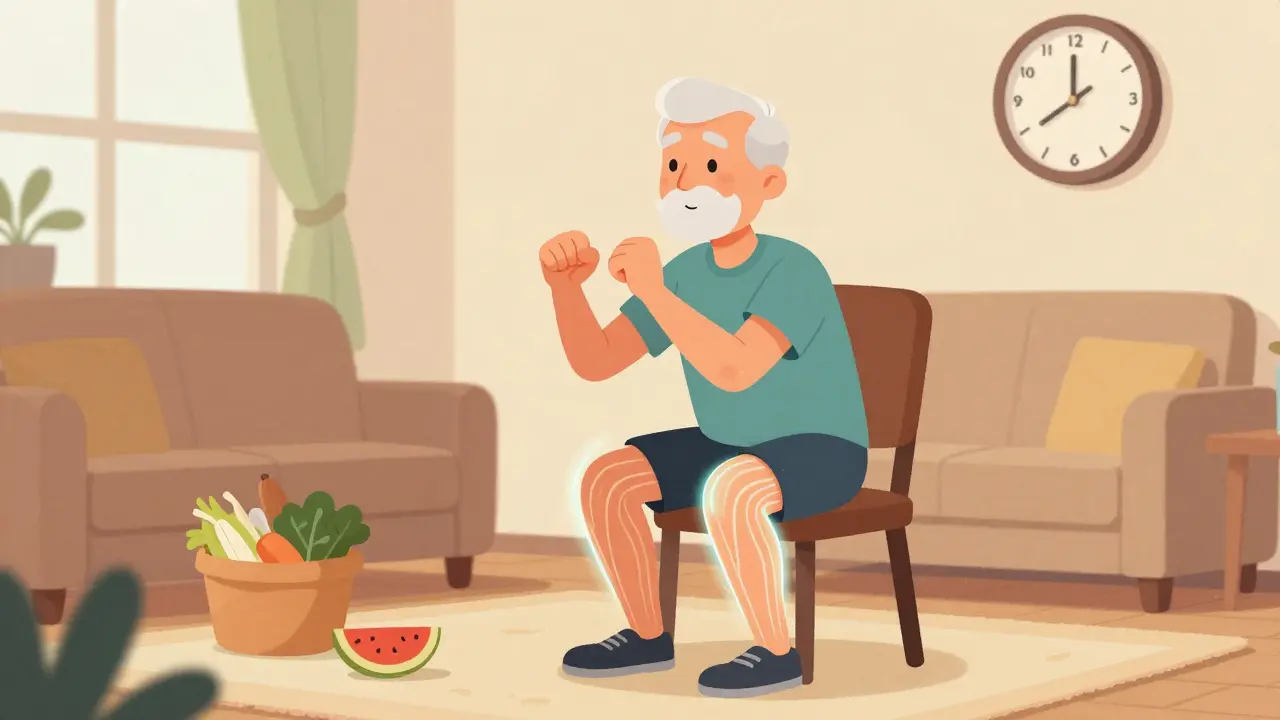
By your 40s, you might notice it’s harder to lift groceries, climb stairs, or get up from a chair without using your hands. It’s not just getting older-it’s sarcopenia. This isn’t normal wear and tear. It’s a real, measurable loss of muscle mass and strength that starts quietly in your 30s and picks up speed after 65. Left unchecked, it doesn’t just make life harder-it increases your risk of falls, hospital stays, and losing independence. The good news? Strength training isn’t just helpful. It’s the most proven way to fight back.
What Exactly Is Sarcopenia?
Sarcopenia isn’t just feeling weaker. It’s a medical condition defined by the loss of skeletal muscle mass, strength, and physical function due to aging. First recognized in 1989 by Dr. Irwin Rosenberg, it’s now officially diagnosed using three clear signs: handgrip strength below 27kg for men or 16kg for women, walking speed slower than 0.8 meters per second, and low muscle mass measured by a DXA scan (below 7.0kg/m² for men, 5.5kg/m² for women). These aren’t arbitrary numbers-they’re based on decades of research from the European Working Group on Sarcopenia in Older People (EWGSOP3, 2023).
By age 60, about 1 in 10 adults have sarcopenia. By 80, that number jumps to 1 in 2. And it’s not just about looking weaker-it’s about losing the ability to live independently. In the U.S. alone, sarcopenia costs the healthcare system $18.5 billion a year. That’s because falls, fractures, and hospitalizations skyrocket when muscles fade.
Why Does Muscle Disappear as You Age?
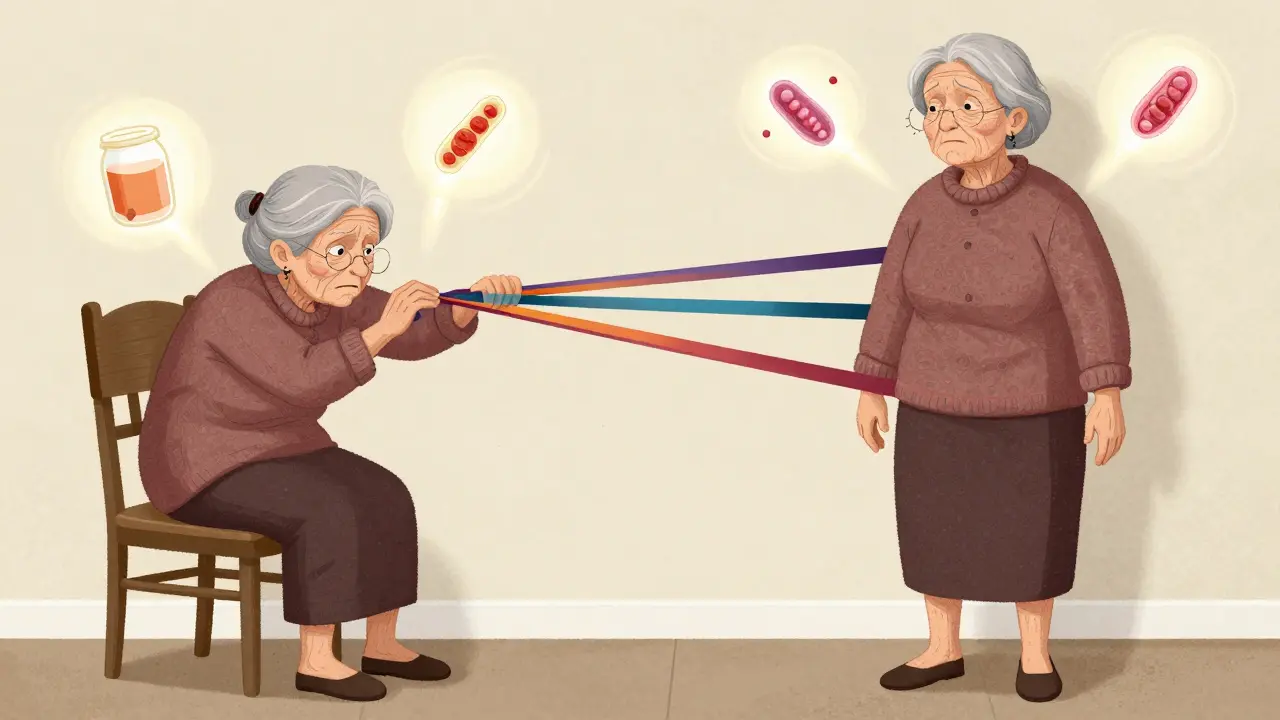
Your muscles don’t just shrink randomly. They’re being attacked from multiple angles. After 60, you lose about 3-5% of your motor neurons each year. These are the nerve cells that tell your muscles to move. Fewer signals mean fewer muscle fibers firing. Type II muscle fibers-the fast-twitch ones that let you jump, lift, or catch yourself when you trip-decline by 30-40% by age 80. Meanwhile, your body’s ability to repair muscle drops by 50-60% because satellite cells (your muscle’s repair crew) become less active.
Inside your muscle cells, protein synthesis slows by 20-25%. Your mitochondria, the power plants of your cells, produce 15-20% less energy. Chronic inflammation rises, with IL-6 and TNF-α levels climbing 30-50%. This low-grade inflammation literally blocks muscle growth. And if you’re eating less protein or moving less, it gets worse. It’s not one thing. It’s a perfect storm of aging biology.
Sarcopenia vs. Other Types of Muscle Loss
Not all muscle loss is the same. If you break a leg and spend weeks in bed, you might lose 1-1.5% of muscle per day-that’s disuse atrophy. Cachexia, often linked to cancer or severe illness, causes rapid weight loss (5-10% of body weight) and affects organs beyond muscle. Dynapenia is pure strength loss without much muscle mass change. Sarcopenia is different: it’s slow, age-related, and requires both low muscle mass AND poor function to be diagnosed.
Then there’s sarcopenic obesity-when muscle drops but fat increases. This affects 15-20% of older adults. You might not look thin, but your body is losing strength from the inside. That’s why BMI alone doesn’t tell the whole story. Two people with the same weight can have wildly different muscle levels.
How Strength Training Reverses the Damage
Here’s the science-backed truth: strength training is the only intervention proven to rebuild muscle and function in older adults. A 2012 review by Dr. Jeremy Walston found that just 12-16 weeks of resistance training increases muscle mass by 1-2kg and strength by 25-30%. That’s not a small gain-it’s the difference between needing help to get up from a chair and doing it on your own.
Studies show that doing strength training twice a week improves walking speed by 0.1-0.2 meters per second. That might not sound like much, but it cuts fall risk by 30-40%. One 72-year-old woman in a 2023 Healthgrades review saw her fall risk score drop from 42 to 28 after a 10-week SilverSneakers program. Another 68-year-old man went from 18kg to 24kg in handgrip strength-enough to open jars again.
The American College of Sports Medicine recommends: 2-3 sessions per week, 1-3 sets of 8-12 reps, using 60-80% of your one-rep max. You don’t need to lift heavy. You need to lift enough to challenge your muscles. Progression matters. If you’re not getting harder over time, you’re not building.
What Works Best for Seniors
Start simple. You don’t need a gym. Begin with bodyweight moves: chair squats, wall push-ups, seated leg lifts, and standing calf raises. Do 10-15 reps, 2 days a week. Once you can do 2 sets easily, add resistance bands. TheraBand levels 1-5 are affordable and safe. Then, move to weight machines at the gym-they’re stable, guided, and easier on joints than free weights.
Key tips: exhale when you push or lift (never hold your breath), rest 48 hours between sessions, and eat 20-30g of protein within 45 minutes after working out. Eggs, Greek yogurt, chicken, or a protein shake all work. Consistency beats intensity. One 2022 survey of 3,215 older adults found that those who trained twice weekly were 75% more likely to stay independent than those who didn’t.
Common Barriers-and How to Overcome Them
Many older adults quit because of pain, fear, or frustration. About 35-40% report joint discomfort. The fix? Use machines with limited range of motion. If squats hurt your knees, try seated leg presses. Balance issues? Start seated. Use a chair for support. Motivation drops when training feels lonely. Join a group. Social exercise increases adherence by 35-40%. SilverSneakers, now covered by many Medicare Advantage plans, has helped 4.2 million seniors in the U.S. stay active.
Cost is another barrier. Specialized senior programs can run $50-$75/month. But you don’t need them. Free YouTube channels like “SilverSneakers Fitness” or “Go4Life” (from the National Institute on Aging) offer full workouts. The CDC recommends starting with bodyweight and bands-no equipment needed.
The Bigger Picture: Why This Matters Now
By 2030, 72 million Americans will be over 65. Globally, 1 in 6 people will be. Sarcopenia isn’t a personal problem-it’s a public health crisis. Only 28% of U.S. seniors meet the muscle-strengthening guidelines. Meanwhile, there are just 12,500 certified geriatric physical therapists in the country. That’s not enough. That’s why telehealth programs are rising. A 2022 JAMA Internal Medicine study found virtual strength coaching was 85% as effective as in-person.
New tools are emerging. The FDA approved RT001 for clinical trials-a drug targeting mitochondrial dysfunction. AI-powered apps like Exer AI give real-time form feedback, boosting adherence by 25%. Blood tests for myostatin and GDF-15 may soon detect sarcopenia before symptoms appear.
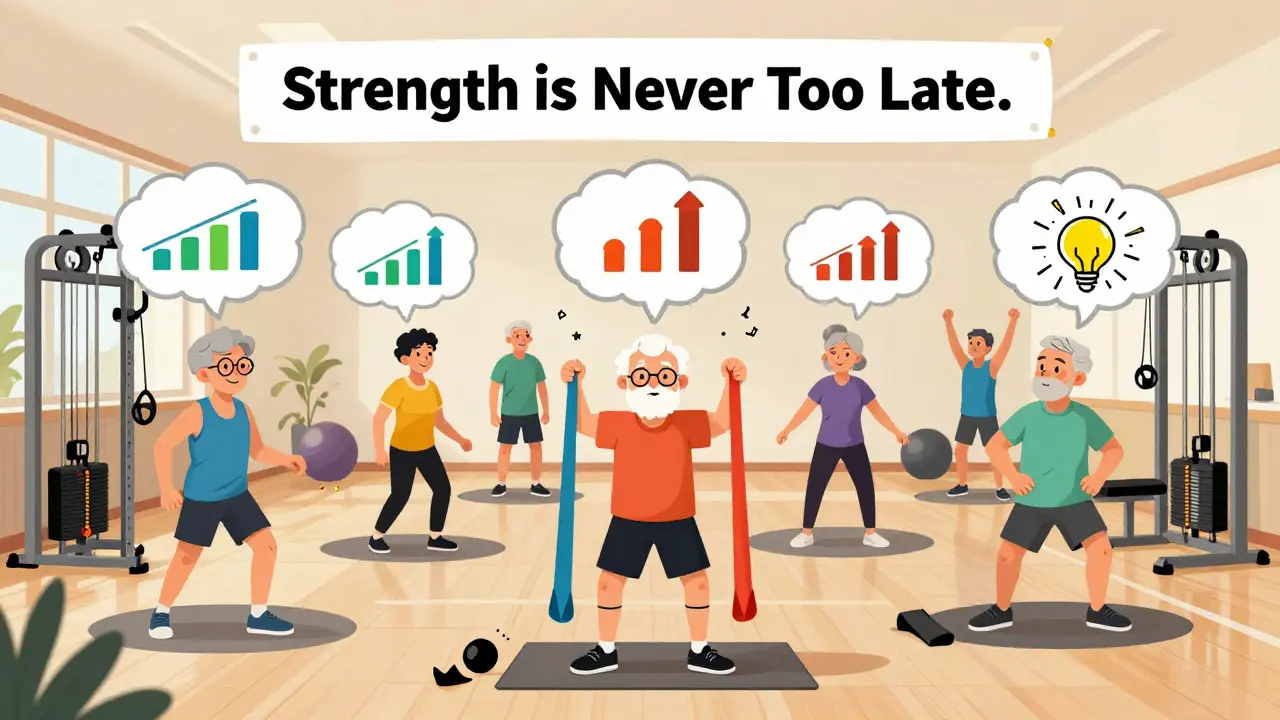
But none of this replaces the simplest, safest, and cheapest tool: movement. Strength training doesn’t just build muscle. It rebuilds confidence, independence, and control over your life.
Getting Started: Your Simple 4-Step Plan
- Start with bodyweight exercises 2 days a week (chair squats, wall push-ups, seated rows with a band).
- Use 10-15 reps per set. Stop if you feel sharp pain, but mild fatigue is normal.
- After 4 weeks, add light resistance (bands or machines) and increase weight by 2.5-5% weekly.
- Pair training with 20-30g of protein within an hour after your workout.
You don’t need to be strong. You just need to start. And keep going.
Is sarcopenia the same as muscle atrophy?
No. Muscle atrophy can happen at any age due to injury, illness, or lack of movement-for example, bed rest can cause 1-1.5% muscle loss per day. Sarcopenia is specific to aging. It begins in your 30s-40s, progresses slowly, and involves both muscle loss and functional decline, not just size reduction.
Can you reverse sarcopenia after 70?
Yes. Studies show that even people in their 80s can gain muscle mass and strength with resistance training. A 2023 review found older adults who trained twice weekly increased muscle mass by 1-2kg and strength by 25-30% in just 12-16 weeks. Age doesn’t stop adaptation-it just means you need to start slowly and stay consistent.
Do I need weights to fight sarcopenia?
Not at first. Bodyweight exercises and resistance bands are just as effective for beginners. You can build strength with chair squats, wall push-ups, and seated rows using TheraBand. Weights come later, once you’ve built a base. The goal is progressive overload-not heavy lifting.
How often should I strength train if I’m over 65?
Twice a week is the minimum for noticeable results. The American College of Sports Medicine recommends 2-3 sessions per week, with at least 48 hours between sessions to let muscles recover. More than 3 sessions doesn’t add much benefit and increases injury risk. Consistency matters more than frequency.
What if I have arthritis or joint pain?
You can still train. Use machines instead of free weights-they guide movement and reduce joint strain. Try seated exercises. Lower the range of motion by 20-30% to avoid pain. Warm up with gentle movement first. Many seniors with arthritis improve mobility and reduce pain with regular strength training. Talk to a physical therapist if you’re unsure where to start.
Is protein really that important after workouts?
Yes. Your body’s ability to build muscle declines with age. After strength training, your muscles need 20-30g of protein within 45 minutes to repair and grow. Good options: 3 eggs, a cup of Greek yogurt, 100g of chicken, or a protein shake. Skipping protein after training cuts your gains by half.
Next Steps: What to Do Today
Don’t wait for symptoms to get worse. If you’re over 50, start now. Pick one bodyweight exercise-chair squats or wall push-ups-and do 10 reps today. Tomorrow, do them again. In a week, add a resistance band. In a month, you’ll feel stronger. In three months, you’ll wonder why you waited so long. Your future self will thank you.
Comments
Susan Purney Mark
Just started chair squats last week 😊
Used to think I was just "getting old"-turns out I was just lazy.
Now I do them every morning before coffee. My knees feel better, and I can pick up my grandkid without groaning.
Consistency > intensity. Also, protein shake after = game changer. 💪
March 7, 2026 at 03:37
Ian Kiplagat
Been doing this since 62. No gym. Just bands and walking.
Strength isn’t about lifting heavy. It’s about staying upright.
And yes-protein matters. Always eat eggs post-workout.
Simple. Effective. Non-negotiable. 🍳
March 9, 2026 at 00:27
amber carrillo
It is remarkable how consistent, low-intensity resistance training can restore functional independence in older adults.
Research consistently supports this approach over high-impact alternatives.
Protein timing is also critical due to anabolic resistance in aging muscle.
Thank you for sharing evidence-based guidance.
Many are unaware these interventions are accessible and safe.
March 10, 2026 at 15:43
Aaron Pace
Have you heard about the new FDA-approved RT001 drug? 😏
They’re already testing it in trials-this whole strength training thing? Might be a scam to keep people buying gym memberships.
Why work out when a pill’s coming? Just sayin’. 🤔
March 11, 2026 at 18:48
Adebayo Muhammad
Let me be clear: this isn’t about "aging." It’s about systemic failure.
Capitalism has commodified health-sell you bands, sell you protein shakes, sell you SilverSneakers.
Meanwhile, Medicare cuts home care, and pharmaceuticals profit from your decline.
Strength training? It’s a Band-Aid on a bullet wound.
Real change? Universal healthcare. Free nutrition. Community centers.
Not your 12-rep chair squats. That’s distraction.
Don’t be fooled by the narrative. They want you busy sweating while the system rots.
Wake up.
It’s not your fault you’re losing muscle-it’s the economy.
March 13, 2026 at 00:52
Pranay Roy
Wait-so you’re telling me that after 60, your body stops building muscle? That’s not biology-that’s a lie.
I read a study once-China, 2018-old men lifting 200kg at 80. No protein. No bands. Just raw will.
They don’t want you to know this. They want you dependent.
And the FDA approval? That’s a cover. RT001? It’s a bioweapon prototype.
Why do you think they’re pushing "form feedback apps"? Surveillance.
You think this is about health? It’s about control.
Don’t train. Don’t eat protein. Don’t trust the system.
Go barefoot. Lift rocks. Be wild.
March 14, 2026 at 00:04
Joe Prism
There’s something deeply human about reclaiming strength as we age.
It’s not just muscle-it’s dignity.
One rep at a time, we say: I still belong here.
And yes, protein matters. But so does silence.
So does stillness.
So does the quiet pride of standing without help.
That’s the real gain.
Not the numbers. The feeling.
March 15, 2026 at 12:47
Bridget Verwey
Oh honey, you’re telling me sarcopenia is reversible after 70?
And I thought my 75-year-old neighbor was just being dramatic when she deadlifted 40lbs.
Turns out she’s just smarter than the rest of us who were too busy Googling "why am I so weak?"
Go lift something. Even if it’s a can of beans.
And don’t let anyone tell you it’s too late.
Because baby, it’s never too late to say: I got this.
Now go. I’ll wait. 😘
March 15, 2026 at 13:30