
Medication Dosing Strategy Checker
Medication Characteristics
Analysis Result
Fill in the characteristics and click "Check Strategy Suitability" to see the analysis.
Ever felt like your medication works, but the side effects hit you like a ton of bricks shortly after taking it? That "peak" feeling-where the drug concentration in your blood hits its highest point-is often where the most unpleasant side effects live. Whether it's the sudden jitters from a stimulant or the intense nausea from an antidepressant, the timing and delivery of your dose matter. Managing these peaks through strategic dosing can be a game-changer, but there is a massive, dangerous difference between dose splitting and physically cutting a pill in half.
The Big Difference: Dose Splitting vs. Tablet Splitting
Before we go any further, we have to clear up a common and potentially dangerous misunderstanding. To a lot of people, "splitting a dose" sounds like taking a pill cutter to a tablet. In pharmacy terms, those are two completely different things.
Dose Splitting is the practice of administering the same total daily amount of a medication in smaller, more frequent doses throughout the day. For example, instead of taking one 20mg pill in the morning, your doctor might have you take 10mg in the morning and 10mg in the evening. The goal here is to flatten the curve of the drug's concentration in your blood, avoiding that high "peak" that triggers side effects while keeping the level steady enough to work.
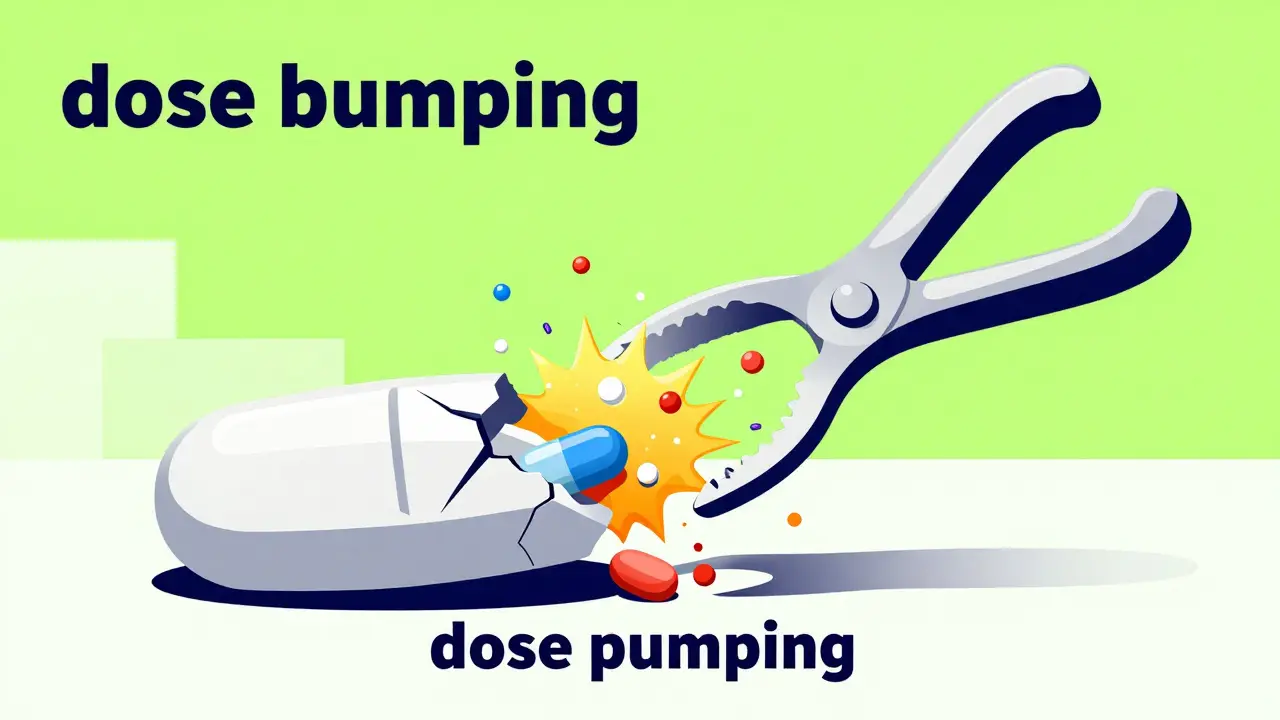
On the flip side, Tablet Splitting is the physical act of breaking a pill. While it seems like the same thing, physically cutting a pill-especially one not designed for it-can actually create the exact opposite of the desired effect. If you cut an extended-release tablet, you might accidentally release 24 hours of medicine in one hour. Instead of lowering the peak, you've just created a massive, dangerous spike in your bloodstream.
How Peaks Trigger Side Effects
To understand why this works, you have to look at how drugs move through your body. When you take a standard immediate-release pill, the drug enters your bloodstream quickly, reaching a Peak Plasma Concentration (Cmax). For many drugs, side effects are "concentration-dependent." This means that as long as the drug is in your system at a low level, you're fine-but once it hits a certain threshold, the side effects kick in.
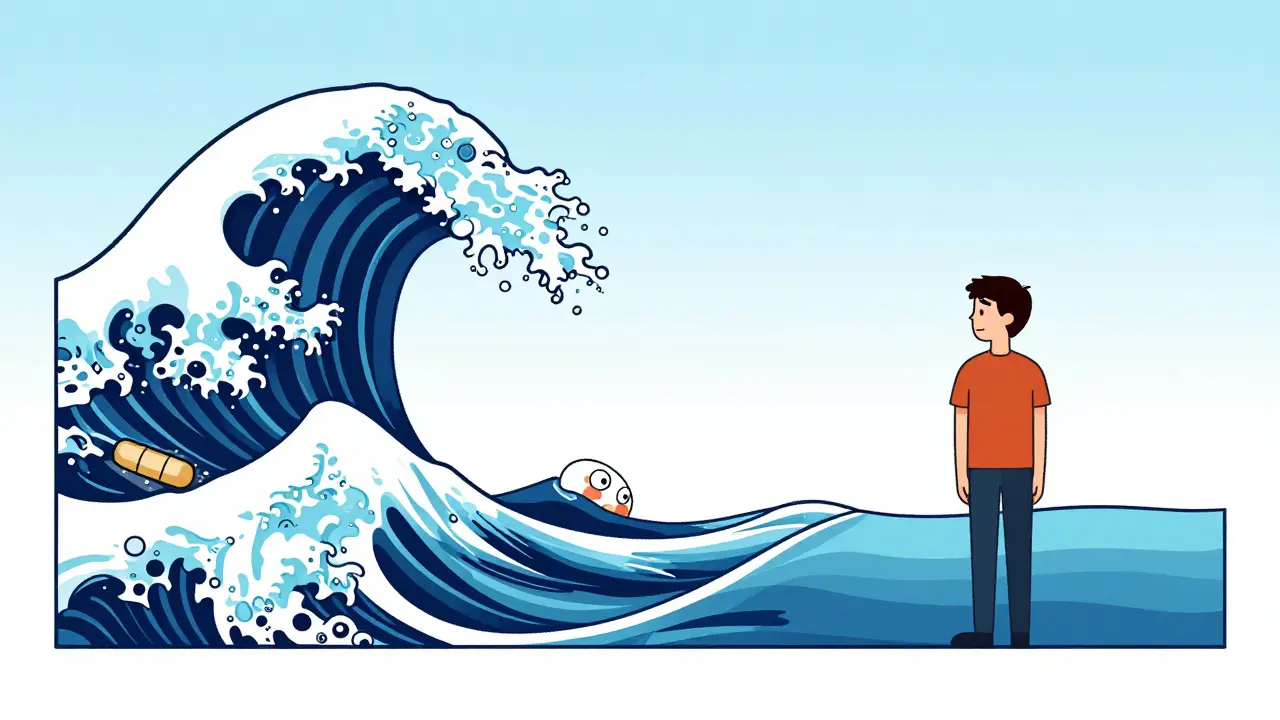
Imagine a wave in the ocean. If the wave is 10 feet high, it'll knock you over. But if you could spread that same amount of water into a gentle 2-foot tide that lasts longer, you'd stay on your feet. Dose splitting does exactly that. By breaking the daily total into smaller pieces, you keep the "wave" of the drug below the threshold that triggers nausea, dizziness, or sedation, but above the level needed to treat your condition.
When Dose Splitting Actually Works
Not every drug is a candidate for this strategy. The success of lowering peaks depends on a few specific pharmacological factors. The most important is the Half-Life, which is the time it takes for the concentration of the drug in your body to reduce by half.
Drugs with a short half-life (usually less than 6 hours) are the best candidates. Because they leave the system quickly, they create sharp peaks and deep valleys. Splitting these doses helps fill those valleys and chop off those peaks. For instance, some people find that splitting the dose of immediate-release stimulants reduces the "crash" and the initial jitteriness.
In contrast, drugs with very long half-lives-like Sertraline, which stays in the system for over 25 hours-have a natural buffer. Because they accumulate slowly and leave slowly, the peaks are already quite flat, so splitting the dose often doesn't change much for the patient.
| Drug Characteristic | Suitability for Dose Splitting | Expected Outcome |
|---|---|---|
| Short Half-Life (<6 hrs) | High | Lower peaks, steadier levels |
| Long Half-Life (>12 hrs) | Low | Minimal change in side effects |
| Immediate Release | Possible | Reduced Cmax (peak concentration) |
| Extended/Sustained Release | Contraindicated | Risk of "dose dumping" if split physically |
The Danger Zone: Narrow Therapeutic Indices
There is a category of drugs where playing with the dosing schedule is incredibly risky. These are medications with a Narrow Therapeutic Index (NTI). For these drugs, the difference between a dose that heals you and a dose that poisons you is tiny.
Take Warfarin (a blood thinner) or Digoxin (used for heart failure). With Warfarin, if your INR (a measure of how fast your blood clots) fluctuates too much because of inconsistent dosing, you could either develop a blood clot or start bleeding internally. Because the margin for error is so small, any fluctuation caused by inaccurate tablet splitting or irregular dosing intervals can be clinically dangerous.
This is why you'll see "do not split" warnings on many of these medications. The risk of an accidental overdose or underdose is simply too high to justify the potential reduction in side effects.
Real-World Scenarios: Successes and Failures
To see this in action, let's look at a couple of relatable examples. Consider Metformin, a common medication for type 2 diabetes. It's notorious for causing gastrointestinal distress-basically, it can make your stomach turn. Some users have reported a huge improvement by splitting their total daily dose from two large doses to four smaller ones. By keeping the concentration lower at any one time, the gut can handle the medication better, and the incidence of diarrhea drops significantly.
Now, look at the failure side. Imagine someone taking Lisinopril for high blood pressure. If they decide to physically split a 40mg tablet to make two 20mg doses but do it poorly, they might end up taking 10mg one day and 30mg the next. In a documented case, this kind of inconsistency led to a hypertensive emergency where the patient's blood pressure spiked to 192/102, landing them in the emergency room. The "savings" or "convenience" of splitting the pill weren't worth the trip to the hospital.
Guidelines for Safe Implementation
If you're struggling with side effects, you might be tempted to try dose splitting on your own. Don't. You need a professional to verify that your specific medication is safe to split. Here is the typical criteria pharmacists and doctors use to decide if this strategy is viable:
- Formulation: It must be an immediate-release version. If the box says "XR," "ER," "SR," or "CR," you generally cannot split it.
- The Score Line: If you are physically splitting a pill, it should have a score line (that little groove). Unscored tablets can vary wildly in where the actual medicine is located within the pill, leading to uneven doses.
- Therapeutic Window: The drug must have a wide therapeutic index (it's safe across a broader range of concentrations).
- Tools: If approved to split, use a dedicated pill splitter from a pharmacy. Using a kitchen knife or scissors increases the chance of the pill crumbling, which can cause you to lose 15-25% of the actual dose.
Next Steps: Talking to Your Doctor
If you want to try lowering your peaks, start by keeping a side-effect diary. Note exactly when you take your medication and exactly when the side effects start. If they always peak 60 to 90 minutes after your dose, you have a strong case for discussing dose splitting with your provider.
Ask your doctor: "Given the half-life of this medication, would splitting my total daily dose into smaller, more frequent administrations help reduce these side effects without losing efficacy?"
Can I split an extended-release (ER) tablet to reduce side effects?
Generally, no. Extended-release tablets are engineered to release medicine slowly over many hours. Breaking the tablet destroys this mechanism, causing the entire dose to be released at once (called "dose dumping"). This can lead to a dangerous spike in drug levels and increased toxicity.
Is it cheaper to buy a higher dose and split it?
In some cases, yes. For certain medications like atorvastatin, buying a higher-dose tablet and splitting it (if approved by a doctor) can save money. However, you must ensure the tablet is scored and that you are using a proper pill splitter to avoid taking inaccurate doses.
Which medications should NEVER be split?
You should never split medications with a narrow therapeutic index, such as Warfarin or Digoxin, unless specifically instructed by a specialist. Additionally, immunosuppressants, chemotherapy agents, and most antiarrhythmics are too sensitive for splitting.
How do I know if I'm taking too much of a drug after splitting?
Signs of a "peak" being too high include intensified side effects shortly after dosing. If you've split a pill and feel suddenly dizzy, nauseous, or experience a rapid heart rate, contact your healthcare provider immediately, as you may be experiencing concentration spikes.
Does splitting the dose make the medicine less effective?
Not necessarily. If the total daily dose remains the same, the overall amount of medicine in your system usually stays the same. In some cases, splitting can actually make the drug *more* effective by keeping the blood levels steady rather than letting them drop too low between large doses.