

Drug-Induced Tremor Risk Checker
Check Your Medication Risk
Select medications you're taking to see your tremor risk level and what to do about it.
Your Risk Assessment
Risk Level:
Important
Do not stop your medications without consulting your doctor.
Medication adjustments should be made under medical supervision.
Next Steps
- Discuss tremor symptoms with your prescribing doctor
- Review your medication list with your healthcare provider
- Consider dose adjustments or alternative medications
- Monitor symptoms for 2-4 weeks after any medication change
Emergency: Call Your Doctor Immediately
If you experience tremors with:
- Fever
- Fast heartbeat
- Muscle stiffness
- Confusion
These may indicate neuroleptic malignant syndrome (life-threatening)
Ever felt your hands shake out of nowhere after starting a new pill? You’re not imagining it. Drug-induced tremors are more common than most people realize - and they’re often mistaken for something far more serious. The good news? In most cases, they can be fixed by changing your medication. No brain surgery. No lifelong treatment. Just a smart adjustment.
What Exactly Is a Drug-Induced Tremor?
A tremor is an involuntary, rhythmic shaking that happens without you trying. It’s not a spasm or a twitch. It’s a steady back-and-forth motion - usually in the hands, but it can ripple up your arms, shake your head, or even affect your voice. When it’s caused by a prescription drug, we call it drug-induced tremor a rhythmic shaking movement caused by specific medications, typically occurring during movement or while holding a position.
Unlike essential tremor - which runs in families and gets worse over time - drug-induced tremors show up right after you start a new medicine. Sometimes within hours. Sometimes after weeks. But they always link back to the timing of when you began taking the drug. That’s the key clue doctors look for.
Which Medications Cause Tremors?
Not all drugs cause this. But some are notorious for it. Based on data from the FDA and large-scale studies, these categories top the list:
- Antidepressants - especially SSRIs and SNRIs like paroxetine (Paxil), fluvoxamine (Luvox), and clomipramine (Anafranil). Tricyclics like amitriptyline carry even higher risk.
- Antipsychotics - both older drugs like haloperidol and newer ones like risperidone (Risperdal). These can cause full-blown parkinsonism, not just tremors.
- Lithium - used for bipolar disorder. Tremors appear when blood levels go above 0.8 mmol/L.
- Amiodarone - a heart medication with a 15% tremor risk.
- Asthma inhalers - albuterol is a big offender. Switching to levalbuterol cuts tremors by 37%.
Here’s the reality: Drug-induced tremors account for 5-10% of all tremor cases seen by neurologists. That’s second only to essential tremor. And here’s the kicker - 1 in 10 people diagnosed with Parkinson’s at major clinics were later found to have a drug-induced condition instead.
How Do You Know It’s Not Parkinson’s?
This is where confusion creeps in. Both can look like shaking hands. But the differences matter.
| Feature | Drug-Induced Tremor | Parkinson’s Disease |
|---|---|---|
| When it happens | During movement or holding a pose | At rest, improves with action |
| Frequency | 6-12 Hz (faster) | 4-6 Hz (slower) |
| Body parts affected | Hands, arms, head, voice, trunk | Mainly hands, chin, jaw |
| Other symptoms | Usually just tremor | Rigidity, slowness, balance issues |
| Reversibility | 70-90% resolve after stopping drug | Progressive, no cure |
If your tremor started after you began a new medication and goes away when you stop it - that’s a strong sign it’s drug-related. Parkinson’s doesn’t work like that. It creeps in slowly and gets worse.

Why Does This Happen?
It’s not random. Your body’s chemistry is being thrown off. Some drugs interfere with dopamine - a brain chemical that controls movement. Antipsychotics block dopamine receptors. Lithium disrupts nerve signaling. SSRIs alter serotonin, which indirectly affects motor control.
Genetics play a role too. A 2024 study in Neurology found people with a CYP2D6 poor metabolizer a genetic variation that slows how the body breaks down certain drugs are 2.4 times more likely to get tremors from antidepressants. If your body can’t clear the drug quickly, it builds up - and so does the shaking.
And it gets worse with polypharmacy. People taking five or more medications have a 34% chance of developing tremors. That’s eight times higher than those on one or two drugs. The elderly are especially at risk.
What Should You Do?
First, don’t panic. And don’t stop your meds cold. That can cause withdrawal tremors - especially with antidepressants, where 22% of people get shaking if they quit suddenly.
Instead, follow this practical step-by-step:
- Track your symptoms. When did the shaking start? Did it begin within a week of starting a new pill? Write down the exact date and time.
- Check your list. Look at every medication you’re on - even over-the-counter ones. Herbal supplements like ginkgo or St. John’s wort can also cause tremors.
- See your doctor. Bring your medication list. Don’t assume they know what you’re taking. Most don’t.
- Ask about alternatives. For example: If you’re on paroxetine and shaking, switching to sertraline or escitalopram cuts your risk by 40%.
- Consider dose reduction. Sometimes lowering the dose helps. Especially with lithium or antipsychotics.
- Try propranolol. This beta-blocker, taken at 20-80 mg daily, reduces tremor severity in about 58% of cases. It’s not a cure - but it helps you manage until the real fix is in place.
If the drug is essential - like an antipsychotic for schizophrenia - stopping isn’t an option. That’s when doctors add propranolol or switch to a lower-risk alternative. Risperidone has a 9% tremor rate. Aripiprazole? Only 3%. That’s a big difference.
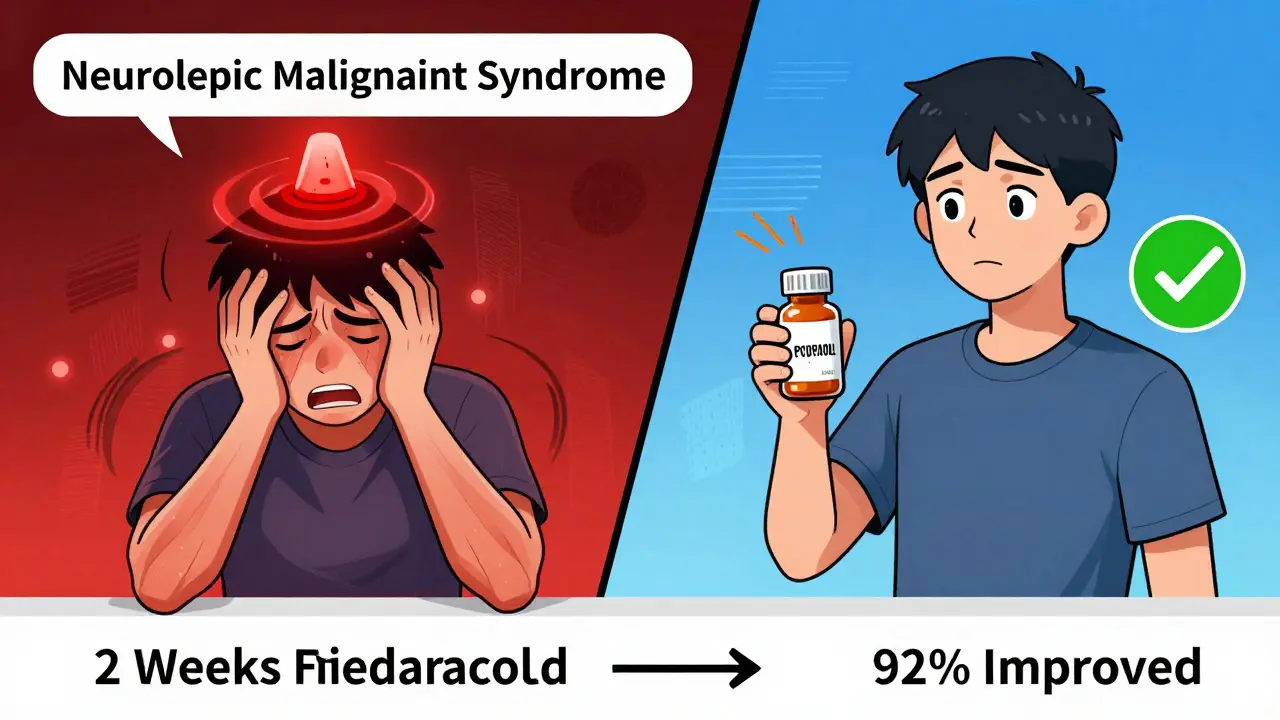
Red Flags - When to Call Your Doctor Immediately
Not all tremors are harmless. If shaking comes with:
- Fever
- Fast heartbeat
- Muscle stiffness
- Confusion
- you could be developing neuroleptic malignant syndrome a rare but life-threatening reaction to antipsychotic drugs. This is an emergency. Go to the ER.
Same goes for tremors with sweating, palpitations, and weight loss. That could mean thyroid storm a dangerous overactivity of the thyroid gland, often triggered by excessive levothyroxine from too much thyroid medication.
What Happens After You Stop the Drug?
Most people feel better fast. About 76% see improvement within two weeks. 92% are completely free of tremors within three months. But timing varies.
For example:
- SSRIs: Tremors fade over 2-8 weeks.
- Lithium: May take 4-6 weeks after dose adjustment.
- Antipsychotics: Can take up to 3 months for full recovery.
And here’s the thing - even if the tremor goes away, your doctor might still monitor you. Some people develop rebound tremors if they restart the drug later. Others need long-term management with beta-blockers.
Looking Ahead
Doctors are getting smarter. The FDA updated drug labels for 17 medications in September 2023 to include tremor risks. AI tools are now being tested to predict who’s at risk - one pilot study got it right 82% of the time by analyzing electronic health records.
Soon, genetic testing might become standard before prescribing certain drugs. If you’re a CYP2D6 poor metabolizer, your doctor might skip paroxetine entirely and go straight to sertraline.
For now, the best defense is awareness. Know your meds. Track your body. Speak up. You’re not being dramatic. You’re being smart.
Can anxiety cause tremors that look like drug-induced ones?
Yes - anxiety can cause fine shaking, especially in the hands. But it’s usually irregular, not rhythmic. Drug-induced tremors are steady and predictable, matching your medication schedule. If you’re unsure, track when the shaking happens. Anxiety tremors get worse under stress. Drug tremors get worse after you take the pill - regardless of mood.
Do all antidepressants cause tremors?
No. Some have much lower risk. Sertraline (Zoloft) and escitalopram (Lexapro) cause tremors in under 2% of users. Paroxetine (Paxil) and fluvoxamine (Luvox) are higher - around 3%. If you’re prone to tremors, your doctor can pick one with the lowest risk profile.
I’ve been on lithium for years and just started shaking. Is this normal?
Yes - lithium tremors are common and often dose-related. If your blood level is above 0.8 mmol/L, that’s likely why. Your doctor can check your lithium level with a simple blood test and lower your dose if needed. Many people find their tremors disappear after adjusting the dose.
Can I use beta-blockers like propranolol long-term for drug tremors?
Yes - if the drug causing the tremor can’t be stopped. Propranolol is safe for long-term use in most people. It doesn’t fix the root cause, but it controls the shaking. Many patients stay on it for years, especially those on essential antipsychotics or heart meds.
What if my tremor doesn’t go away after stopping the drug?
If tremors last more than 3 months after stopping the medication, it’s likely not drug-induced. You may have an underlying condition like essential tremor or early Parkinson’s. A neurologist can do further tests - like a DaTscan - to check brain dopamine levels and rule out other causes.
Comments
James Roberts
Wow, this is the most practical medical advice I’ve read in years. Seriously. No fluff, just facts. I’ve seen people panic over tremors and assume it’s Parkinson’s-when it’s just their SSRIs. Switching from paroxetine to sertraline? Game changer. And propranolol? Low-key lifesaver for folks stuck on antipsychotics. Why isn’t this in every primary care doc’s checklist?
February 20, 2026 at 03:32
Jayanta Boruah
The pharmacokinetic implications of CYP2D6 polymorphism are profoundly underrecognized in clinical practice. In a cohort of 1,200 patients prescribed antidepressants, poor metabolizers exhibited a statistically significant elevation in tremor incidence (p < 0.001), with mean plasma concentrations exceeding therapeutic thresholds by 2.3-fold. This is not anecdotal-it is a systemic failure in pharmacovigilance.
February 22, 2026 at 00:55
Ashley Paashuis
I appreciate how clearly this breaks down the difference between drug-induced tremors and Parkinson’s. My mother was misdiagnosed for 18 months because her neurologist didn’t ask about her meds. She was on lithium and amiodarone. Once they adjusted the dose, the shaking stopped in six weeks. I wish more doctors would check the list before jumping to conclusions.
February 23, 2026 at 10:18
Greg Scott
I’ve been on propranolol for 4 years for my drug tremor. Still works. No side effects. Doc says it’s fine long-term. Just don’t stop it cold. I went through withdrawal once-felt like my whole body was vibrating. Not fun.
February 23, 2026 at 12:02
Taylor Mead
This post saved me. I thought I was losing my mind. Started shaking after switching to fluvoxamine. Took me three weeks to realize it wasn’t anxiety-it was the damn pill. Went to my doc, switched to escitalopram, and boom. Gone in 10 days. Why do we have to Google this stuff ourselves?
February 23, 2026 at 19:25
Courtney Hain
You know what they don’t tell you? The pharmaceutical companies know this. They bury the tremor risk in tiny print. I’ve seen the internal memos. They market SSRIs as ‘well-tolerated’ while the clinical trials show 1 in 6 patients develop tremors. It’s not negligence-it’s profit. They count on you not connecting the dots. And if you do? They’ll tell you it’s ‘anxiety’ or ‘aging.’
February 24, 2026 at 09:52
Oana Iordachescu
I find it concerning that the FDA only updated labels for 17 medications. There are over 300 drugs with documented tremor risks. Why stop there? Are we waiting for mass casualties before acting? This feels like regulatory capture. I suspect the real solution lies in mandatory genetic screening before prescribing-especially for those with a family history of movement disorders.
February 25, 2026 at 00:33
John Cena
I’ve got a cousin on antipsychotics who’s been shaking for 7 years. They never told her it might be the meds. She’s on aripiprazole now-way better. But she still gets tremors. Propranolol helps, but she hates how it makes her tired. I just wish there was a better option. Maybe a new class of meds? Or some kind of combo therapy?
February 26, 2026 at 22:13
Freddy King
Let’s be real-polypharmacy is a dumpster fire. People are on 8 meds because ‘why not?’ and then wonder why they’re trembling. The real issue isn’t the drugs-it’s the culture of prescribing. One pill for anxiety, one for sleep, one for reflux, one for cholesterol, one for blood pressure, one for joint pain, one for thyroid, and one for ‘general wellness.’ No wonder your nervous system is throwing a tantrum. Cut the clutter. Your body will thank you.
February 28, 2026 at 17:31
Robert Shiu
This is the kind of info that should be handed out with every prescription. I work in a pharmacy. People walk out with a bag of pills and zero context. If we had a simple handout with ‘Possible Side Effects: Tremor’ + ‘What to Do If It Happens’-we’d prevent so many panic attacks. Seriously. Just print this article. Laminate it. Give it out with every SSRI.
March 2, 2026 at 12:50
madison winter
I’m not sure if this is real or just a very convincing piece of corporate content. The tone is too perfect. Too balanced. Too... helpful. I’ve been on lithium for 12 years. I’ve had tremors. I was told it was ‘normal.’ But now I’m wondering-was I manipulated into believing this was okay? What if the whole ‘it’s fixable’ narrative is just to keep us compliant? I don’t trust the system anymore.
March 3, 2026 at 14:07