
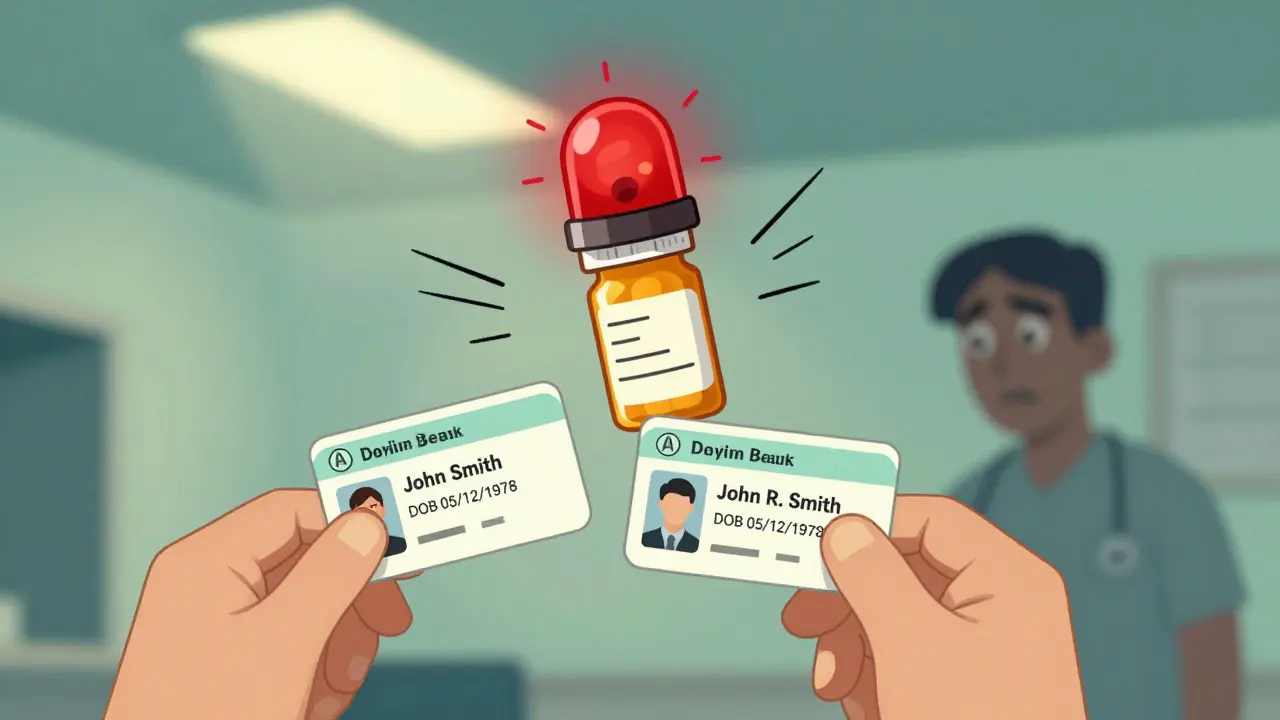
Every year, thousands of patients in the U.S. receive the wrong medication-not because a pharmacist made a careless mistake, but because the system failed to confirm who the patient really was. In pharmacies, where hundreds of prescriptions are filled daily, a simple mix-up between two patients with similar names or birth dates can lead to life-threatening consequences. That’s why using two patient identifiers isn’t just a best practice-it’s a non-negotiable safety rule backed by federal standards, research, and real-world tragedy.
Why Two Identifiers? The Science Behind the Rule
The requirement to use two patient identifiers comes straight from The Joint Commission’s National Patient Safety Goal (NPSG.01.01.01), first introduced in 2003. It wasn’t created in a boardroom-it was born from preventable deaths. One patient was given chemotherapy meant for another. Another received insulin because their record was confused with someone else’s. These weren’t rare cases. They were symptoms of a broken system. The rule is simple: before handing over any medication, you must verify the patient’s identity using two separate pieces of information. Acceptable identifiers include the patient’s full name, date of birth, medical record number, or phone number. What’s not allowed? Room number, bed number, or location. Why? Because those change. A patient might move from Room 205 to 207. Their bed might be reassigned. But their name and birth date? Those stay the same. A 2020 study in JMIR Medical Informatics found that up to 10% of serious drug interaction alerts go undetected simply because systems can’t link a patient’s full history across different visits. That means a patient could be given a drug they’re allergic to-because the pharmacy never saw the allergy listed in their old record. And that’s only possible if the system doesn’t know it’s the same person.Manual Verification: The Flawed Default
Most community pharmacies still rely on verbal confirmation: "Can I have your name and date of birth?" Then the pharmacist checks the label. Sounds easy. But it’s not reliable. Think about it: you’re juggling 15 prescriptions at once. The patient says, "I’m John Smith, born May 12, 1978." You pull up the record. Everything matches. You dispense. But what if the real John Smith is actually John Robert Smith? What if the system has him listed under his middle name? What if another patient, John Smith, was born on May 12, 1977? One digit off. One letter missing. That’s all it takes. A 2023 survey by the American Society of Health-System Pharmacists found that 63% of pharmacists admit to occasionally cutting corners on verification during busy hours. In community settings, 42% said they rarely document the verification process at all. That’s a problem. Because if something goes wrong, and no one recorded that the identifiers were checked, there’s no proof it ever happened. And it’s not just about memory. Human attention fades. A 2020 review in BMJ Quality & Safety found no solid evidence that having two staff members double-check a prescription reduces errors-unless the process is automated. Manual double-checking often becomes a checkbox ritual, not a safety net.Technology That Actually Works: Barcode and Biometrics
The most effective way to prevent these errors isn’t more training. It’s better technology. Barcode scanning at the point of dispensing has been proven to cut medication errors by 75%, according to a 2012 study in the Journal of Patient Safety. Here’s how it works: the pharmacist scans the patient’s wristband (which contains their name and medical record number) and the medication’s barcode. The system checks: Is this the right patient? Is this the right drug? Right dose? Right time? If anything doesn’t match, the system stops the process. No exceptions. Even better? Biometric identification. Systems like Imprivata PatientSecure use palm-vein scanning-something unique to each person, impossible to fake. A 2024 Altera Health survey showed these systems match patients to their records 94% of the time. Compare that to hospitals without such systems, where matches drop to just 17%. That’s not a small improvement. That’s life-saving. One real case from Imprivata tells the story: a man was brought to the ER unconscious. The hospital created a new record because they couldn’t find him in the system. Days later, they discovered he had a full medical history under his middle name-and a documented allergy to a drug he was about to be given. He survived because the system eventually caught it. But he shouldn’t have had to.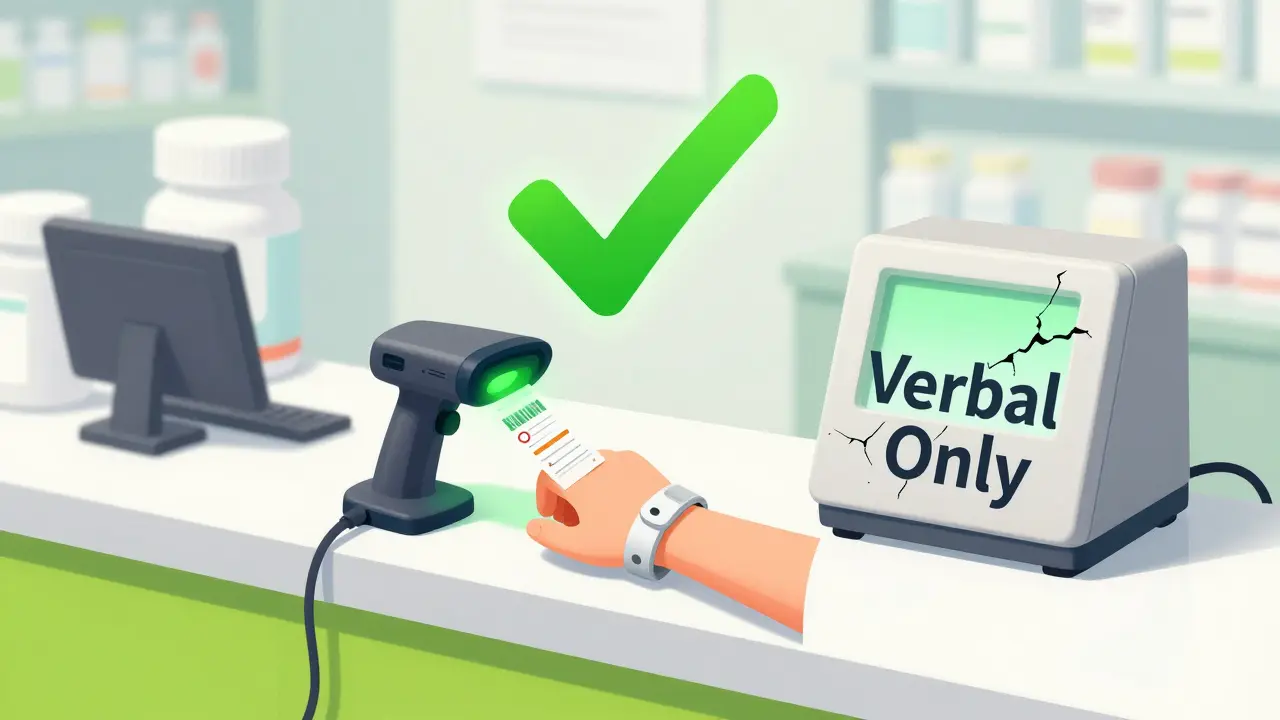
The Hidden Problem: Duplicate Records
Here’s the dirty secret no one talks about: many hospitals and pharmacies don’t even know they have duplicate records. A patient might be registered once as "Sarah Jones, DOB 03/15/1985" and again as "S. Jones, DOB 03/15/1985." Or worse-"Sarah Jones, DOB 03/15/1984." These duplicates are why a patient might get two different blood pressure medications from two different doctors, each unaware of the other’s prescription. A 2023 report from the Office of the National Coordinator for Health IT found that 8-12% of patient records in U.S. healthcare systems contain duplicates. That’s tens of millions of records across the country. And each one is a ticking time bomb. Enterprise Master Patient Index (EMPI) systems are designed to fix this. They act like a central database that links every record of a patient-no matter how they were entered-into one clean profile. But adoption is slow. Only 68% of large health systems use them. Why? Cost. Setting up an EMPI can run $1.2-$1.8 million for a 100-bed hospital. But the alternative? $40 million a year in costs from error correction, duplicate testing, and legal claims.What Happens When You Don’t Follow the Rule
The Joint Commission doesn’t just recommend this rule. They enforce it. In 2023, non-compliance with the two-identifier requirement was the third most common violation in hospital surveys-accounting for 28% of all patient safety goal failures. What does that mean for a pharmacy? Lose accreditation. Lose Medicare and Medicaid reimbursement. Lose the ability to operate. That’s not a threat. That’s the law. And it’s not just hospitals. Community pharmacies are under increasing scrutiny. The 21st Century Cures Act and CMS rules now require accurate patient identification as a foundation for nationwide health data sharing. If your pharmacy can’t prove it’s identifying patients correctly, you’re not just at risk of fines-you’re blocking the entire healthcare system from working efficiently.
How to Get It Right: A Real-World Checklist
If you’re a pharmacist, pharmacy technician, or manager, here’s what actually works:- Always use two identifiers-never one. Never assume.
- Use the same identifiers every time-name and date of birth are the most reliable.
- Scan, don’t just ask-if your pharmacy has barcode wristbands and scanners, use them. Every time.
- Document verification-even if it’s just a checkbox in the system. If it’s not recorded, it didn’t happen.
- Train staff regularly-not once a year. Every six months. Use real near-miss cases as examples.
- Push for EMPI and biometrics-if your system doesn’t have them, advocate for them. The ROI is clear.
What’s Next? The Future of Patient ID
In January 2025, a pilot program launched in five U.S. regions to test a universal patient identifier-a single, unique number tied to each person, like a Social Security number but for health records. It’s controversial. Privacy advocates worry about misuse. But the data is overwhelming: without it, duplicate records and misidentification will keep costing lives. The World Health Organization, the Emergency Care Research Institute, and Harvard Medical School all agree: patient identification is the most basic, most ignored safety step in healthcare. And pharmacies? They’re ground zero. The truth is, no amount of training, posters, or reminders will fix this unless the system is designed to make mistakes impossible. Technology isn’t the enemy. Complacency is.Frequently Asked Questions
What are the two acceptable patient identifiers in a pharmacy?
The two acceptable identifiers are any two pieces of information that uniquely identify the patient, such as full name and date of birth, or name and medical record number. Room number, bed number, or location are not allowed because they can change. The Joint Commission requires that identifiers be person-specific and consistently used across all medication, blood, and specimen handling.
Why is date of birth used instead of address?
Address is not a reliable identifier because patients move, have multiple residences, or may be staying with family temporarily. Date of birth is permanent, unique to the individual, and consistently recorded in medical systems. It’s one of the few identifiers that rarely changes and is less likely to be shared between patients.
Can a pharmacist rely on verbal confirmation alone?
Verbal confirmation is the minimum standard, but it’s not enough. Studies show that relying only on verbal checks leads to errors in 15-20% of cases when staff are rushed. The safest approach combines verbal confirmation with technology-like scanning a barcode on the patient’s wristband or using a biometric scanner-to ensure the system verifies identity independently.
What happens if a pharmacy doesn’t use two identifiers?
Non-compliance can lead to loss of accreditation from The Joint Commission, which means the pharmacy can no longer bill Medicare or Medicaid. It also exposes the pharmacy to lawsuits if a patient is harmed. In 2023, 37% of non-compliant organizations failed audits because they didn’t document verification-even when they claimed they did it.
Do two identifiers prevent all medication errors?
No. Two identifiers prevent errors caused by patient misidentification-like giving the wrong person a drug. But they don’t fix errors like wrong dosage, wrong drug selection, or drug interactions. Those require additional safety layers: clinical decision support, barcode scanning of medications, and pharmacist review. Two identifiers are the foundation-not the entire safety system.
Is there evidence that two identifiers actually reduce deaths?
Yes. A 2012 study in the Journal of Patient Safety found a 75% reduction in medication errors reaching patients after barcode systems were implemented. The ECRI Institute estimates that 6-8% of all serious reportable events in healthcare through 2026 will be due to misidentification unless systems improve. That translates to hundreds of preventable deaths annually. Proper identification is the first line of defense.
Comments
Emma #########
I’ve seen this play out firsthand-my grandma almost got the wrong blood thinner because the pharmacy mixed her up with another Mrs. Johnson. She’s 82, quiet, barely speaks up. They just asked, ‘You’re Mary Johnson, right?’ and moved on. Thank god her daughter caught it before she swallowed it. This isn’t just policy-it’s about people who can’t fight for themselves.
January 19, 2026 at 11:03
Andrew McLarren
It is imperative to underscore that the implementation of dual patient identification protocols is not merely a regulatory formality, but a foundational element of clinical governance. The Joint Commission’s mandate, grounded in empirical evidence of preventable morbidity and mortality, warrants uncompromising adherence. Any deviation constitutes a systemic failure of professional duty, irrespective of workload or operational pressure.
January 21, 2026 at 08:21
Andrew Short
Let’s be real-this whole ‘two identifiers’ thing is just a bureaucratic band-aid. You think scanning a barcode stops errors? Nah. It just gives pharmacists a false sense of security while they still miss drug interactions, wrong doses, and allergies because the EHR is a dumpster fire. And don’t get me started on EMPIs-those are just expensive vanity projects for hospital IT nerds who think they’re saving lives by spending millions on software that still can’t tell if ‘J. Smith’ and ‘John Smith’ are the same person. Wake up.
January 21, 2026 at 14:42
christian Espinola
Two identifiers? That’s the best you’ve got? What about fingerprints? Facial recognition? DNA? No. You’re still using names and DOBs-information that can be stolen, forged, or misheard. And you wonder why healthcare is broken? Because you’re clinging to 1980s tech while the world moved on. The real problem? The government won’t give us a universal ID because they’re scared of ‘privacy.’ But they’re not scared of killing people with misidentified meds. Hypocrisy much?
January 22, 2026 at 00:49
Chuck Dickson
Y’all are overcomplicating this. Just scan the wristband. Say the name. Confirm the DOB. Done. No drama. I’ve trained 30+ techs at my clinic and all it takes is 5 minutes of practice and a little accountability. You don’t need fancy biometrics if you just stop rushing. And yes-document it. Even if it’s just a quick ‘checked’ in the system. It’s not about surveillance-it’s about saying ‘I saw this, I did my job.’ That’s pride. That’s professionalism. And it saves lives.
January 23, 2026 at 07:56
Naomi Keyes
Actually, you missed a critical point: The Joint Commission requires that identifiers be ‘person-specific’-not just ‘commonly used.’ So, ‘full name and date of birth’ is correct, but ‘medical record number’ is only acceptable if it’s unique to the patient across ALL systems-not just within one hospital. Also, ‘phone number’ is explicitly discouraged because it’s not always tied to the patient’s identity in the EMR-many are family members’ numbers. And you must use the exact format as stored in the system: ‘03/15/1985’ not ‘March 15, 1985.’ Otherwise, the system may not match. And don’t forget: if the patient is non-verbal, you must use a photo ID or guardian verification with documentation. This isn’t optional-it’s protocol. And you’re all still getting it wrong.
January 23, 2026 at 16:44
Dayanara Villafuerte
Bro, I work in a pharmacy in L.A. and we just got biometric palm scanners last month. 🤯 First week? 3 people tried to use their mom’s ID. One guy said, ‘But I’m allergic to penicillin!’ and we scanned him-turns out he’s not even in the system. We had to call his doctor. 🤦♀️ Now we scan EVERYONE. Even the grandma who says, ‘I’ve been coming here for 20 years!’ Yeah, well, your record’s under ‘Linda’ not ‘Linda Marie.’ 😅 Tech ain’t perfect, but it beats guessing.
January 25, 2026 at 14:44
Andrew Qu
For anyone thinking this is just paperwork: think of it as your shield. If something goes wrong, and you documented the two identifiers? You’re protected. Not just legally-but morally. You did your part. And if your pharmacy doesn’t have barcode scanning? Ask for it. Politely. Bring the data. Show them the 75% drop in errors. You’re not being a nuisance-you’re being the person who stops someone’s kid from getting the wrong medicine. That’s worth pushing for.
January 26, 2026 at 03:01
kenneth pillet
barcodes work. scan the wristband. scan the med. done. no drama. just do it. why is this hard?
January 26, 2026 at 19:33
Jodi Harding
They call it a ‘safety rule.’ But it’s really a test of whether we care enough to slow down. We don’t need more tech. We need more humility. And fewer pharmacists who treat verification like a speedrun.
January 27, 2026 at 16:29
Danny Gray
So… we’re supposed to trust a system that can’t even tell if ‘Sarah Jones’ and ‘S. Jones’ are the same person… but we’re supposed to believe that scanning a barcode will fix everything? That’s like putting a bandaid on a broken leg and calling it ‘innovation.’ The real issue? Healthcare is a profit-driven mess. They don’t fix identification because fixing it would mean admitting the whole system is built on shaky data. And nobody wants to pay for that truth.
January 29, 2026 at 08:28